
Employee Equity vs. Cash Compensation: What Founders Need to Know
Founders face a recurring question that feels part math puzzle, part dating dilemma: how much equity and how much cash to include in your total compensation package to win great people without harming your runway or your cap table? The offers you craft today will shape culture, pace, and control tomorrow.
In a noisy world of opinions, it helps to take a practical, straight talking approach that blends risk, morale, and taxes. If you already work with startup consulting, you know the broad contours, but the devil lives in the tradeoffs that govern hiring, retention, and investor confidence.
How Equity Compensation Actually Works
Equity is an ownership promise that asks a candidate to trade certainty for potential upside — the foundation of any startup equity plan. Unlike salary, it is volatile in value and slow to realize, which is exactly why it shines when you cannot match big company cash. Equity says two things at once. It says the company wants real alignment. It also says there is not enough cash to pay everyone market rates yet. That double message is fine if you explain it clearly and attach the right mechanics.
Common Equity Instruments
Most early teams use stock options because they are simple to grant, easy to explain, and let employees decide when to exercise. Options can be incentive stock options for employees or nonqualified options for everyone else.
As companies mature, many shift to restricted stock units to reduce exercise headaches and tax surprises. Some teams add purchase plans for broad participation. Choose instruments that match your stage, your valuation discipline, and your appetite for administrative complexity.
Incentive Stock Options (ISOs)
Nonqualified Options (NSOs)
Restricted Stock Units (RSUs)
Vesting, Cliffs, and Refreshers
Standard vesting is four years with a one year cliff, then monthly or quarterly vesting. That schedule rewards commitment and discourages quick exits that bloat the cap table. Refreshers are grants given after one or two years to retain strong performers whose initial options have become more about sunk costs than future gains. Without refreshers, star contributors can drift toward competitors who promise a fresh equity story with a shiny new grant.
How Cash Compensation Fits In
A well-designed cash compensation package is about stability, predictability, and immediate life needs. People pay rent with dollars, not fully diluted percentages. Underpaying for too long moves your team into financial stress, which leaks into quality and speed. Overpaying reduces runway and can lull people into believing the company is safer than it is. Cash choices are never just numbers. They are signals about risk, urgency, and how the company treats day to day reality.
Runway, Burn, and Cash Discipline
A healthy offer considers your runway in months, your burn trend, and your fundraising plan. If your runway is under a year without clear milestones, leaning on equity while keeping salaries modest can be prudent. Once your metrics are credible and your next raise seems likely, lift cash toward market ranges. Tie raises to hitting plan, and state that policy plainly. Consistency builds trust and prevents ad hoc exceptions that breed resentment.
When Higher Salaries Are Wise
Certain roles cannot accept much risk because of family obligations or because the talent market is tight. Security engineers, seasoned finance leaders, and senior recruiters often require closer to market cash. Paying up does not betray your scrappy DNA.
It protects the company from security holes, messy books, and slow hiring that costs more than the extra salary ever will. The trick is to make exceptions explicit so they do not turn into myths about who is valued.
Choosing the Mix
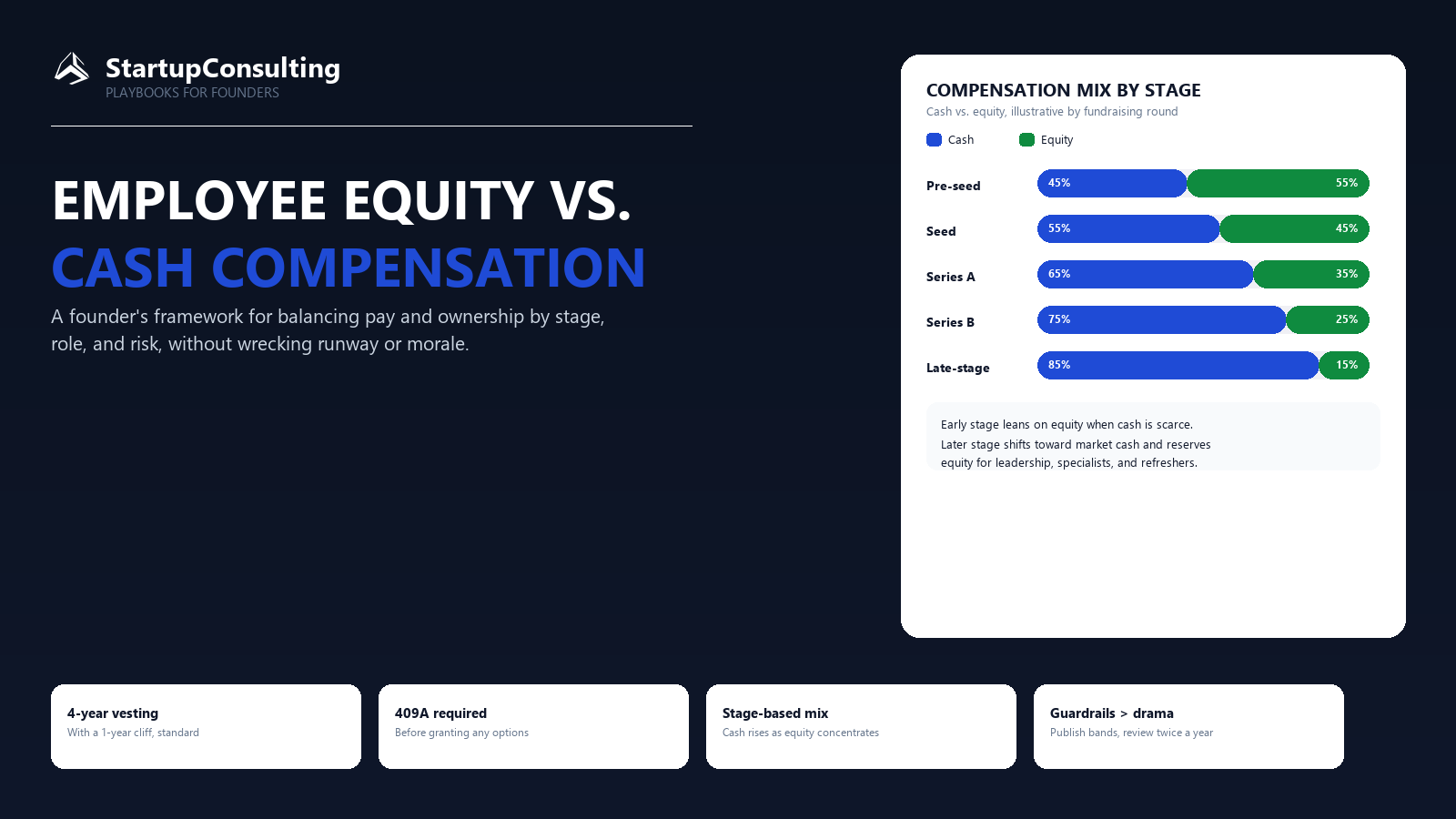
The right equity-to-cash compensation strategy changes with stage, role, and competition. Seed teams often set salaries at lean levels and grant chunky options. Series A and B move salaries toward market medians while keeping meaningful equity for impact hires. Later stages inch up cash and reserve equity primarily for leadership, specialized roles, and refreshers. If a competitor is waving lavish cash, you can counter with influence, scope, and a clean path to promotion.
Stage by Stage Guidance
At idea or pre seed, your leverage is mission and learning. Offers lean toward equity and flexibility. At seed, tighten the story with clear milestones and a 409A valuation so candidates can estimate value.
At Series A, formalize leveling and equity bands so offers feel fair rather than improvised. By Series B, refreshers and promotion paths are the retention engine, and a direct counter to the hidden costs of high turnover that stack up when strong performers drift toward competitors. As you approach late growth, use cash to compete with public companies while keeping equity for those who move the needle.
Signal Effects and Culture
Compensation is a culture amplifier. Heavy equity tells people the future matters more than the present. Heavy cash tells people certainty is prized. Neither is automatically better. The danger is sending mixed signals.
If you brag about extreme ownership while backloading equity for a tiny few, people will notice. If you pay generously in cash but refuse to fund tools, people will notice that too. Align your philosophy and your day to day choices or prepare for eye rolling in one on ones.
Legal, Tax, and Compliance Basics
Comp is thrilling until tax season arrives. The structure of a grant can be the difference between a happy employee and a surprise bill. You do not need to be a tax lawyer, but you should respect the basics and know when to call one. Put someone thoughtful in charge of the plan, and keep documentation tidy enough that future you will want to hug present you.
409A Valuations and Fair Value
Before granting options, get a 409A valuation from a reputable provider. This defends strike prices and protects employees from penalties. Keep it fresh when you raise or hit material milestones. Auditors and acquirers will ask for the paper trail. If you shift to RSUs, coordinate with finance so the accounting reflects fair value at grant and does not create surprises near an audit.
Tax Timing and Withholding
With options, employees decide when to exercise. Early exercise with a proper election can start the capital gains clock, but only if local rules allow. RSUs typically settle on vest and trigger income, which means the company must manage withholding and sometimes sell to cover programs. Explain these realities in plain language long before vesting dates sneak up. Education beats last minute Slack messages full of panic.
Equity mechanics are only half of the tax picture. A founder's own entity choice matters just as much as the option plan: a C-corp founder drawing a salary faces a different payroll and dividend tax exposure than an owner in a pass-through LLC reporting profit straight on a personal return. If that decision is still unsettled, our breakdown of how pass-through and corporate taxation affect founder take-home pay is a useful companion read before you finalize how you pay yourself alongside the team. Once that entity decision is made, the next question is how to split your own take between wages and profit distributions — our guide to salary vs. dividends for founders walks through the payroll-tax math and reasonable-compensation rules involved.
International Hires and Remote Teams
Hiring across borders multiplies complexity. Equity plans may not be recognized or may require local filings. Some countries prefer cash bonuses that track equity value. Remote policies should be explicit about what happens if an employee moves. Surprises lead to resentment. Clarity builds trust and spares your finance team from late night spreadsheet archaeology.
Communication and Negotiation
Compensation conversations can feel tense, but they do not have to. People want to feel respected, informed, and treated like adults. You can deliver that without giving away the store. Prepare explanations, not just numbers, and aim for outcomes that people can describe to a friend without rolling their eyes.
Offer Letters That Educate
Your offer should translate percentage into potential share counts, note current capitalization, and highlight what would happen in plausible exit scenarios. Avoid rosy fairy tales. Provide a simple calculator so candidates can model outcomes at different valuations and dilution levels. Include vesting, cliffs, refreshers, and a concise tax overview with links to clear resources. Clarity makes no one poorer and often makes the yes arrive faster.
Answering the Big Questions
Candidates will ask how you chose the numbers. Share the bands and how the role leveled. They will ask about future grants. Explain your policy and timing. They will ask about dilution. Outline expected pool increases across rounds so no one is shocked when the plan is refreshed. Each clear answer adds trust points that matter more than a few basis points and keeps rumor mills from doing your job for you.
Practical Benchmarks and Guardrails
You do not need magic numbers, but you do need compensation benchmarking and guardrails so every offer does not become a bespoke art project. Guardrails keep the cap table healthy, prevent inequities, and reduce backchannel drama. Publish them internally, revisit them twice a year, and hold the line unless something truly exceptional appears.
Executive Bands
Executive compensation often commands meaningful equity, but grants should reflect stage and risk. Early leaders may hold low single digits that shrink with each round. Later hires get smaller slices because the risk has dropped. Tie refreshers and bonuses to durable results, not short term heroics. That keeps incentives aligned and limits entitlement, which can grow faster than your monthly active users if left unchecked.
Individual Contributors and Rising Stars
For engineers, designers, and product managers, set bands by level with overlap that rewards unusually strong candidates without breaking consistency. For rising stars, reserve a promotion pathway with a defined equity bump. Meeting expectations should feel fair. Exceeding them should feel exciting. Keep your philosophy documented so managers can make offers without reinventing the wheel every Friday at 5 p.m.
| Guardrail Area | Default Policy | Why It Matters | Common Failure Mode |
|---|---|---|---|
|
Offer Bands by Level
Define cash + equity ranges per level with small overlap for exceptional hires.
|
Keep a simple ladder: level → salary band → equity band → approved exceptions list.
LevelingBandsDocumented exceptions
|
Prevents “every offer is a bespoke art project” and reduces perceived unfairness. | Managers improvising offers → internal inequity → backchannel drama. |
|
Approval Thresholds
Set clear sign-off rules for out-of-band compensation.
|
If an offer is outside the band, require written justification + designated approver (e.g., CEO/Head of People/Finance).
Sign-offAudit trailConsistency
|
Keeps exceptions rare, explicit, and defensible to candidates and the team. | Quiet exceptions that turn into myths about who is valued. |
|
Executive Bands
Equity should reflect stage and risk.
|
Tie executive equity, refreshers, and bonuses to durable outcomes (not short-term heroics).
Stage-adjusted equityOutcome-based incentives
|
Prevents entitlement and ensures leaders optimize for long-term company health. | Over-granting early or rewarding flashy wins that don’t compound. |
|
IC Bands & “Rising Stars” Path
Bands per level + a clear promotion bump.
|
Publish an equity bump for promotion and a retention path for top performers.
Promotion bumpCareer clarityRetention
|
Meeting expectations feels fair; exceeding them feels exciting (and reduces attrition). | High performers drift because the initial grant becomes “sunk cost” equity. |
|
Refreshers & Retention
A predictable refresher policy for strong performers.
|
Define timing and criteria (e.g., after a set period, at promotion, or when role scope expands).
CriteriaTimingPerformance linkage
|
Keeps equity meaningful over time and reduces “leave for a fresh grant” behavior. | Inconsistent refreshers that feel political rather than principled. |
|
Cap Table Protection
Treat equity like a budget.
|
Track equity usage against a hiring plan and revisit allocations on a set cadence.
Option pool budgetingForecastingTwice-yearly review
|
Avoids surprise dilution events and helps fundraising diligence go smoothly. | Granting without tracking → sudden pool top-ups at the worst time. |
|
Communication Standard
Make offers explainable.
|
Provide a plain-language offer explanation: bands, vesting, cliffs, and how equity works in practice.
Plain languageVesting clarityNo surprises
|
Reduces negotiation friction and prevents confusion that later becomes resentment. | Candidates (and employees) guessing what equity means, then feeling misled later. |
Preparing for Fundraising and Liquidity
Compensation intersects with fundraising in obvious and subtle ways. Investors look at burn, headcount plan, and equity pool strategy to judge discipline. Acquirers look at vesting schedules, outstanding options, and the health of plan administration. The cleaner your plan, the easier diligence feels, and the less time you spend hunting for signatures.
Pool Planning and Board Dynamics
Enter each round with a clear ask for the option pool. Explain how many hires it supports by level and for how long. If you under ask, you may face a sudden top up that dilutes everyone at a worse moment. If you over ask, you signal fuzzy planning. Share the logic with the board and treat pool sizing like any other forecast, not a mysterious ritual.
Secondary Sales and Morale
As companies mature, limited secondary sales can relieve pressure without distorting incentives. Keep them small, tie eligibility to tenure and performance, and explain the rules early. Surprises breed rumors. Clear policies build loyalty during the long march to liquidity and keep people focused on building rather than speculating in the kitchen line.
Conclusion
Equity and cash are not rivals. They are ingredients of a single talent acquisition and employee retention strategy that you mix to reflect risk, stage, and the truth about your business. Use equity to align and inspire. Use cash to create stability and speed. Explain the tradeoffs, set guardrails, and keep the paperwork clean enough that your future self will applaud your past self. When in doubt, choose clarity, consistency, and a plan you can defend in front of candidates, investors, and your own team.
Put this into practice with AI
This article is for general information only and is not legal, tax, accounting, HR, or investment advice. Consult a qualified professional for your specific situation.
Related reading
 HR
HRThe Complete HR Compliance Checklist for New Companies
A complete HR compliance checklist for startups, covering hiring, payroll, policies, and legal essentials to keep your new company compliant.
Read article HR
HROutsourcing HR for Startups: What It Costs and When It Makes Sense
Learn when HR outsourcing makes sense for startups, what it costs, and how the right partner streamlines hiring, compliance, and daily operations.
Read article HR
HRBuilding Your First HR Department: A Step-by-Step Guide for Startups
A practical, founder-friendly guide to building your first HR department, clear steps, smart systems, and culture that scales with your startup.
Read article