
How to Create Scalable Hiring Processes Without HR Overhead
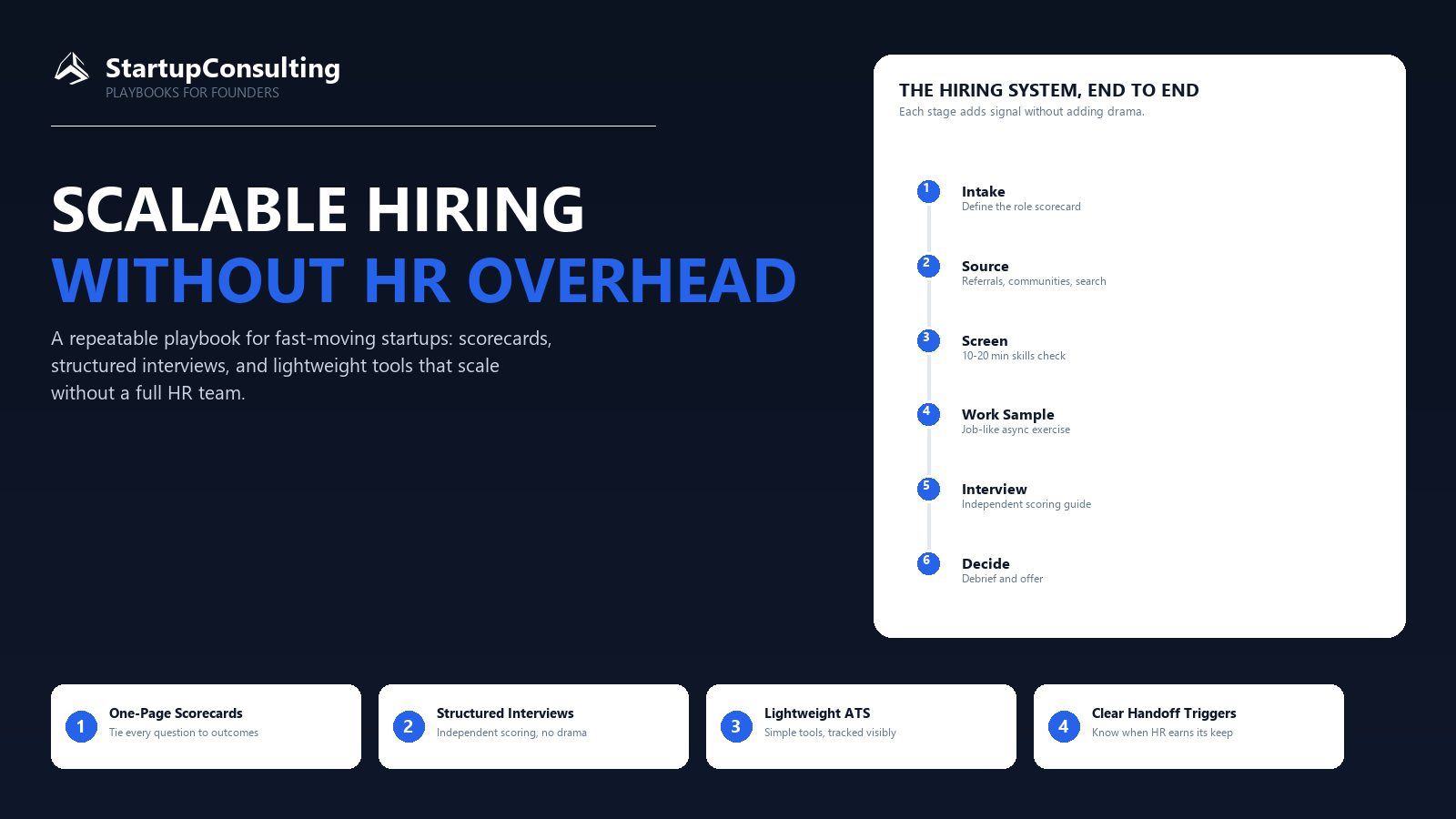
Hiring at a small, fast company can feel like juggling torches on a unicycle while someone keeps handing you cats. The goal is speed without turning your calendar into a full time HR schedule, the outcome any founder wants from a scalable hiring process. In startup consulting, this tension appears daily because headcount needs pop up before anyone can build departments.
The fix is not a policy brick. The fix is a compact system that is clear, repeatable, and kind to candidates. Use the steps below to build a process that scales with your product, respects people, and keeps your sanity intact, using a recruiting workflow any hiring manager can run without you in the room.
Define What Scalable Hiring Really Means
Before tools and templates, settle on a true north. Scalable hiring means that each additional open role creates minimal extra strain, that quality does not degrade when volume rises, and that decisions are consistent across interviewers and time.
It also means that new people join with clarity about expectations, communication norms, and success metrics. It shows up first in hiring funnel metrics: pass-through rates that hold steady even as application volume climbs. You want a process that is light on drama and heavy on predictability, the kind that keeps calendars under control and lets everyone return to shipping.
Why Overhead Creeps In
Overhead sneaks in when the hiring motion is rebuilt from scratch for every role. People improvise, meetings multiply, and interview questions wander into pleasant small talk instead of predictive signals. Scalable hiring avoids this pattern by standardizing where standardization helps, then leaving space for role specific nuance.
Design The System Architecture
Treat hiring like a small product. You will need simple, documented flows for intake, sourcing, screening, interviewing, decision, and onboarding. Together, these flows make up your recruiting workflow, the backbone of a startup hiring process that does not require a dedicated in-house HR team to run, though outsourced HR support can still backstop the trickier edge cases. Each flow should be short enough to read in five minutes.
Role Scorecards That Fit on One Page
Create a one page scorecard for every role, no exceptions. List the mission, three to five outcomes for the first six months, and the core competencies that predict those outcomes. Tie interview questions directly to each competency. If a question does not map to the scorecard, remove it without guilt. A tight hiring scorecard like this is also what protects quality of hire once volume increases and more people are involved in decisions.
Sourcing That Does Not Eat Your Week
Sourcing is where burnout lurks. Write a crisp role pitch and reuse it with minor tweaks. Collect a handful of go to channels, like employee referrals, relevant communities, and a targeted search list. Book one recurring block per week to send outreach, then move on.
An Application Flow People Actually Finish
Applicants will abandon long forms. Ask only for what you read, keep it under ten minutes, and send a quick automated reply that sets expectations. If you promise a response within five business days, meet it. Speed itself communicates respect.
Build Assessment That Scales With Volume
Assessment should tell you whether a person can do the work, will do the work, and will work well with the team. Done well, this also protects candidate experience, since people move through a process that feels intentional instead of improvised. You do not need gimmicks, just reliable signals that scale.
Light, Predictive Screens
Start with a short skills screen. Ten to twenty minutes is enough. Target the core of the job, such as diagnosing a bug, outlining a sales discovery call, or drafting a marketing experiment. If the work requires writing, then read something they write. If the work requires numbers, then ask for numbers. Avoid puzzles that reward cleverness over relevance.
Work Samples That Mirror the Job
Use work samples that feel like a slice of real work rather than a weekend project. Time box the exercise and tell candidates the expected duration so they do not guess. Review samples asynchronously using the rubric, record scores, and move the top candidates forward.
Structured Interviews That Respect the Calendar
Run structured interviews with a shared guide. Each interviewer owns a topic, asks the same questions to each candidate, and scores independently before the debrief. Keep interviews to thirty to forty five minutes. You are looking for data, not a life story.
Keep Tools Lightweight and Boring
Fancy software will not fix a wobbly process. Start simple and upgrade only when pain is real.
A Minimal ATS You Can Grow Out Of
Use a lightweight applicant tracking system, even a spreadsheet at first, as long as it is reliable and visible. Track candidate stage, owner, next action, and notes. Add templates for outreach, scheduling, and rejection.
Templates That Save You From Rewriting
Write templates for each common message. Outreach, stage advancement, polite rejection, and offer. Keep them friendly and tight. Personalize with one sentence that shows you actually read the resume or portfolio.
Lean On Async Wherever Possible
Asynchronous workflows scale better than endless meetings. Use recorded screen shares to walk through assignments or to explain the product. Share a single FAQ that answers the recurring questions. Reserve live time for high signal conversations or final alignment.
Governance Without the Red Tape
You can protect quality without turning the company into a policy museum. Think of governance as guardrails for judgment. This is where recruiting operations and hiring compliance quietly live, even inside a lean, founder-led hiring process — the same ground a proper HR compliance checklist covers once you are hiring past the first few roles.
Decision Rights That Avoid Too Many Cooks
Appoint a hiring manager for each role, clearly state who gives input, and define who decides. Input is optional, decision is not.
Calibration That Keeps Standards High
Run short calibration sessions with interviewers every few weeks. Compare notes from recent candidates, examine where scores diverged, and refine the rubric or the questions. Calibration prevents drift, the quiet enemy of quality.
Mind the Human Experience
Candidates talk, and reputation compounds. Treat people well even when the answer is no.
Communication That Feels Human
Send status updates at each stage. Avoid ghosting. If a candidate invested serious time, offer a brief call for feedback.
Interviews That Reduce Anxiety
Tell candidates the plan for each conversation. Share who they will meet, the topics, and the time limit. Anxiety wastes signal, and your goal is signal. A bit of transparency raises performance on both sides of the call.
Measure What Matters and Tune the System
Pick a few metrics, review them on a cadence, and make small adjustments. Time to hire, pass-through rate, and quality of hire are the three worth tracking first. Pick metrics you can explain quickly to a smart friend between meetings over coffee.
Funnel Health You Can Explain to a Stranger
Track pass through rates at each stage. If the skills screen rejects ninety percent, your sourcing or pitch is off. If late stage declines spike, your offers or timelines need work.
Time, Cost, and Quality In Balance
Time to accept should trend down as the system matures. Cost per hire should be explicit, including your own hours. Quality shows up as time to productivity and manager satisfaction at ninety days.
Continuous Improvement Without Drama
Resist the urge to overhaul the whole process at once. Adjust one variable at a time, like question sets or sourcing channels, then measure again.
When to Introduce Dedicated HR
Eventually, the ceiling arrives. The trick is to see it coming.
Clear Triggers for the Hand Off
Consider adding dedicated HR support when interviewers spend more than twenty percent of their week on hiring, when the pipeline spans more than twenty active roles, or when compliance tasks begin to crowd out product work. Those are signals that coordination cost is about to spike. The same buy-versus-build math shows up on the marketing side of the business, where founders weigh the same tradeoffs before bringing in a fractional CMO instead of a full-time hire.
How to Hand Off Without Losing Your Soul
When you bring in HR expertise, hand them a clear process, a clean pipeline, and evidence of what has worked. Keep decision rights with hiring managers, invite HR to tighten operations, improve compliance, and coach interviewers. You want leverage, not a power struggle.
Conclusion
You do not need a large HR team to hire well at scale. You need a compact playbook, a few reliable tools, and the discipline to use them the same way each week. Clarity beats charisma, documentation beats memory, and consistency beats heroics.
Build the core, review it on a cadence, and keep sharpening the parts that earn their keep. When the day arrives that you genuinely need specialized help, you will hand over a working system rather than a tangle of ad hoc rituals. That is how lean teams grow up without growing slow.
Put this into practice with AI
This article is for general information only and is not legal, tax, accounting, HR, or investment advice. Consult a qualified professional for your specific situation.
Related reading
 HR
HRThe Complete HR Compliance Checklist for New Companies
A complete HR compliance checklist for startups, covering hiring, payroll, policies, and legal essentials to keep your new company compliant.
Read article HR
HROutsourcing HR for Startups: What It Costs and When It Makes Sense
Learn when HR outsourcing makes sense for startups, what it costs, and how the right partner streamlines hiring, compliance, and daily operations.
Read article HR
HRBuilding Your First HR Department: A Step-by-Step Guide for Startups
A practical, founder-friendly guide to building your first HR department, clear steps, smart systems, and culture that scales with your startup.
Read article