
Employment Law Basics Every Startup Must Understand
Launching a startup feels a lot like assembling a jet while it is already taxiing down the runway. Between pitching to investors, wooing customers, and debugging code at 3 a.m., it is tempting to treat employment law as tomorrow’s problem. Resist that urge. One sloppy hire or missed pay stub can flatten your budget faster than any burn rate.
The good news is that the core rules are knowable, even without a law degree or an expensive retainer. This guide, written for founders who would rather ship product than flip through statutes, breaks down the essentials in plain English. Think of it as your field guide to employment law for startups — the startup employment law basics every founder should understand before the first offer letter goes out. As your unofficial Startup Consulting buddy, let’s keep you compliant and your team happy.
Know Your Hiring Categories
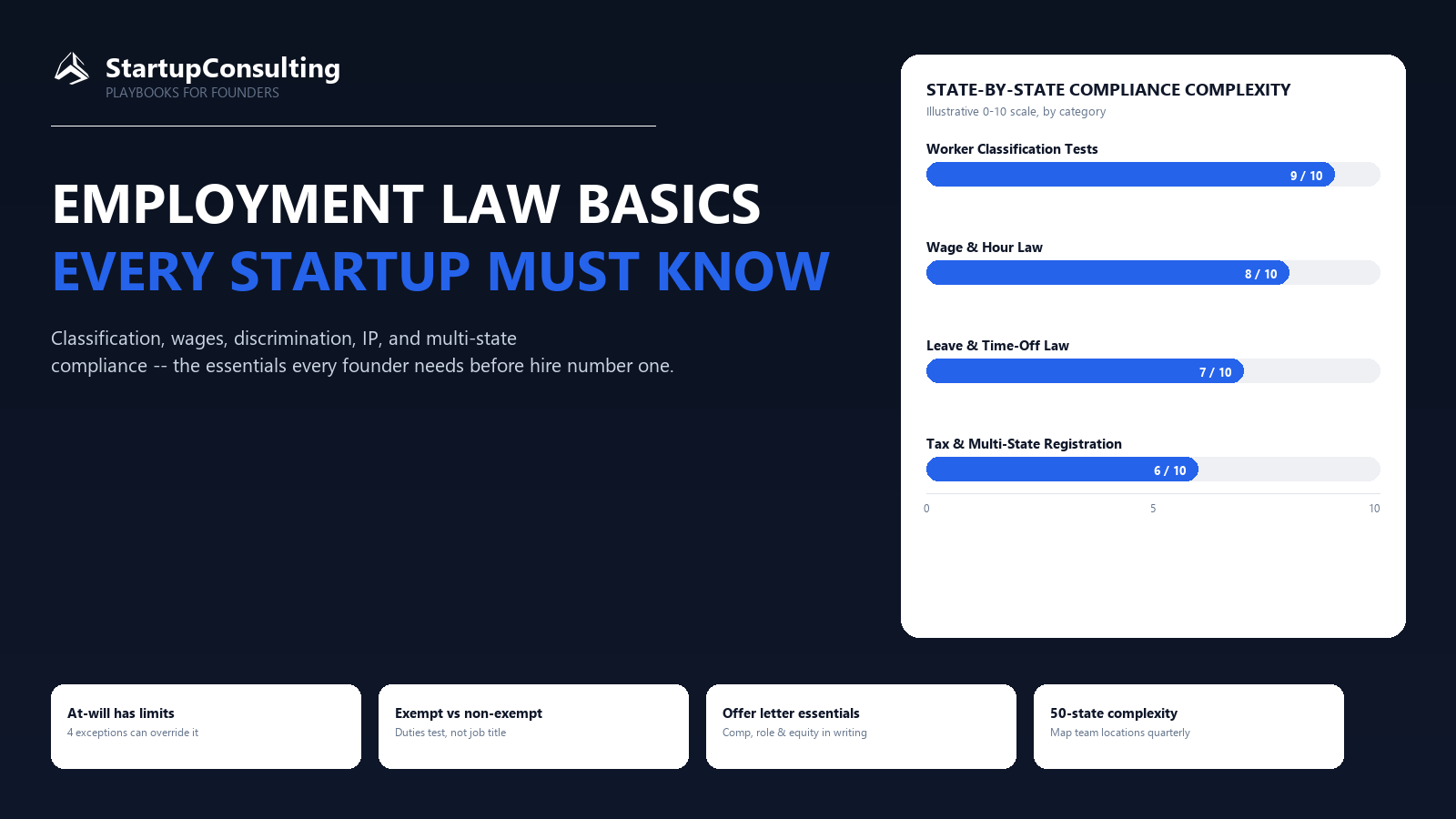
Every employment obligation flows from how the worker is classified. Mixing up categories is like swapping ingredients halfway through a cake recipe; the result is messy, expensive, and oddly shaped. Get this step right — including exempt vs non-exempt classification and independent contractor misclassification risk — and most later tasks snap neatly into place.
Employees Versus Independent Contractors
Federal and state agencies love to peek behind your glossy contractor agreements to see whether the person actually behaves like an employee. If you control their schedule, tools, and workflow, chances are they belong on payroll with taxes withheld, not on a 1099. Misclassification fees arrive with interest and zero sympathy.
Exempt Versus Non Exempt
Not every hoodie-clad software engineer qualifies for overtime exemption. The test looks at salary basis, pay threshold, and the actual duties performed. Mix in even one duty that falls outside the executive, administrative, or professional boxes and you owe time-and-a-half for the late-night sprint.
| Hiring Category | What It Means | Why It Matters |
|---|---|---|
|
Employees vs. Independent Contractors
Classification drives payroll rules
|
The company must determine whether the worker is truly operating independently or whether the business controls the person’s schedule, tools, duties, and workflow strongly enough that the person functions like an employee. | This affects tax withholding, payroll setup, benefits eligibility, insurance, and legal exposure. Misclassifying someone as a contractor when they function like an employee can trigger back taxes, penalties, and wage claims. |
|
Exempt vs. Non-Exempt
Overtime rules depend on this
|
Once someone is treated as an employee, the next question is whether the role is exempt from overtime based on salary basis, salary level, and the actual job duties performed. | Getting this wrong can create overtime liability quickly, especially in startups where late nights and weekend work are common. Titles alone do not decide exemption status; duties and pay structure do. |
Founders And Officers Are Employees Too
It is easy to assume employment law only applies to your first outside hire, but founders and officers who draw a salary, hold a defined title, and receive equity are employees in the eyes of most state agencies. Put founder compensation, vesting schedules, and role boundaries in writing just as you would offer letter essentials for employee number one. Vague ownership of duties among co-founders is one of the fastest ways to create friction that can stall a company long before any regulator gets involved — see our guide on avoiding founder disputes for a framework on keeping roles, compensation, and decision rights clear from day one.
Pay The People Right
Cash may be king, but wage rules are the court ledger. Regulators do not care that your startup runs lean; they expect each paycheck to reflect the law down to the last decimal. Errors trigger penalties that compound faster than venture interest.
Minimum Wage And Beyond
Avoid the trap of assuming federal rates set the floor everywhere. Cities like San Francisco shrug at Washington’s numbers and impose their own. Audit your remote team’s locations quarterly so that a far-flung customer support rep does not cost you a surprise back-pay bill.
Overtime Rules For Hustling Teams
Startup mythology celebrates eighty-hour weeks, yet wage law pays overtime after forty. Track hours even for salaried non-exempt staff, and bake the cost into budgets rather than praying nobody files a complaint. Digital time-tracking apps beat sticky notes every single review.
Pay Frequency And Record Keeping
Choose a regular pay calendar and stick to it. Skipping paydays to wait for that overdue invoice breaks wage laws and erodes morale faster than stale pizza. Keep records for at least three years, because state auditors relish asking for pay stubs from employees you barely remember hiring.
Protect Their Space And Safety
Culture is not just ping-pong tables. It is the daily grind of keeping bias, harassment, and injuries out of the building. Investors notice whether you take these duties seriously. Skimp here and you will pay in reputational damage long after any settlement is signed.
These same compliance habits resurface the moment you raise capital. Due diligence checklists in a priced round routinely pull offer letters, contractor agreements, and I-9 files, and unresolved wage and hour compliance gaps or independent contractor misclassification issues can chip away at your valuation or slow down closing. Clean employment records make for a faster, less painful negotiation once you sit down to review an investor-ready term sheet.
Anti Discrimination Essentials
Interview questions about marital status or a candidate’s accent may feel like small talk, yet they hand plaintiffs a gift-wrapped exhibit. Train every hiring manager on protected classes, then enforce a rule that the job description, not gut feel, makes decisions. Written anti-discrimination policies only earn their keep when hiring, promotion, and termination calls actually follow them in practice.
Harassment Prevention Culture
The law requires a policy, but people remember actions. Publish a clear complaint channel, promise zero retaliation, and follow through even if the accused is your co-founder. Ignoring a slack DM today can evolve into a seven-figure verdict next year.
Leave Entitlements Without Headaches
From sick leave to parental bonding time, various statutes — including FMLA leave policies at the federal level and their state-law counterparts — grant days off whether your roadmap likes it or not. Create a shared calendar for tracking, set up payroll codes, and resist the temptation to demand medical details you are not entitled to have.
Guard The Company’s Brain
Great ideas leak faster than coffee through a cheap filter. Shore up intellectual property before your first engineer pushes code to GitHub. Otherwise a disgruntled employee could walk and recreate the product at a rival demo day.
Confidential Information Controls
Non-disclosure agreements help, but only if labeled files, restricted permissions, and need-to-know habits back them up. Document these rules as part of your employee handbook requirements, review access quarterly, lock laptops whenever desks are empty, and remember: simple stickers that scream Confidential can deter curiosity.
Intellectual Property Ownership
A standard work-made-for-hire clause assigns code, designs, and content to the company, but the contract must be signed before the work starts. If Betty the freelancer creates your logo without such language, Betty owns it, not you. Fix paperwork before launch day, not during a funding round.
Post Employment Restrictions
Non-compete rules are tightening nationwide, yet narrow, reasonable agreements can still protect trade secrets. Focus on client lists and source code, keep the radius small, and offer something valuable in exchange, such as severance or extended option exercise windows. Enforceability swings so widely by state that this is exactly the kind of complex employment-law situation where hiring a startup attorney instead of relying on a generic template keeps you from drafting a restriction a court will simply refuse to enforce.
Part Ways The Smart Way
Even the happiest teams eventually split. Exits handled poorly spark lawsuits and unflattering Glassdoor reviews. Your brand story should end with a handshake, not a subpoena. Planning the farewell from day one makes leaving feel organized, not chaotic.
At-Will Employment And Its Exceptions
Most startup employment law begins from a simple default: in nearly every state, employment is at-will employment, meaning either side can end the relationship at any time, for any lawful reason, without advance notice. Founders lean on this rule constantly, but at-will status is riddled with exceptions that regulators and plaintiffs’ attorneys know well. Implied contracts buried in handbook language, public-policy protections for whistleblowers and jury duty, and every anti-discrimination law on the books can each override the at-will presumption before a termination ever reaches a courtroom.
Progressive Discipline To Avoid Drama
Document expectations, coach in writing, and give employees a chance to correct mistakes. A surprise termination memo triggers emotional whiplash, while a paper trail showing clear warnings stands up in court and calms investors who review your data room.
Final Paychecks And Paperwork
States set strict deadlines for final wages, accrued vacation, and benefits notices. Queue those documents before the goodbye lunch so no one waits for money you legally owe. Hand over a polite separation letter that reminds them of confidentiality while wishing them luck.
Stay Ahead Of Government Filings
Paper forms may feel prehistoric, yet agencies judge your sophistication by the neatness of your files. Build a digital vault that stores everything from I-9s to injury logs and back it up as carefully as source code. Annual reviews of the vault reveal gaps before inspectors do.
Posters And Policies On The Wall
Yes, the break room needs those colorful federal and state posters. Download updates every January, laminate them, and snap a photo as proof of posting. Similarly, handbooks must match the law of each state where employees sit, not just the one on your lease. Ignoring a poster fine is like donating to the Department of Labor with no tax deduction.
Immigration Compliance Basics
Form I-9 seems straightforward until you misplace the verification deadlines. Set calendar alerts for day three, day ninety, and re-verification dates. Keep documents in a separate file from personnel records, and never joke about visa status; auditors have limited humor receptors. Small errors morph into penalties that could cover a new espresso machine for every agent in the field.
Remote Work And Multi State Registrations
The pandemic scattered talent across zip codes like confetti. Each location may trigger business registration, workers’ compensation insurance, and state tax withholding. Map your team’s addresses quarterly, then consult counsel about threshold rules before the first cease-and-desist letter arrives. Setting up payroll in every state is annoying, yet cheaper than debating jurisdiction in front of a judge.
Conclusion
Employment law may not sparkle like product launches or investor decks, but it is the scaffolding that keeps your startup standing tall. Master these startup employment law basics, update them as your headcount and geography shift, and you will spend fewer nights worrying about surprise audits and more time building the next big thing.
Put this into practice with AI
This article is for general information only and is not legal, tax, accounting, HR, or investment advice. Consult a qualified professional for your specific situation.
Related reading
 Legal
LegalWhen to Hire a Startup Attorney vs. Use Online Legal Templates
Decide when to hire a startup attorney vs use legal templates, balancing cost, risk, speed, and growth without risking investors, equity, or IP.
Read article Legal
LegalHow to Ensure Your Startup Is Legally Ready for VC Due Diligence
A practical, witty checklist to get your startup legally ready for VC due diligence, from cap tables and IP to compliance and data rooms investors trust.
Read article Legal
LegalAvoiding Founder Disputes: Legal Best Practices for Early Teams
Learn legal best practices to prevent founder disputes, align roles, equity, and decisions, protect IP, and keep early teams focused and drama free.
Read article