
How to Protect Your Startup’s Intellectual Property from Day One
Launching a startup feels like strapping a rocket to a skateboard: thrilling and slightly reckless. One bolt you must tighten early is intellectual property. From source code to the quirky avocado mascot you doodled at 2 a.m., every original element can become an asset or a lawsuit. Investors and future competitors judge how tightly you lock ideas. This guide mixes practical wisdom from the trenches of Startup Consulting with a splash of humor so the legal jargon goes down easy.
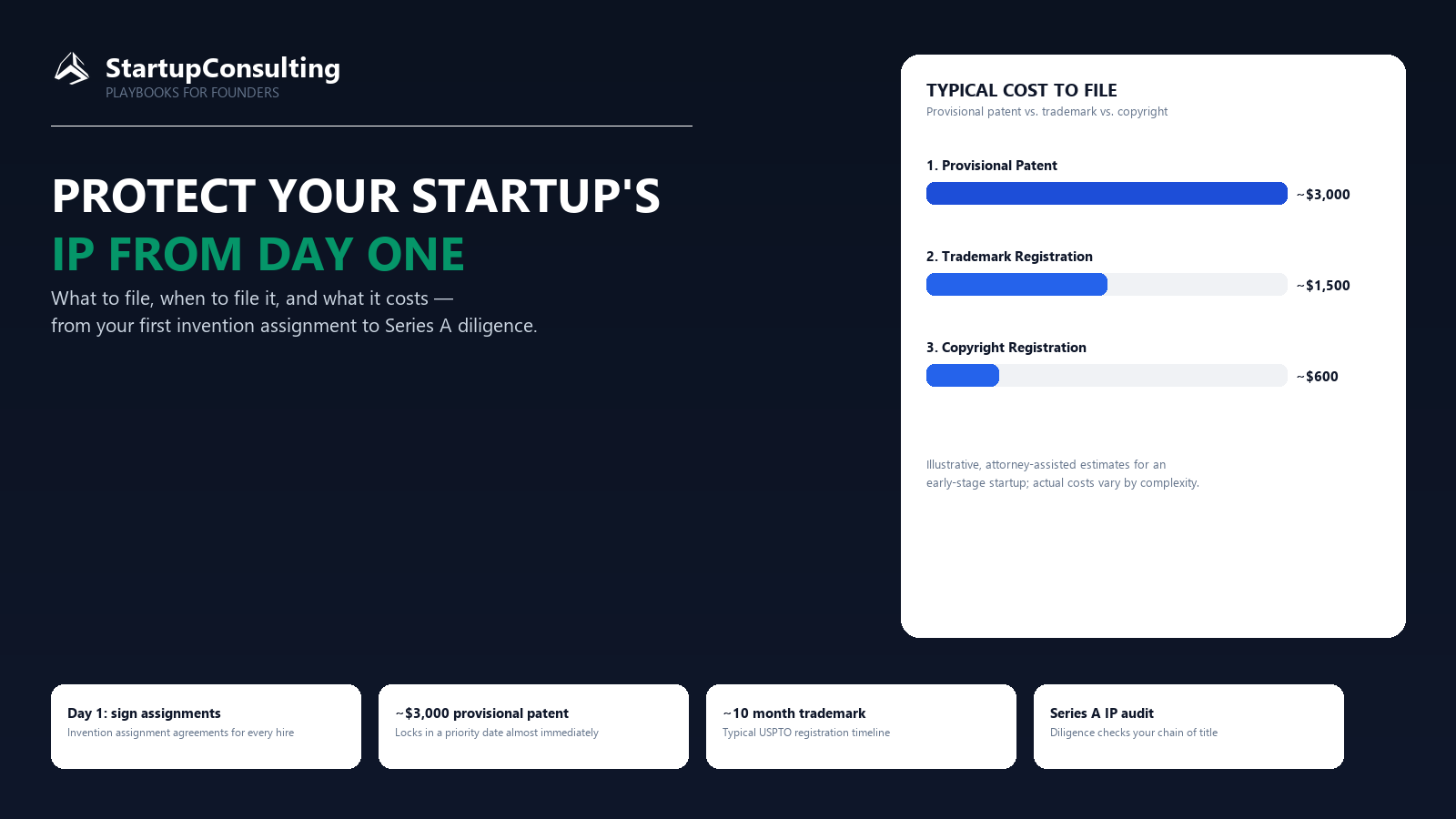
Before wading into the details, it helps to see the whole arc at once. IP protection for a startup is not a single filing you check off and forget; it is a sequence of small, timely moves that starts on day one and keeps paying off all the way through your first priced round.
Identify Your IP Assets
Before you can shield anything, you need to know what you actually own. Intellectual property comes in more flavors than a midnight ramen menu, so start by mapping every creative spark, line of code, and brand element your team produces.
Ideas Versus Expressions
Ideas themselves are free as birds, but the moment you pin them down in writing, graphics, or prototypes, the law starts paying attention. Teach your crew the difference right away. A concept for an AI-powered cat feeder is not protectable until you sketch out the mechanism, write the algorithm, or at least record a voice memo detailing the design. Encouraging thorough documentation turns nebulous thoughts into assets your lawyer can swing like a lightsaber in negotiations.
Patentability Litmus Tests
Not every quirky invention deserves a patent application. Run quick filters: Is it novel, useful, and non-obvious to someone in the field? If the answer is a confident yes, book a patent attorney before posting that prototype GIF on social media. Skipping this step invites copycats who screenshot your brilliance, sprint to the patent office, and toast with your potential investors while you stare at your notification icon in disbelief.
Choose the Right Legal Shield
Once you know what needs guarding, pick the correct shield. Legal tools come in different shapes, each blocking a specific kind of threat. Matching your asset with the wrong weapon is like wearing oven mitts in a sword fight.
Do not overlook the shield that never expires as long as you keep the secret: a trade secret. Pricing algorithms, supplier lists, and proprietary manufacturing steps can stay protected indefinitely, but only if you enforce genuine confidentiality controls, because one careless Slack message can destroy that protection forever. Most of this IP, trade secrets included, ultimately sits on the balance sheet of the operating entity itself, and for many startups that is a Delaware C-corporation, which comes with its own franchise tax obligations worth budgeting for well before the annual report deadline sneaks up on you.
Copyrights Are Cheap Insurance
Code, blog posts, video tutorials, and pitch decks gain automatic copyright the moment they are fixed, but registration turbocharges enforcement. For a modest fee you get statutory damages and a big stick to wave in court. Schedule a quarterly copyright filing party, complete with pizza, playlists, and friendly competition to see who submits the fastest form. Your future self will thank you during that inevitable takedown battle on a sleepy Friday night.
Patents Buy You Breathing Room
Early stage patents are pricey, yet they can grant up to twenty years of breathing room. File provisional applications with the USPTO to lock in a priority date while you refine the tech and woo investors. Treat the provisional like a save game slot; you can iterate safely, knowing competitors must start from level zero. Remember to convert within twelve months or that slot self-destructs like a spy gadget without any dramatic warning.
Patents are not the only registration clock worth watching. Trademark registration through the USPTO typically takes far longer than filing a provisional patent, while copyright registration usually lands somewhere in between. All three, however, cost far less than discovering mid-acquisition that nobody actually filed anything. The comparison below lays out typical costs and timeframes so you can plan and budget realistically.
Build IP Into Everyday Operations
Paper shields are pointless if your day to day habits leak secrets faster than a colander. Bake IP hygiene into workflows so protection becomes a reflex, not a quarterly panic attack triggered by due diligence—and extra napkins for inevitable brain spills.
Use Confidentiality Agreements
Every contractor, intern, and barista who sees test builds should sign a confidentiality agreement before the first latte cools. Templates are fine, but keep them updated and file them where humans can find them. Nothing derails acquisition talks faster than a missing document proving the summer intern does not own half the codebase.
Document Everything Like a Mythbuster
When a feature ship date is racing toward you, documentation feels like wearing ankle weights in a sprint. Do it anyway. Use version-control comments, design journals, and photo logs to create a trail of invention. If a dispute arises, timestamps and commit hashes are the courtroom equivalent of video evidence featuring confetti, a marching band, and your signature victory dance, all captured in glorious 4K for the jury's enjoyment.
Clean Ownership Chains
Employees who build on nights and weekends often blend personal and company gear like smoothie ingredients. Use invention-assignment clauses that funnel all related IP to the company, while carving out space for side projects. Clear boundaries prevent awkward coffee chats where a founder discovers the flagship algorithm technically belongs to someone's dog, who now demands equity treats and a seat on the advisory board during the next funding round.
The paperwork that makes this stick is the invention assignment agreement itself: a properly drafted IP assignment clause in every offer letter and contractor statement of work, paired with work-for-hire language covering creative deliverables like logos, copy, and app design, so there is never any ambiguity about who owns the output of paid work.
| Operational Habit | What To Put in Place | Why It Matters | Best Outcome |
|---|---|---|---|
|
Use Confidentiality Agreements Early
Do not wait until sensitive information is already circulating.
|
Require contractors, interns, advisors, vendors, and anyone with access to product details, code, or prototypes to sign confidentiality agreements before exposure begins. | A startup’s IP protection weakens quickly when outside contributors see valuable information without clear confidentiality obligations attached to it. | The company builds a cleaner legal record and reduces the chance that diligence later uncovers a missing document that puts ownership or secrecy into question. |
|
Document Everything Like It Matters
Because if a dispute appears later, it probably will matter.
|
Use version-control history, design notes, invention logs, meeting records, commit comments, and prototype archives to create a timestamped trail of how ideas and assets were developed. | Good documentation turns abstract creative work into evidence. Without it, proving who created what and when becomes much harder under investor scrutiny or legal challenge. | The startup gains a stronger ownership story backed by dates, records, and development history instead of memory alone. |
|
Clean Ownership Chains
Make sure the company owns what the company is building.
|
Put invention-assignment clauses in employment and contractor agreements, define what belongs to the company, and carve out legitimate personal side projects clearly. | Early teams often blur personal and company work. That becomes dangerous when a core algorithm, design, or product component turns out to sit outside the company’s legal ownership chain. | Founders, investors, and acquirers can see a more defensible structure where the business—not individual contributors—holds the rights to core IP. |
|
Turn IP Hygiene Into a Workflow
Protection works best when it is routine, not heroic.
|
Build IP checkpoints into onboarding, contractor setup, product release workflows, and regular legal or operations reviews so the team checks ownership and confidentiality as a normal step. | Startups move fast, and anything not built into the workflow tends to get skipped. A repeatable process reduces dependence on memory and legal panic. | IP protection becomes part of everyday execution, creating a more resilient operating culture instead of a reactive scramble. |
|
Treat Due Diligence as a Future Reality
Build today as if investors or acquirers will inspect everything tomorrow.
|
Keep signed agreements organized, store proof of registrations and filings, and maintain a discoverable record of who contributed to what across the company. | Investors and buyers care less about how passionate the team feels and more about whether the company can prove control over its core assets. | When fundraising, partnerships, or acquisition talks begin, the startup is ready with usable proof instead of cleanup work. |
Monitor, Enforce, and Evolve
Protection is not a fire and forget missile. You must patrol the skies, swat infringers, and level up your strategy as the company pivots from scrappy garage to global juggernaut chasing market share every quarter.
Set Up Early Warning Systems
Google Alerts are free, and cheap monitoring services are cheaper than a single hour of litigation. Track brand names, key phrases, and even snippets of code so you can pounce on infringement while it is still wearing pajamas. Silence does not mean safety; it often means you are blissfully unaware of the dumpster fire in a distant forum thread, roasting marshmallows with your logo for everyone to see tonight online.
Friendly Letters Before Big Guns
Your first response to theft should not be a flamethrower. Start with a polite cease-and-desist letter that outlines the infringement and offers a graceful exit. Most offenders cave once they realize you are watching. Escalate to legal artillery only if they ignore your diplomacy and keep broadcasting your stolen assets like a late-night infomercial for miracle ankle weights that promise six-pack abs to toddlers and pets.
Update Strategy as You Pivot
Your product roadmap is a living beast, which means your IP strategy must molt alongside it. Each pivot into new tech stacks or markets may call for additional patents, trademarks, or license agreements. Schedule an annual strategy audit, bribe the team with cupcakes, and encourage everyone to point out gaps before rivals do, preferably while balloons and upbeat playlists soften the legal paranoia that inevitably creeps into the room anyway.
Conclusion
Your startup’s intellectual property is the crown jewel that turns raw hustle into real value. By cataloging assets, matching them with the right legal tools, weaving protection into daily habits, and policing the marketplace, you keep thieves at bay and investors intrigued. Start early, stay vigilant, and treat IP like the secret sauce it is—because nothing tastes worse than success that someone else trademarked first.
Put this into practice with AI
This article is for general information only and is not legal, tax, accounting, HR, or investment advice. Consult a qualified professional for your specific situation.
Related reading
 Legal
LegalWhen to Hire a Startup Attorney vs. Use Online Legal Templates
Decide when to hire a startup attorney vs use legal templates, balancing cost, risk, speed, and growth without risking investors, equity, or IP.
Read article Legal
LegalHow to Ensure Your Startup Is Legally Ready for VC Due Diligence
A practical, witty checklist to get your startup legally ready for VC due diligence, from cap tables and IP to compliance and data rooms investors trust.
Read article Legal
LegalAvoiding Founder Disputes: Legal Best Practices for Early Teams
Learn legal best practices to prevent founder disputes, align roles, equity, and decisions, protect IP, and keep early teams focused and drama free.
Read article