
What Every Founder Should Know About Delaware Franchise Tax
Launching a startup often feels like building a rocket while hanging onto the tail fin. You tackle product roadmaps, investor slide decks, and hiring snarls all at once. Then, just when you think you have accounted for every last nickel, Delaware knocks on your virtual door asking for its yearly franchise tax.
This levy funds the tiny state’s court system that venture capitalists adore, but for founders the invoice can either be a minor annoyance or a five-figure surprise. With a bit of foresight—plus the occasional tip that usually hides inside paid startup consulting sessions—you can tame the numbers and avoid an ugly springtime scramble.
Why Delaware Loves Startups
Delaware’s corporate law is like a well-oiled API: predictable, tested, and constantly patched by a court system dedicated to business disputes. Investors view the Court of Chancery as friendly territory, so they often insist new portfolio companies incorporate there. Every benefit has a price tag, and Delaware’s price is the franchise tax. Think of it as a subscription fee for legal stability. Accepting that trade-off early helps reframe the tax as a strategic cost of capital rather than an arbitrary government toll.
For growing companies, the state’s filing routine also grants credibility. When your operations team needs an official certificate of good standing to open a new bank account or close a funding round, Delaware’s fast turnaround can shave critical days off a closing timeline. That speed arises largely because the franchise tax keeps the administrative lights on and the clerks’ coffee cups full.
The Franchise Tax Basics
Delaware does not measure franchise tax by revenue or profit. Instead, it bases the assessment on a corporation’s capital structure. The state offers two calculation methods, and founders are free to pick whichever yields the lower bill.
Authorized Shares Method
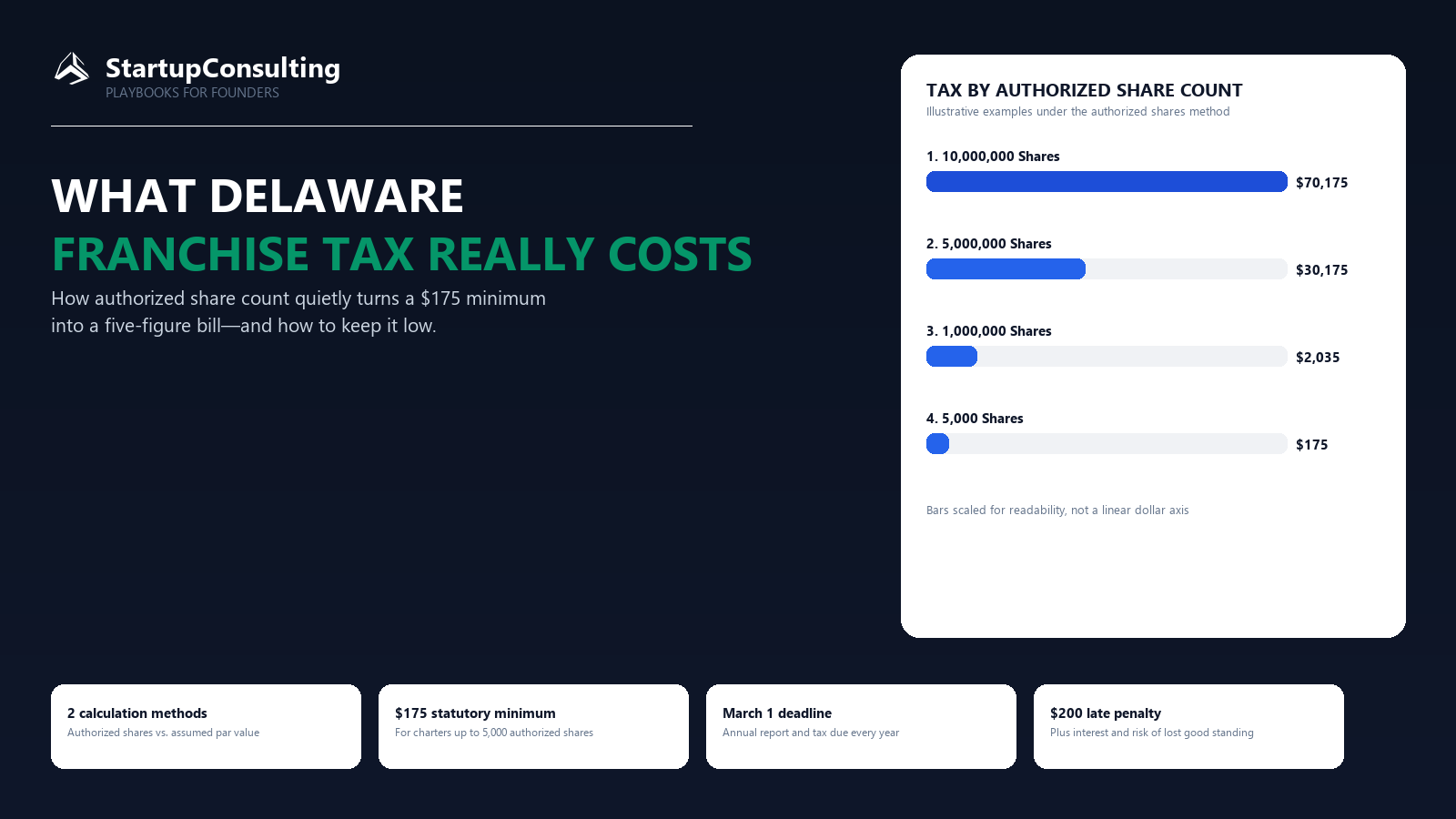
The default approach is blunt. Delaware counts the number of authorized shares, regardless of how many are issued or outstanding. Companies with up to five thousand authorized shares pay the statutory minimum.
From there, tiers escalate quickly. Authorize ten million shares—common in first-time charters that accommodate option pools—and the invoice can breach seventy thousand dollars. Many founders discover this cliff the hard way when the first annual report reminder appears in February.
This tiered climb is exactly why the Delaware Division of Corporations lets every Delaware C-corp choose between the authorized shares method and the assumed par value capital method each time the annual report comes due, and it is also why the statewide franchise tax cap of two hundred thousand dollars rarely enters into a founder-stage company's actual planning—you would need an enormous, asset-heavy balance sheet to get anywhere near it.
Assumed Par Value Method
Thankfully, Delaware also provides a formula that considers both the number of issued shares and the corporation’s gross assets. By dividing total assets by issued shares, the state calculates an assumed par value per share, then assesses tax on that figure.
The result often plummets the bill to the statutory floor of four hundred dollars, provided your balance sheet is modest and you have not issued all authorized shares. Using this method requires extra math but seldom takes more than a spreadsheet and ten minutes.
Annual Report and Deadlines
Every Delaware corporation must file an annual report and pay franchise tax by March first. The report lists directors, officers, and an address for service of process. Failure to file triggers a two-hundred-dollar penalty plus interest, and the state can revoke good standing, torpedoing fundraising deals in a single keystroke. Busy founders should mark January fifteenth on a calendar as a soft internal deadline.
Completing the filing early prevents last-day log-in issues and leaves time to resolve unexpected errors, such as a director’s middle initial mismatch that blocks submission. Corporations formed after the first of the year still owe for that calendar year, even if incorporation paperwork arrived on December thirty-one. Planning long incorporations in November or earlier allows you to deploy capital immediately while spreading the tax across an entire year of activity rather than a handful of weeks.
Because Delaware routes every one of these reminders to whatever address is on file for your registered agent, and because the annual report fee is bundled directly into the same online payment as the franchise tax itself, a stale forwarding address is one of the most common ways a founder discovers a lapsed filing months after the fact—usually while a lender or lead investor is asking for a certificate of good standing.
How to Estimate and Reduce Your Bill
Savvy founders model franchise tax while drafting their charter. Slight tweaks in share count, par value, or balance sheet structure can slice thousands off future invoices.
Tidy Up Authorized Shares
The easiest lever is total authorized shares. Seed-stage companies rarely need ten million shares; eight million can accommodate founders, option pools, and early investors without crowding the cap table. Each reduction of one million authorized shares can shave hundreds from the authorized share method, and if you never activate that approach, you still gain negotiating flexibility when new rounds demand more pool capacity.
Founders can also amend the charter later to add shares, typically for a one-time filing fee far lower than multiple years of inflated franchise tax bills. That amendment usually occurs right before a priced round when new investors push for additional shares anyway.
Balance Sheet Moves
Under the assumed par value method, the lower your total assets relative to issued shares, the smaller the tax. Timing asset recognition can therefore matter. Delaying a late-December cash infusion until January selectively keeps year-end assets low. Similarly, issuing only the shares necessary to cover founder equity and executed option grants minimizes the denominator used in the calculation. The less share count and asset bulk you show on the annual report snapshot, the friendlier the formula becomes.
Accountants sometimes flag intangible assets like intellectual property transfers that land on the balance sheet without fresh cash. Recording those transfers after March can sidestep an unnecessary tax spike while preserving legal protections.
Common Mistakes Founders Make
First, many teams rely solely on the default authorized shares method because the online portal auto-selects it. Skipping the assumed par value tab can cost five figures in needless tax. Second, founders forget that option pool shares count as authorized but unissued, which inflates the expensive default tier. Third, some teams fail to file altogether. A corporation that lapses into bad standing must pay back taxes, penalties, and cure fees before the state will issue documents essential for closing a new round.
Investors often interpret such lapses as operational negligence. Another oversight is neglecting to update the list of officers and directors. Delaware mails reminders to the registered agent address, so outdated or inaccurate officer data can leave notices unopened. Assign one person—often the corporate secretary—to own annual report accuracy and mark a recurring calendar event years in advance.
Action Checklist for This Year
Begin by confirming the number of authorized and issued shares on your cap table software. Next, pull a year-end balance sheet to tally total assets. Run both franchise tax methods in a simple spreadsheet or through a calculator many law firms host on their websites. If the assumed par value method wins, copy the resulting numbers into the Delaware portal rather than accepting the auto-filled default.
Then, prepare the annual report. Verify director names, officer titles, and addresses. Pay the tax and filing fee with a corporate card to generate a digital receipt for your accounting software. Lastly, download the stamped filing confirmation immediately. Many states hide documents behind log-ins after a short period, so saving them prevents frantic searches during due diligence.
Looking forward, hold a short board meeting to review whether the share structure still fits growth plans. If authorized shares greatly exceed forecasts, consider a charter amendment. Align that amendment with your next fundraising step to bundle legal costs and avoid separate filing fees.
| Action Step | What To Do | Why It Matters | Best Outcome |
|---|---|---|---|
|
1. Confirm Authorized and Issued Shares
Start with the cap table before touching the filing portal.
|
Review your cap table software or corporate records to confirm the current number of authorized shares and the number of issued shares outstanding. | Delaware’s franchise tax methods depend heavily on capital structure, and founders often make mistakes when they rely on outdated charter assumptions or forget how large the option pool is. | You begin the process with accurate share counts, which makes the tax comparison more reliable and reduces the chance of an avoidable overpayment. |
|
2. Pull a Year-End Balance Sheet
You need assets data to test the assumed par value method properly.
|
Collect the year-end balance sheet and identify total gross assets so you can run the assumed par value formula with real numbers instead of guesses. | Without the balance sheet, you cannot meaningfully compare the two Delaware tax methods, and the portal’s default route may push you into a higher bill. | You gain the inputs needed to check whether the assumed par value method materially lowers the tax. |
|
3. Run Both Tax Methods
Never assume the auto-selected method is the cheapest.
|
Calculate the franchise tax under both the authorized shares method and the assumed par value method using a spreadsheet or a reliable calculator. | Many startups overpay simply because they accept the portal default instead of comparing the methods side by side. | You choose the lower result and avoid a potentially large bill caused by using the wrong method by default. |
|
4. Prepare and Verify the Annual Report
The tax payment and annual report should be treated as one coordinated task.
|
Check director names, officer titles, addresses, and any other required corporate details before filing the report and submitting payment. | Small inaccuracies can delay filing, create confusion later during diligence, or trigger last-minute scrambling if the submission is blocked. | The corporation stays in good standing with clean public records, which matters for banking, fundraising, and official certificates. |
|
5. Pay Early and Save the Confirmation
Do not wait for March 1 panic.
|
Submit the filing and payment before the deadline, use a corporate card if appropriate, and immediately download the stamped confirmation and receipt. | Filing late can trigger penalties, interest, and bad-standing problems, while missing the receipt creates unnecessary pain during future audits or due diligence. | You avoid penalties and preserve a clean, searchable paper trail for accounting, legal, and fundraising work. |
|
6. Review the Share Structure for Next Year
Do not treat this as a one-time compliance chore.
|
After filing, review whether the current authorized share count still makes sense and whether a future charter amendment should be bundled with your next financing event. | Franchise tax planning improves when founders treat capital structure intentionally rather than letting old incorporation defaults linger for years. | You enter the next cycle with a structure that better fits growth plans and may produce a lower future tax burden. |
Conclusion
The Delaware franchise tax is less a random toll and more a subscription to the legal framework that lubricates venture fundraising. Understanding its twin calculation methods, meeting deadlines, and tuning your capital structure can keep the annual invoice closer to trivia than tragedy. Franchise tax is just one line on a startup's overall tax bill, and pairing a clean Delaware filing with a disciplined look at the deductions founders most often leave on the table can meaningfully lower what the company owes each year.
Treat the filing as a routine maintenance check, delegate the task to a reliable team member, and revisit share counts whenever strategy shifts. By turning franchise tax from surprise to line-item, you preserve cash for code, customers, and the next bold chapter in your startup story.
Put this into practice with AI
This article is for general information only and is not legal, tax, accounting, HR, or investment advice. Consult a qualified professional for your specific situation.
Related reading
 Tax
TaxHow to Stay Audit-Proof: Startup Tax Compliance Made Simple
Stay audit-proof with simple startup tax habits. Learn to organize records, meet deadlines, and reduce audit risk while keeping founders sane and funded.
Read article Tax
Tax5 Ways to Reduce Your Startup’s Tax Burden Before Year-End
Five practical year-end tax strategies for startups to cut liabilities, improve cash flow, and keep more capital working before December 31.
Read article Tax
TaxHow To Structure Your Startup For Maximum Tax Efficiency
Learn how to structure your startup for maximum tax efficiency, from entity choice to equity planning, so more capital stays focused on growth.
Read article