
5 Common Accounting Mistakes That Sink Startups
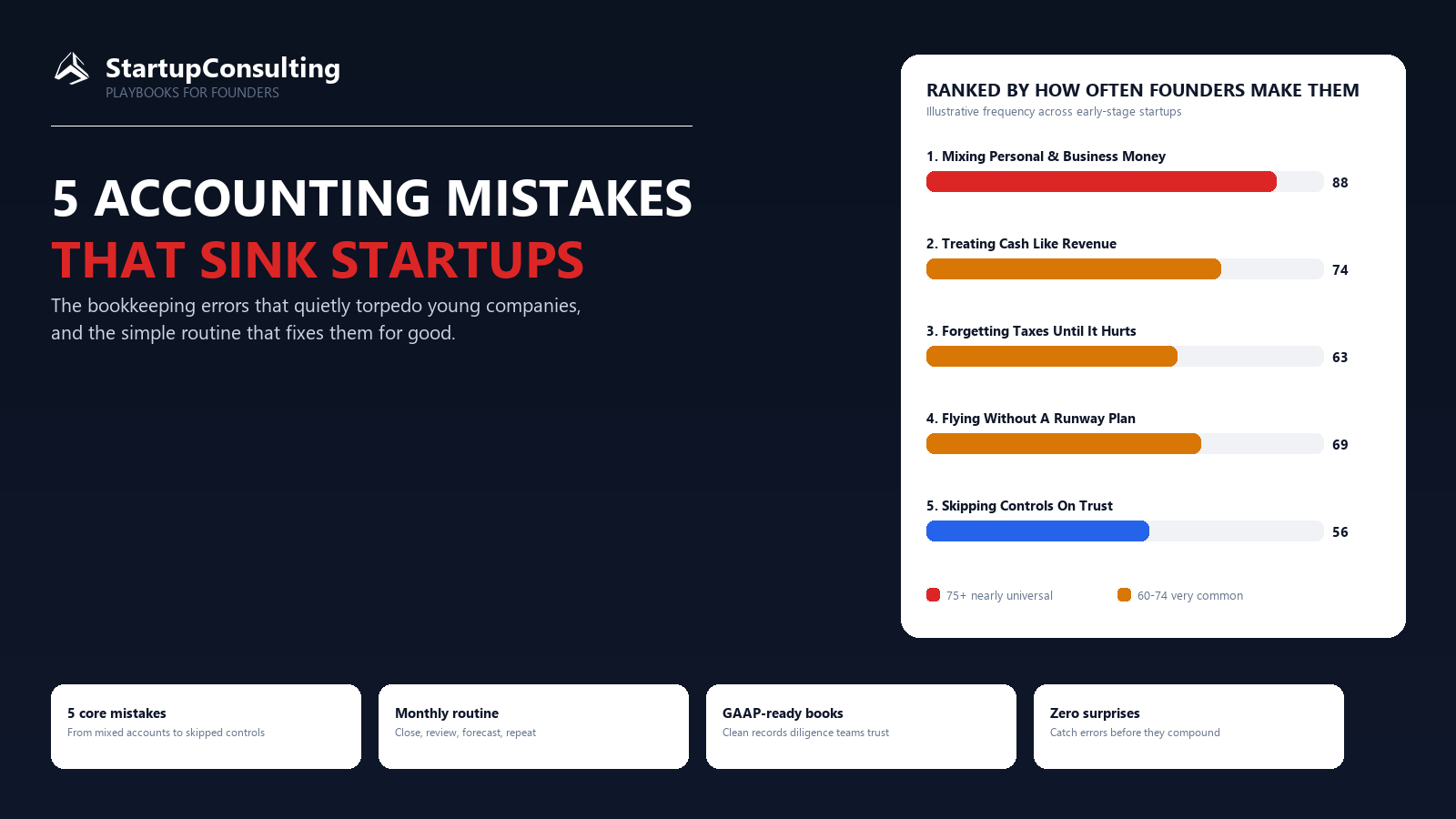
Startups run on speed, optimism, and caffeine, which is a thrilling recipe for product sprints and a wobbly recipe for bookkeeping. Money moves faster than paperwork, tiny errors snowball into messes that scare investors and drain bank accounts. This guide breaks down the five accounting mistakes that quietly torpedo young companies and shows you how to sidestep these bookkeeping errors with a calm, GAAP-compliant routine.
If you already pay for startup consulting, you will recognize a few of these warning lights on the dashboard, and if you do not, consider this your map for cleaner, investor-ready books and fewer headaches.
Mistake 1: Mixing Personal and Business Money
What It Looks Like
The founder pays the cloud bill from a personal card, then buys groceries with the company debit card on the ride home. A contractor is paid from the wrong account because it felt faster. A laptop is expensed one month, then depreciated the next, and nobody knows which entry is real. The bank feed reads like a diary rather than a ledger, and receipts are missing.
Why It Is Dangerous
Blurring the line between personal and business funds destroys the audit trail that clean financial statements depend on. It complicates taxes, distorts margins, and can pierce the corporate veil, exposing personal assets. It also burns time. You pay to make the mess, then pay again to unwind it. Investors notice during diligence.
How to Fix It
Open business accounts before your first sale. Put company cards in the right hands with clear limits. Route every subscription, payroll, and vendor payment through those accounts. Use tools that capture receipts instantly. If you pay something personally, record it as an owner contribution with a receipt. If the company pays something personal, reimburse it immediately.
Mistake 2: Treating Cash Like Revenue
What It Looks Like
A customer prepays for a year of service, the bank balance jumps, and the team celebrates like it is fresh income. A preorder campaign floods the account in June, then deliveries slip into September, while the scoreboard still shows June as a big win. Founders report top line numbers without mentioning the liability that sits behind a happy bank balance. The optimism is contagious, the runway looks longer, and spending rises to match.
Why It Is Dangerous
Cash is not the same as earned revenue, and conflating the two is one of the fastest ways to fail financial due diligence. Recognizing income before it is delivered inflates performance, distorts margins, and sets you up for a wall of refunds or support costs that arrive later. It also misleads hiring and marketing decisions.
You feel richer than you are, so you add headcount and lock in new leases. When revenue recognition catches up, the numbers sag and the budget groans. If lenders or investors were shown the wrong picture, credibility takes a hit that is hard to repair.
How to Fix It
Separate revenue recognition from cash collection. Create a schedule that recognizes revenue only when you deliver the product or the service period passes. For subscriptions, spread the annual payment over each month. For physical goods, recognize revenue when items ship.
Record customer prepayments as deferred revenue and track them like promises you must keep. Adopt a monthly close routine, built on accrual accounting principles, that reconciles bank activity, invoices, and delivery logs so your financial statements tell the truth. Once juggling those prepayment schedules by hand starts to feel like a second job, that is usually the cue described in our breakdown of exactly when to move from cash to accrual accounting.
Mistake 3: Forgetting Taxes Until It Hurts
What It Looks Like
Early invoices have no sales tax because the team thought software is exempt everywhere. Payroll is processed without the right state registrations because the first employee moved across the country. Contractors are paid all year, then the team scrambles in January to file forms. Federal estimates are skipped because cash is tight, which feels clever until penalties arrive.
Why It Is Dangerous
Governments do not forget. Missing registrations or underpaying taxes leads to penalties, interest, and time spent on hold. Sales tax nexus rules vary by state, and remote employees can create new obligations overnight. Payroll mistakes can trigger letters from state agencies that slow down fundraising because diligence will surface them. Ignoring estimated taxes can shrink your runway by a surprise five figures at the worst possible moment.
How to Fix It
Inventory where you have customers, employees, and contractors. Register in the jurisdictions that require it, starting with payroll and sales tax. Use a simple matrix that shows where you collect and remit. For software businesses, check rules for digital goods and subscription services because they change.
Set calendar reminders for quarterly federal and state estimates, and build those payments into your forecast. Collect W-9s before the first contractor payment and send forms early so January is boring.
Mistake 4: Flying Without a Cash Runway Plan
What It Looks Like
The team knows the bank balance, yet no one can say how long it will last. Hiring is greenlit because there is room on the card. Marketing spend spikes on a hunch. Vendor pricing creeps up. Nobody connects the dots until the board deck is due, then there is a scramble to explain why runway shrank by months.
Why It Is Dangerous
Runway is your oxygen gauge. Without a clear view of burn and unit economics, you drift into a crunch that forces reactive decisions, which are usually expensive. Discounts to close deals, rushed bridge notes, and hurried cuts trade future growth for short term survival. The story with investors shifts from momentum to triage, and the team feels the wobble.
How to Fix It
Track net burn, runway, and core SaaS metrics like MRR monthly, and know the drivers behind each one. Group expenses by a chart of accounts that mirrors how the business actually runs, and watch the trend lines. Tie revenue to leading indicators like pipeline and conversion rates. Build a forecast for at least twelve months, then compare actuals to that forecast every month. Treat variances like bugs, ask why, adjust, and model the full cost of each new hire before you commit.
Mistake 5: Skipping Controls Because You Trust Your Team
What It Looks Like
Everyone shares the same vendor login because it is easy. One person handles invoices, pays them, and reconciles the books. Approvals happen in chat messages that vanish. The founding team treats receipts like optional art. Bank accounts have broad access, because that feels efficient, until you discover an old card still works after an employee leaves.
Why It Is Dangerous
Trust is priceless, and controls protect it. Without basic safeguards, you invite mistakes and the occasional bad decision. Duplicate payments slip through. Phishing invoices look real on a busy Friday. Refund fraud can hide in the noise. If something does go wrong, the lack of process makes it hard to show what happened and who approved it, which matters for audits, tax season, and future funding.
How to Fix It
Install light, founder friendly controls early. Keep vendor access unique to each person and turn it off when they leave. Separate duties so the person who approves an invoice is not the same person who pays it. Require receipts for every company card transaction and make the software nag until they are attached.
Use two factor authentication on financial tools and keep every login tied to a named owner, not a shared password. Store approvals in a system that keeps logs. Close the books on a schedule and review the financial statements together, with eyes on both the income statement and the balance sheet.
Pulling It Together: A Simple Monthly Routine
The Close
Close the books every month, even if your company is tiny. Reconcile bank accounts, credit cards, and any payment processors. Match invoices to payments. Recognize revenue correctly. Review the balance sheet, not just the income statement, because liabilities tell stories that profits hide. If the close feels heavy, improve your systems or chart of accounts instead of skipping the work.
The Review
Once the close is done, take one hour with your leadership team to read the numbers like a story. Start with cash, then move to burn, then revenue recognition, then liabilities. Compare this month to last month, then to the forecast. If there is a big change, write the sentence that explains it. If you cannot write that sentence, dig deeper. The goal is shared understanding, not a prettier slide.
The Forecast
Update your forecast for the next three, six, and twelve months. Check hiring plans, vendor contracts, and marketing budgets against the model. If you plan to raise capital, build in the time it really takes, with conservative dates, so you do not run short. Consider a buffer for the unknown. Markets move, sales cycles lengthen, and unexpected costs appear. A healthy buffer buys options.
The Habits
Make receipts a daily habit. Make approvals traceable. Make access narrow. Train new hires on how you handle money and why it matters. Praise people who catch errors. Celebrate clean closes, not just big sales. Culture grows from what you notice, so notice financial hygiene. Write a one page financial playbook that lives in your wiki, update it after each close, and make it part of onboarding so your hygiene survives growth spurts and calendar chaos. Really.
| Step | Purpose | Checklist | Outputs | Avoids |
|---|---|---|---|---|
|
1
The Close
Make the books true before you talk about performance.
|
Turn raw transactions into reliable financial statements with a clean audit trail. |
|
Closed P&L
Closed Balance Sheet
Deferred Rev Schedule
|
Revenue illusions, missing receipts, surprise liabilities. |
|
2
The Review
Read the numbers like a story, together.
|
Build shared understanding of what changed, why it changed, and what it implies. |
|
Variance Notes
Leadership Alignment
Action List
|
Board-deck surprises, “haunted spreadsheet” debates. |
|
3
The Forecast
Turn the close into decisions and runway clarity.
|
Update runway, hiring plans, and spend with a reality-based model. |
|
Updated Runway
Hiring Plan
Cash Forecast
|
Reactive cuts, rushed bridge notes, accidental runway collapse. |
|
Always
The Habits
Light controls that keep trust intact.
|
Keep approvals traceable, access narrow, and hygiene consistent as you grow. |
|
Audit Trail
Access Log
Finance Playbook
|
Fraud risk, duplicated payments, tax-season fire drills. |
Conclusion
Strong, audit-ready books do not guarantee success, but weak books make failure far more likely. Treat your accounting like product hygiene, routine and non negotiable, and you will sidestep the traps that sink many young companies. Your future self will say thank you, your investors will breathe easier, and your customers will enjoy a steadier product because you run a steadier company.
Put this into practice with AI
This article is for general information only and is not legal, tax, accounting, HR, or investment advice. Consult a qualified professional for your specific situation.
Related reading
 Finance
Should You Pay Yourself a Salary or Dividends as a Founder?
Founder pay explained: compare salary vs dividends, tax impacts, compliance rules, and cash flow tradeoffs to choose the smartest compensation mix.
Read article Finance
Burn Rate, Runway, and Cash Flow: Financial Metrics Every Founder Should Track
Burn rate, runway, and cash flow shape every startup’s survival plan. Learn how these metrics guide smarter decisions and keep your company moving with confidence.
Read article Finance
When to Switch from Cash to Accrual Accounting (and Why It Matters)
Learn when and why to switch from cash to accrual accounting, how it transforms your reports, and the key signals that show your business is ready to upgrade.
Read article