
How to Manage Remote Startup Teams Without Killing Productivity
Remote work is not a plot twist anymore, it is the opening scene. If you run a young company, your team probably stretches from a kitchen table in Lisbon to a coworking nook in Lagos, with someone taking a standup call from a parked car.
You can keep the spark of a scrappy venture and still practice solid remote team management, without burning out your people or drowning in meetings. The playbook below blends practical leadership habits with lighthearted honesty, the kind you would expect from thoughtful startup consulting, and it focuses on what actually helps leaders keep productivity alive without grinding people down.
Set the Ground Rules for Autonomy
Autonomy is not the same as silence. Distributed teams flourish when expectations are explicit and shared, especially for outcomes. Treat every goal as a product with an owner, a timeline, and a crisp definition of done. Post those definitions where everyone can see them and refer to them during one-on-ones. People do their best work when they know what matters and what can wait.
Define Outcomes, Not Hours
The clock is a blunt instrument. Replace it with progress signals that are easy to observe. Track milestones, pull request merges, and customer feedback. When someone hits a milestone early, celebrate it in the same channel where goals live. Hours are inputs. Outcomes pay the bills.
Make Decision Paths Obvious
Slow decisions are productivity potholes. Map who decides what, how input is gathered, and where final calls are recorded. Keep the map short, almost postcard sized, and share it in your team wiki. If a designer needs a call on a landing page, they should know the exact person, the deadline for input, and the channel to post the choice.
| Ground rule | Why it matters | How to apply it |
|---|---|---|
| Autonomy ≠ silence |
Remote teams do their best work when independence is paired with shared expectations. Autonomy means ownership,
not disappearing into a private cave.
Clarity prevents confusion from becoming hidden rework.
|
Write expectations down. Make responsibilities visible. Use lightweight check-ins so people stay aligned without being micromanaged. |
| Define outcomes, not hours |
The clock is a blunt tool. Outcomes are what move the business forward. Measuring progress by deliverables
keeps productivity real, not performative.
Hours are inputs. Outcomes pay the bills.
|
Track milestones, merged pull requests, shipped features, and customer impact. Celebrate early completion in the same place goals are recorded. |
| Make ownership explicit |
Every goal should have a clear owner, timeline, and definition of done. Without ownership, remote work turns
into polite ambiguity.
Ownership reduces duplicate effort and dropped balls.
|
Treat goals like products: assign an owner, publish a deadline, and document what “done” looks like in your team wiki or project tracker. |
| Keep decision paths obvious |
Slow decisions create productivity potholes. People lose momentum when they don’t know who decides, where input
goes, or where final calls live.
Remote speed depends on predictable decision flow.
|
Publish a simple “who decides what” map. Record decisions in one searchable place so teammates don’t relitigate choices in every thread. |
| Make goals visible and shared |
Autonomy scales when everyone can see what matters most. Shared visibility prevents misalignment and helps
teammates coordinate without constant meetings.
Transparency replaces supervision.
|
Post goals and definitions of done in a public workspace. Reference them in one-on-ones and weekly updates to keep focus consistent. |
Build Communication That Actually Helps
Communication can be a warm blanket or a weighted vest. Aim for warmth without the drag. Encourage written updates that are brief, concrete, and searchable. Use status updates to replace recurring meetings that exist mostly out of habit. Set office hours for leaders and let people swing by with quick questions.
Short Meetings with Sharp Edges
Meetings should feel like pit stops. Limit them, schedule with purpose, and exit fast. Send a one sentence purpose and list who is truly needed. Start on time even if two people are still connecting headphones. End when the goal is met, not when the calendar block expires. Capture decisions in the meeting note.
Asynchronous by Default
Asynchronous communication is the remote team superpower. Ask for updates in threads, record quick screen shares, and use reaction emojis to signal understanding. Set response time guidelines that fit your company tempo, for example, two hours for incidents and same day for routine questions. With norms like these, urgency is real, not performative, and people can plan deep work rather than defend it.
Tools That Serve People, Not the Other Way Around
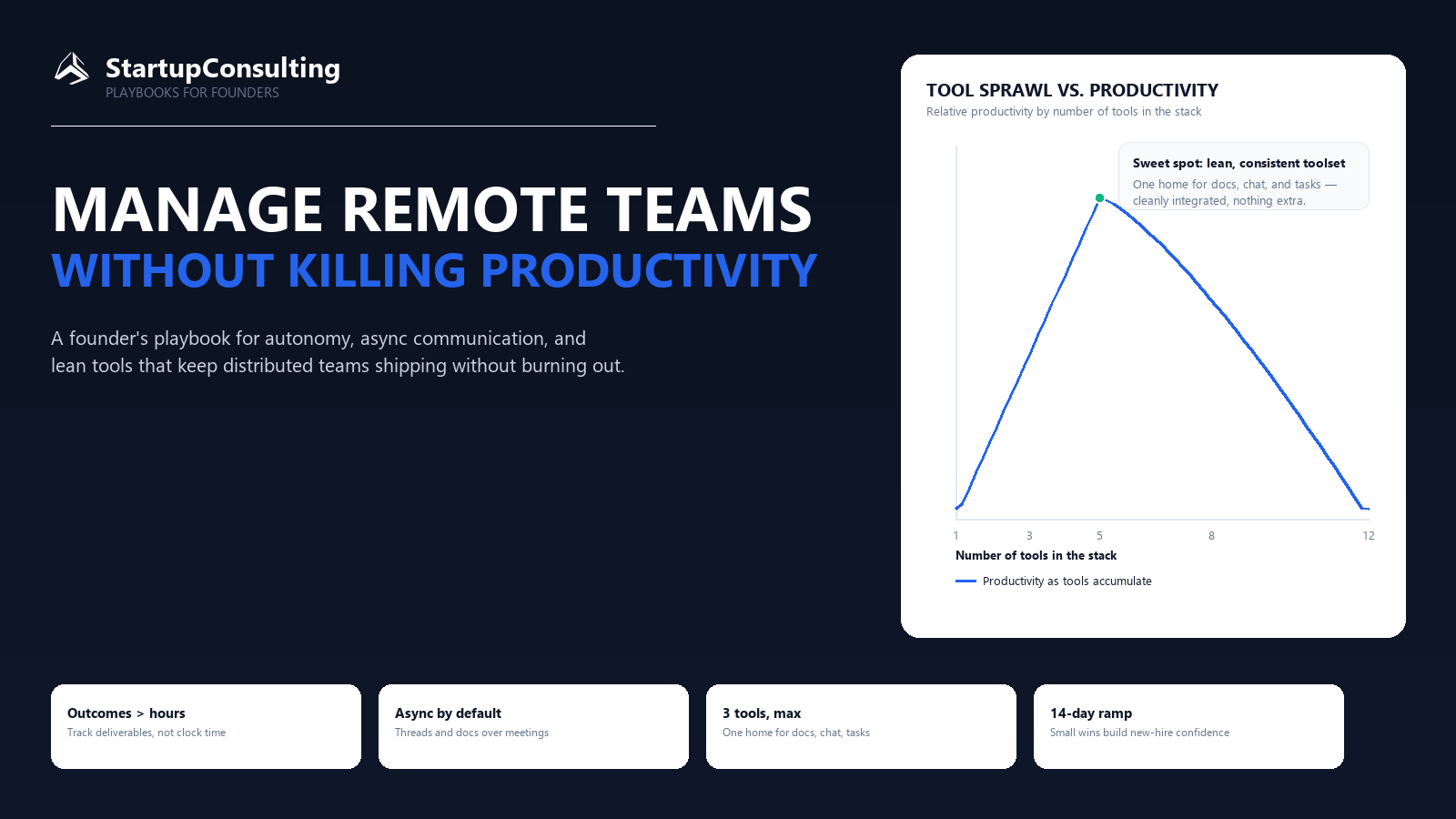
Tools can be shiny distractions or quiet amplifiers when you are managing remote employees. Keep the stack lean, consistent, and boring in the best way, since a lean stack is one of the biggest levers for remote work productivity. Choose one home for docs, one for chat, one for tasks, and resist the siren call of yet another specialized app.
Choose Fewer Apps, Use Them Better
Pick tools that play nicely together. If a task is created during a planning discussion, it should appear automatically in the backlog, already labeled and assigned. If a teammate comments on a spec, the author should get a subtle nudge in chat, not a shouting match of notifications. Integrations are helpful only when they remove manual handoffs.
Create Clean, Shared Workspaces
Chaos multiplies in the cloud. Use a simple naming scheme for documents, standard templates for specs and retrospectives, and a predictable folder structure. Teach people to archive aggressively. New hires find what they need without asking, veterans avoid duplicate effort, and leaders can skim a doc and immediately know where to look for decisions and risks.
Protect Energy and Focus
Remote teams do not share walls, but they share rhythms, and protecting those rhythms is core to remote team culture. Encourage people to carve out focus blocks and to post them on their calendars. Normalize quick status changes that say heads down, back by noon. Treat alerts like fire alarms, not doorbells, and you will see fewer frantic pings and more finished work.
Time Zones as a Feature
Time zones can feel like a puzzle with missing pieces. Use them as leverage. Set a baton pass pattern so work moves across regions overnight. Engineering pushes a branch in the evening, quality picks it up in their morning, and support updates the release notes before lunch somewhere else. You will need overlap hours for tricky work, but most days the sun can carry the sprint forward.
Rituals for Start and Stop
Beginnings and endings anchor remote life. Encourage light daily rituals, like a two sentence morning check in and a one sentence wrap up before signing off. On Fridays, run a weekly reflection in the team channel, two prompts, what moved the needle and what felt heavy. These small bookends help people switch gears and keep the human pulse really visible.
Lead with Clarity and Humanity
Remote leadership styles show through the screen like fingerprints on glass. Be explicit, be kind, and be consistent. Explain why a decision exists, not just what it is. Share your own constraints. Ask questions with curiosity rather than courtroom flair. People are more likely to speak up when they know they will not be ambushed.
Feedback That Lands
Vague feedback wastes everyone’s time. Tie feedback to a shared goal, describe the behavior you saw, explain the impact, and request a specific change. Keep the tone generous. You are fixing a process, not a person. When the improvement appears, acknowledge it publicly. The loop closes and trust grows. Habits like this are also some of the cheapest insurance you have against the hidden costs of high turnover.
Culture You Can Feel Through a Screen
Culture is not a poster. It shows up in how people treat each other when deadlines crowd the calendar. Create small moments that reinforce the kind of company you want. Celebrate clever problem solving in a weekly highlight. Invite rotating hosts to run a short playlist before the all hands begins. Keep the jokes inclusive and the sarcasm gentle. People remember how work feels, and that memory shapes output.
Hiring and Onboarding for Remote Reality
Hiring for remote work is more than a webcam test, and it is where remote onboarding really begins. Look for self direction, written clarity, and a bias for closing loops. In interviews, pay attention to how candidates structure their thoughts and whether they ask crisp questions. During reference calls, listen for signals that they follow through without nagging.
Traits to Screen for
Seek people who manage ambiguity with calm. They welcome a fuzzy brief, then ask the two questions that make it sharp. They show their work, invite input at the right time, and never confuse noise with urgency. They can sketch a plan, take the first step, and adjust as reality speaks up.
Onboarding That Sticks
Onboarding should be a friendly ramp, not a cliff. Create a simple path for the first two weeks, with small wins that build confidence. Assign a buddy who checks in each day, answers the un Googleable questions, and fills in the social map. Provide a sample spec, a sample pull request, and a sample customer note that match your standards. New hires copy the patterns they see.
Conclusion
Managing remote startup teams can feel like juggling on a moving sidewalk, but it does not have to drain momentum. Clarity, autonomy, and simple tools carry a lot of weight when used with care.
Protect focus, lean on asynchronous habits, and keep meetings purposeful. Hire for written thinking, onboard with intent, and nurture tiny rituals that make work feel human. Do these consistently and productivity survives, even thrives, while your team keeps its sense of humor.
Put this into practice with AI
This article is for general information only and is not legal, tax, accounting, HR, or investment advice. Consult a qualified professional for your specific situation.
Related reading
 Marketing
The Startup Founder’s Guide to Fractional CMO Services
Fractional CMO services give startups senior marketing strategy without full-time cost. Learn pricing, scope, KPIs, and how to hire and manage one.
Read article Marketing
How to Leverage Thought Leadership to Attract Investors
Build investor trust with thought leadership: share original insights, prove claims with data, publish consistently, and turn visibility into funding talks.
Read article Marketing
SEO for Startups: How to Rank Before You Even Launch
SEO for startups made simple: set up fast tech, publish prelaunch content, earn early backlinks, and launch already ranking before Product Hunt.
Read article