
Top 10 HR Policies Every Startup Should Have Before Their First Hire
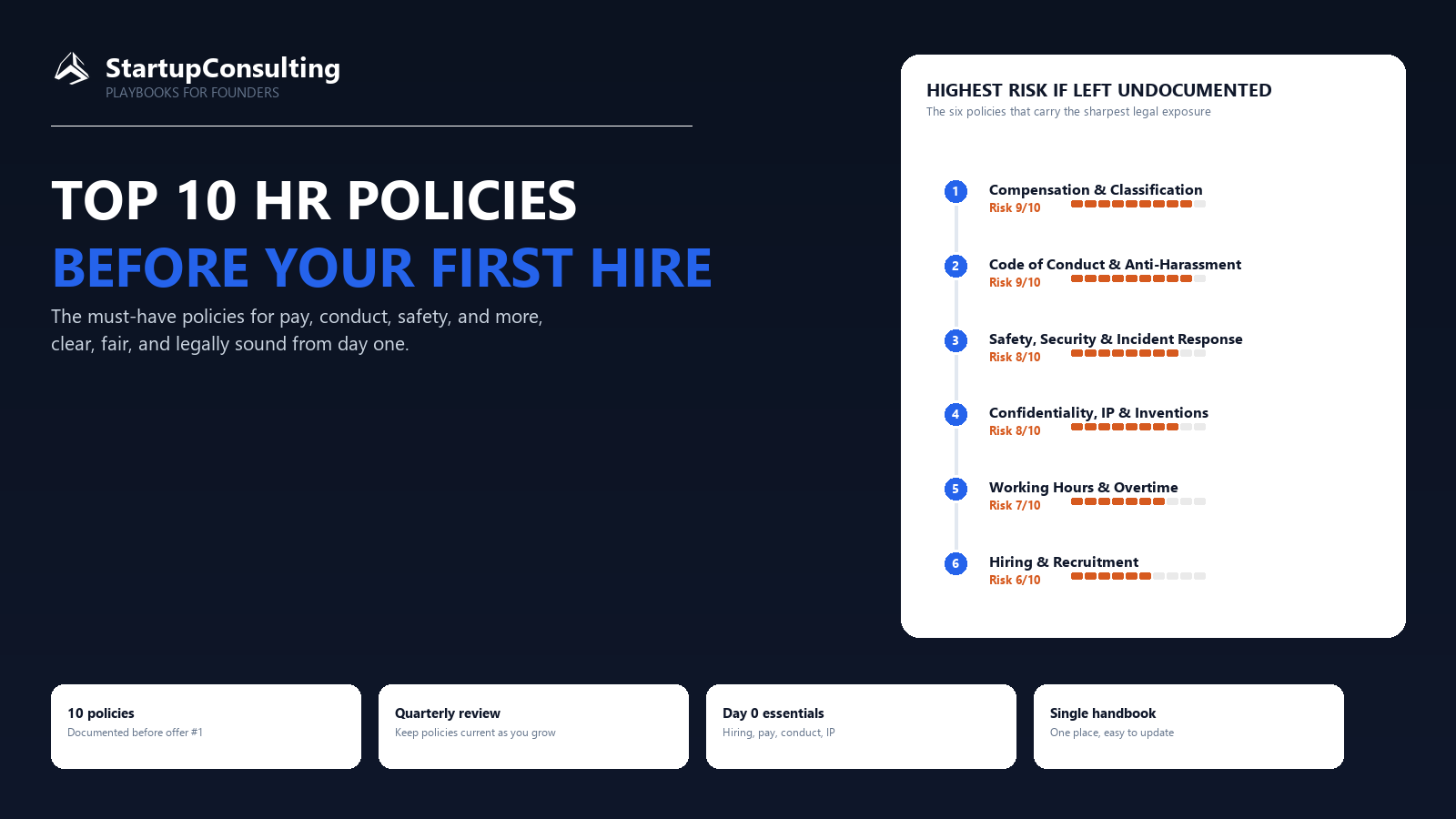
Hiring your first employee feels like leveling up from solo sprinting to relay racing, and the baton is your culture. Before you post that job ad, set a foundation of startup HR policies that is clear, fair, and legally sound. The right policies save you from headaches, hard lessons, and surprise invoices, and they make your tiny rocket ship look credible to candidates who have options. If you have ever skimmed a startup blog at 2 a.m., you know there is plenty of noisy advice.
This guide filters the signal with plain language and a dash of paranoia. If you prefer a shortcut, thoughtful startup consulting can translate these ideas into solid templates that match your market, stage, and risk tolerance. Below are the ten HR policies for startups to finalize before the first person signs an offer, so you start strong, stay compliant, and keep morale high from day one.
1. Hiring and Recruitment Policy
What to Include
Describe your hiring stages from application to offer. Spell out who screens resumes, who conducts interviews, and how decisions are made. Include how you define the role, where you post jobs, and the criteria you use to evaluate candidates. Add a clear statement against discrimination, along with accommodations for candidates with disabilities.
Why It Matters
A documented hiring policy keeps bias in check and prevents last minute improvisation. Candidates notice consistency, and it reflects your values. It also protects you if a rejected applicant raises concerns about fairness or accessibility.
2. Compensation and Classification Policy
What to Include
Explain how you set salary bands, equity ranges, and any signing bonuses. Define exempt and nonexempt roles, pay schedules, and how overtime is calculated and approved. If you offer equity, outline the vesting schedule, cliffs, and what happens upon termination.
Common Pitfalls
Misclassifying employees under your compensation policy can produce dramatic penalty bills. Put rules in writing so managers do not promise perks you cannot deliver. A transparent structure avoids awkward renegotiations and helps close great candidates quickly.
3. Code of Conduct and Anti-Harassment Policy
What to Include
Your workplace conduct policy should state expectations for respectful behavior in the office, in chat tools, and in any work related setting. Define prohibited conduct, including harassment, bullying, and retaliation. Provide multiple reporting channels, at least one outside the direct manager, and commit to prompt, impartial investigations.
Reporting and Response
Explain what happens after a report is made, who investigates, and how confidentiality is handled. Promise protection from retaliation and give examples of corrective actions. This sets a tone of psychological safety from day one.
4. Working Hours, Timekeeping, and Overtime
What to Include
Clarify standard work hours, core collaboration windows, and expectations around responsiveness. Describe how time is tracked, how breaks are taken, and how overtime must be preapproved. For flexible schedules, note how to document hours and how availability is communicated to teammates.
Compliance Tip
Local rules around overtime and breaks change often. Bookmark official resources and make one person responsible for updates. Your policy should reference the current law and your timekeeping system, not a manager’s memory — the same discipline behind any solid HR compliance checklist.
5. Leave and Time Off Policy
What to Include
Your employee handbook should outline paid time off, sick leave, parental leave, and any unpaid leaves that may apply. Describe eligibility, accrual, carryover, and how employees request time off. Include how holidays are observed, what happens if a holiday falls on a weekend, and whether your company closes between major holidays.
Paid Holidays and Sick Time
Clarity prevents calendar drama. Set minimum notice for planned vacations, define blackout periods if needed, and require documentation only when appropriate. Treat sick time as a health tool, not a test of loyalty.
6. Benefits Eligibility and Enrollment
What to Include
Explain which employees are eligible for health insurance, dental and vision, disability coverage, and retirement plans. Note waiting periods, enrollment windows, and who pays what. If you offer stipends for wellness or home office equipment, specify amounts, receipts, and renewal dates.
Early-Stage Reality Check
You may not launch every benefit on day one. Say so, and document your plan to review options at headcount milestones. Candidates appreciate honesty about timing and costs, especially when equity is part of the package.
7. Confidentiality, IP, and Inventions Assignment
What to Include
A solid IP and confidentiality policy requires all employees to protect confidential information and assign inventions and work product to the company. Explain what counts as company IP, including code, designs, data, and documentation. Make it easy to understand what can be shared publicly, and what belongs in private repositories.
Founder Considerations
Founders often blur lines between personal projects and company work. Add language that clarifies preexisting IP and the process for disclosing side projects. This prevents disputes when someone revives an old repo that looks suspiciously like a product feature.
8. Remote Work and Equipment Use
What to Include
Define who can work remotely, which time zones you support, and how often in person gatherings occur. Set rules for equipment purchase and reimbursement, along with expectations for maintaining devices. Include standards for home office setups, from ergonomics to a stable internet connection.
Security and Privacy
Detail security requirements like multi-factor authentication, password managers, and automatic screen locks. Require employees to separate personal and work data, and to report lost devices immediately. Include guidance for working in public spaces so company secrets are not shared with the coffee line.
9. Performance Management and Probation
What to Include
Describe how goals are set, how feedback flows, and the cadence of check ins. Create a simple probation period for new hires, with clear expectations and documented progress. Outline how performance improvement plans work, including timelines and review steps.
Coaching Culture
Make feedback normal, specific, and kind. Encourage managers to catch wins out loud and to address issues early. A rhythm of short written updates beats the anxiety of surprise reviews.
10. Safety, Security, and Incident Response
What to Include
A workplace safety and security policy should cover physical and digital safety. Document building access, visitor sign in, and emergency procedures. Include incident response for data breaches, phishing attempts, and suspicious behavior. Provide a contact tree so employees know exactly whom to call when something feels off.
After an Incident
Explain how you investigate, communicate, and prevent recurrence. Promise timely updates, not silence. People will forgive a mistake faster than a cover up, and your customers will appreciate your transparency.
| # | Policy | What It Covers | Why It Matters |
|---|---|---|---|
| 1 |
Hiring & Recruitment
How you hire, interview, and decide.
|
Role definition, interview steps, evaluation criteria, anti-discrimination, accommodations.
ConsistencyFairnessDocumentation
|
Reduces bias, improves candidate trust, and lowers legal risk. |
| 2 |
Compensation & Classification
How pay and roles are defined.
|
Salary bands, equity ranges, bonuses, exempt vs nonexempt, overtime rules, pay schedule, vesting basics.
Pay clarityOvertimeEquity
|
Prevents misclassification penalties and “promises you can’t keep.” |
| 3 |
Code of Conduct & Anti-Harassment
Expected behavior + reporting.
|
Respect standards, prohibited conduct, reporting channels, investigation process, anti-retaliation.
CultureSafetyAccountability
|
Creates psychological safety and protects the company and team. |
| 4 |
Working Hours, Timekeeping & Overtime
How hours are tracked.
|
Core hours, responsiveness expectations, time tracking method, breaks, overtime pre-approval.
ComplianceTime trackingBreaks
|
Avoids wage-and-hour issues and keeps expectations clear. |
| 5 |
Leave & Time Off
PTO, sick, parental, holidays.
|
Accrual/eligibility, request process, carryover rules, holiday calendar, blackout periods (if any).
PTOSick timeHolidays
|
Prevents “calendar drama” and supports a healthy team rhythm. |
| 6 |
Benefits Eligibility & Enrollment
Who gets what, when.
|
Eligibility rules, waiting periods, enrollment windows, cost sharing, stipends/reimbursements.
Health plansStipendsMilestones
|
Sets realistic expectations and makes offers easier to accept. |
| 7 |
Confidentiality, IP & Inventions
What belongs to the company.
|
Confidential info rules, invention assignment, work product ownership, pre-existing IP disclosures.
IP protectionSide projectsRepos
|
Prevents future disputes and protects the product’s core assets. |
| 8 |
Remote Work & Equipment Use
Where work happens + device rules.
|
Remote eligibility, time zones, equipment reimbursement, device care, security basics (MFA, locks).
Remote rulesEquipmentSecurity
|
Reduces chaos and improves security hygiene from day one. |
| 9 |
Performance Management & Probation
Goals, feedback, and early ramp.
|
Goal-setting, check-in cadence, probation period expectations, improvement plan steps.
FeedbackCoachingClarity
|
Avoids surprise reviews and helps new hires succeed faster. |
| 10 |
Safety, Security & Incident Response
What to do when things go wrong.
|
Physical safety, building access, visitor rules, data breach response, phishing reporting, contact tree.
Incident playbookBreach responseAccess
|
Cuts response time and increases trust through clear, calm action. |
Putting It All Together
Rollout Plan
Collect all policies in a single handbook that is easy to navigate and easy to update. Share it as part of onboarding, then walk through the highlights in a welcoming tone. Ask employees to sign acknowledgments and store them with other personnel documents. Include a spot for questions so people can flag gaps you did not notice in drafting.
Keep It Current
Policies grow stale. Schedule a quarterly review, even if it is a short one. Track regulatory changes, product pivots, and new office locations. When you update a policy, call out what changed, why it changed, and the date it takes effect. Assign a clear owner, review with managers, and send a crisp summary so no one misses the memo — many founders hand this cadence to an outsourced HR partner once the review calendar itself becomes a chore.
Conclusion
Your first hire is a milestone, and strong startup HR policies are the invisible scaffolding that keeps your company culture safe while you build. Treat them as living documents, not stone tablets. Keep the language human, test the processes you write, and revisit them as your team grows. Clarity creates trust, and trust frees people to do excellent work. You will have plenty of unknowns in a startup. HR should not be one of them.
Put this into practice with AI
This article is for general information only and is not legal, tax, accounting, HR, or investment advice. Consult a qualified professional for your specific situation.
Related reading
 HR
HRThe Complete HR Compliance Checklist for New Companies
A complete HR compliance checklist for startups, covering hiring, payroll, policies, and legal essentials to keep your new company compliant.
Read article HR
HROutsourcing HR for Startups: What It Costs and When It Makes Sense
Learn when HR outsourcing makes sense for startups, what it costs, and how the right partner streamlines hiring, compliance, and daily operations.
Read article HR
HRBuilding Your First HR Department: A Step-by-Step Guide for Startups
A practical, founder-friendly guide to building your first HR department, clear steps, smart systems, and culture that scales with your startup.
Read article