
The Hidden Costs of High Turnover (and How Startups Can Prevent It)
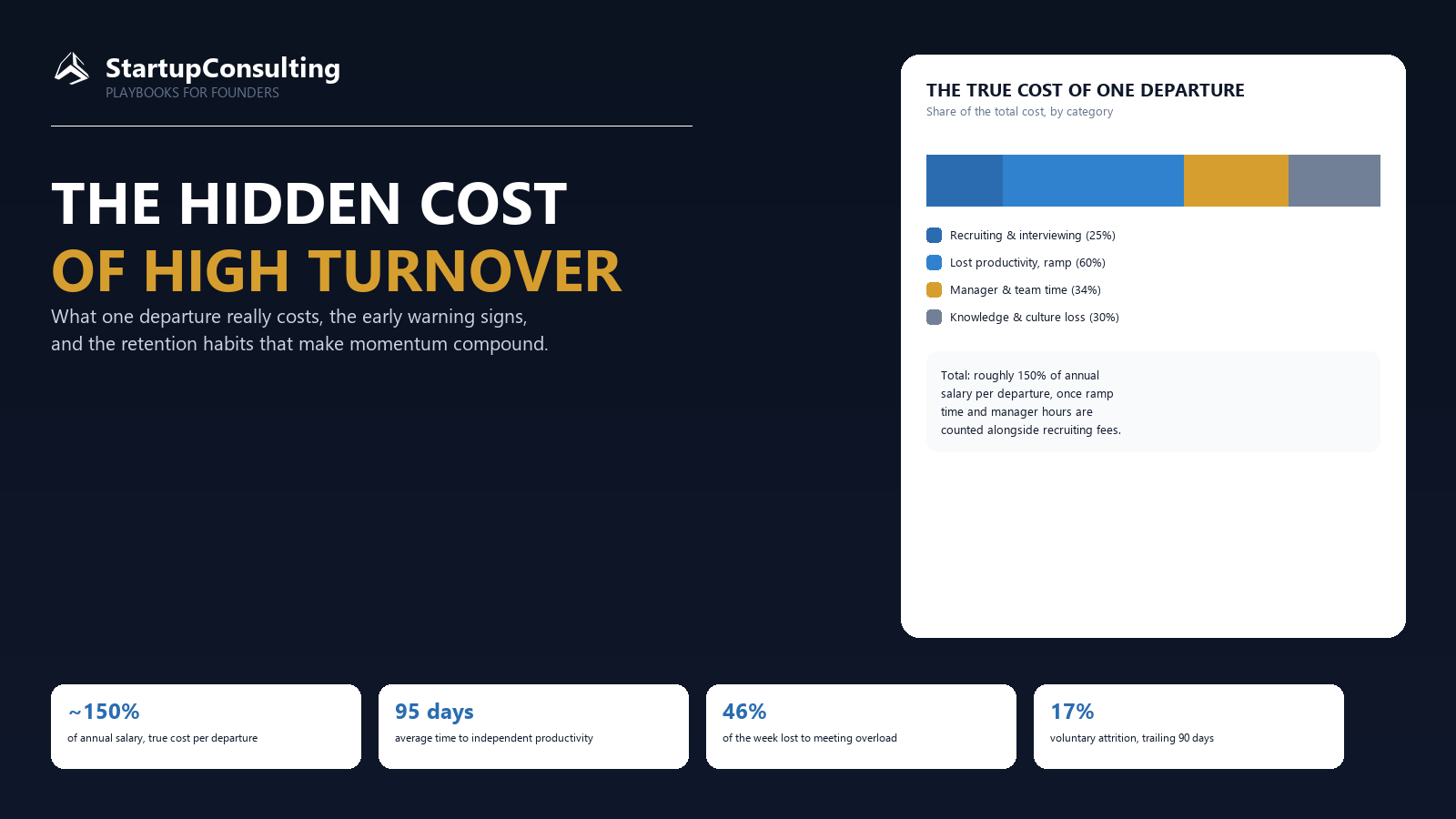
Turnover sounds like a routine personnel swap until you live through it. Slack channels quiet down, builds fail at four in the afternoon, and that optimistic fern by the window starts to droop in sympathy. For founders and operators, the true price hides in ten different corners of the company, from slower launches to managers stretched like taffy.
That is why many leaders look beyond internal instincts and tap outside perspective across finance, people, and product, including startup consulting, to see the full bill. Below, you will find a clear map of the hidden costs and a set of practical, slightly cheeky ways to keep great people around longer, the kind of employee retention strategy that pays for itself many times over.
Why High Turnover Is So Expensive
Replacing a teammate is never a neat chair swap. The cost sprawls from recruiting to lost momentum, while morale takes a hit that spreadsheets cannot quite model. When exits stack up, your roadmap starts to look like city traffic at rush hour.
Everything technically moves, but only after long pauses, honking, and the occasional detour. Even when the new hire is a gem, you still pay a toll in time, context, and risk that compounds across quarters. The expense is real, even if it hides behind friendly farewell notes and cake. This is the true cost of turnover, and it rarely shows up as a single line item.
Lost Productivity Adds Up
Every departure resets the learning curve. New hires need context about customers, code, tools, and unwritten rules like which meeting is secretly optional. During that ramp, teammates spend hours explaining choices, unburying documents, and translating old tickets, which slows the people still here.
The lost output shows up as small delays that quietly snowball. A feature slips a sprint, a marketing launch waits on approvals, and support backlogs creep just enough to irritate your best customers. Multiply that pattern across several roles and the quarter starts to feel like a treadmill set one notch too high.
Recruiting Eats Cash and Focus
Hiring is work. Sourcing candidates, reading resumes, running screens, coordinating panels, and debriefing devours leadership time that would otherwise improve product or close revenue. Agencies and job boards charge real money, but the bigger invoice is attention. Interviews demand preparation and follow up, and the switching cost is brutal.
After five interviews in a day, even a great manager struggles to give thoughtful feedback or ship a pull request without missing a semicolon. Meanwhile, top candidates move quickly, so teams sprint to keep up, which saps energy from the roadmap you meant to push forward.
Hidden Ripple Effects Inside Teams
Turnover never travels alone. It brings rewrites, rebuilding, and nervous jokes about whether the company is fine. People still show up, but the vibe shifts from decisive to tentative. Decisions take longer because tribal knowledge gets scattered, and that vacuum invites quick experiments that create integration debt.
No single incident sinks the ship, yet the waterline rises. The real cost is momentum that evaporates quietly while everyone stays very busy. Busy is not the same as effective, and a team can drown in activity while shipping less value.
Manager Burnout and Decision Drift
When a team is understaffed, managers absorb two jobs at once. They carry their normal responsibilities while triaging gaps, running interviews, and backfilling hands on work. That workload subtly changes how decisions get made. Leaders start choosing quick fixes over durable solutions, which feels efficient until month three when you realize the product now has four dashboards and none of them tell the same story.
Burnout reduces coaching because stressed managers move from proactive to reactive. Without steady, remote-friendly management habits, standards wobble, and teams improvise their own versions of quality.
Culture Erosion and Knowledge Leaks
Healthy cultures rely on stable relationships and a shared shorthand. High turnover dissolves both. Rituals lose meaning when regulars keep leaving, and inside jokes stop making sense. The invisible glue that makes collaboration fast begins to dry out. Meanwhile, when experienced folks depart, bits of customer insight and technical reasoning go with them.
You can write documentation, but not everything fits neatly into a page. A hallway conversation after a tough demo has nuance that a wiki rarely captures. That gap surfaces later as repeated mistakes, opinion battles, and projects that drag.
Early Warning Signs You Can Actually Track
You do not need a crystal ball to spot turnover risk. You need a short list of signals that reveal pressure before it becomes a resignation email. Companies already collect these clues, but they live in tools that rarely talk to one another.
The goal is not surveillance. It is pattern recognition that tells you where to fix the environment, a lightweight retention strategy built on watching the signals instead of waiting on exit interviews. Keep the list small enough to review quickly, and treat it like a network of smoke detectors for team health rather than a report card to grade individuals. When the data whispers, listen.
Time to Productivity and Rework Rates
If new hires take months to make independent contributions, check the onboarding path. Count how many steps require approvals, how often tickets bounce back for clarification, and how many bugs land in the first two releases. Rising rework is a warning signal for context loss.
It means people cannot see the boundaries of a decision, which usually traces back to undocumented architecture choices or shifting objectives. Left untreated, this kind of drag is often what shows up later as voluntary attrition. Trend these metrics quarterly to avoid panicking over one noisy week. The target is steady progress and fewer moments where teams argue about what done means.
Meeting Load and Calendar Clutter
Calendars tell the truth. When a team has too many recurring meetings and too few clear outcomes, people burn time aligning instead of building. Look at back to back blocks, recurring syncs with no notes, and mysterious invites titled quick chat. If folks spend more than half their week in meetings, work splinters into late nights, which accelerates attrition.
Prune meetings aggressively and publish decisions where the work lives so people can catch up without another half hour on video calls. Protect two or three focus blocks per week like precious cargo.
How Startups Can Prevent the Spiral
Retention is not sorcery. It is a sequence of small, predictable investments that make work feel meaningful, fair, and doable. Founders do not need enterprise playbooks to get this right. They need clarity about roles, feedback loops that work at speed, and a manager toolkit that fits a small company.
The practices below are compact on purpose so teams can adopt them without hiring a committee. They also make the company nicer to work in, which is not a side effect so much as the point.
Design Roles that Fit the Work
Job descriptions balloon when teams are small, then stay bloated out of habit. Shrink scope to match realistic outcomes for the next two quarters. Write responsibilities that someone can do without superhero hours, and define interfaces with other teams. People are more likely to stay when they know what success looks like and where their work starts and stops.
Review scopes at every funding or roadmap milestone to retire old expectations that no longer make sense. Clear lines reduce friction and reduce the number of after hours heroics needed to keep the lights on.
Make Compensation Simple and Fair
Confusing pay systems breed mistrust. Use a compact salary band structure with visible levels and calibration windows. Explain how equity works with plain language, including what happens during promotions, refreshes, or down rounds. Keep exceptions rare and well documented. Compensation fairness does not guarantee happiness, but opacity guarantees frustration.
Clear numbers and predictable processes remove suspicion, which is the least expensive retention lever you have. People do not need to win the lottery. They do need to feel that the deal is understandable and consistent.
Build Manager Muscles Early
Great managers are not born. They learn how to set context, coach, and make calls with incomplete data. Offer practical training that fits your size, like short workshops, peer roundtables, and templates for one on ones, feedback, and performance notes. Give managers a simple escalation ladder so they know when to slow down for a people issue.
Leaders who can deliver difficult messages kindly and on time prevent small friction from turning into exit interviews. Managers who practice praise and critique with the same energy create teams that improve without drama.
Treat Onboarding as a Product
Onboarding should show how the company thinks, not just where the files live. Create a living starter guide that explains decisions behind your architecture, your ideal customer profile, your brand voice, and your definitions of quality. Tie the first month to a real deliverable that matters, then assign a buddy who answers the questions people hesitate to ask in public.
Record short walkthroughs of critical systems so knowledge spreads without scheduling. Every hour invested here pays itself back any time someone joins, switches teams, or returns from leave. A strong onboarding experience is one of the highest-leverage retention investments you can make.
| What to build | Why it prevents churn | Simple starter moves | Quick “done” signal |
|---|---|---|---|
|
Roles that fit reality (scope + interfaces) |
People stay longer when success is legible and the job doesn’t require superhero hours to be “good enough.” |
|
|
|
Simple, fair compensation (no mystery math) |
Opacity creates suspicion. Predictable bands and plain-language equity reduce resentment and “quiet quitting.” |
|
|
|
Manager muscles (context + coaching) |
Strong managers catch friction early, coach consistently, and prevent small issues from becoming exit interviews. |
|
|
|
Onboarding as a product (faster ramp, less rework) |
Great onboarding prevents context loss, reduces rework, and lowers the “I’m lost” stress that drives attrition. |
|
|
The Real Return on Staying Power
When people stick around, momentum compounds. Roadmaps stabilize, and customers feel the cadence. This is team stability compounding: fewer resets, more knowledge retention, and faster shipping. Hiring slows to a manageable pace, which frees leaders to think in quarters instead of weeks. You get fewer reinventions for reinvention’s sake and more thoughtful iteration.
The work becomes easier to love, which makes retention a virtuous cycle. Stability is not meant to turn a startup into a museum. It simply lets you move faster in the right direction, with fewer frantic resets and more satisfying wins.
Conclusion
High turnover looks like a recruiting problem, but it is really a systems problem. Reduce daily friction, make expectations clear, teach managers to coach, and let onboarding tell the story of how your company thinks. Do those things consistently and people will choose to stay, not because they have to, but because the work is both humane and exciting.
Put this into practice with AI
This article is for general information only and is not legal, tax, accounting, HR, or investment advice. Consult a qualified professional for your specific situation.
Related reading
 HR
HRThe Complete HR Compliance Checklist for New Companies
A complete HR compliance checklist for startups, covering hiring, payroll, policies, and legal essentials to keep your new company compliant.
Read article HR
HROutsourcing HR for Startups: What It Costs and When It Makes Sense
Learn when HR outsourcing makes sense for startups, what it costs, and how the right partner streamlines hiring, compliance, and daily operations.
Read article HR
HRBuilding Your First HR Department: A Step-by-Step Guide for Startups
A practical, founder-friendly guide to building your first HR department, clear steps, smart systems, and culture that scales with your startup.
Read article