
How To Prepare Your Startup’s Books For A Fundraise Or Exit
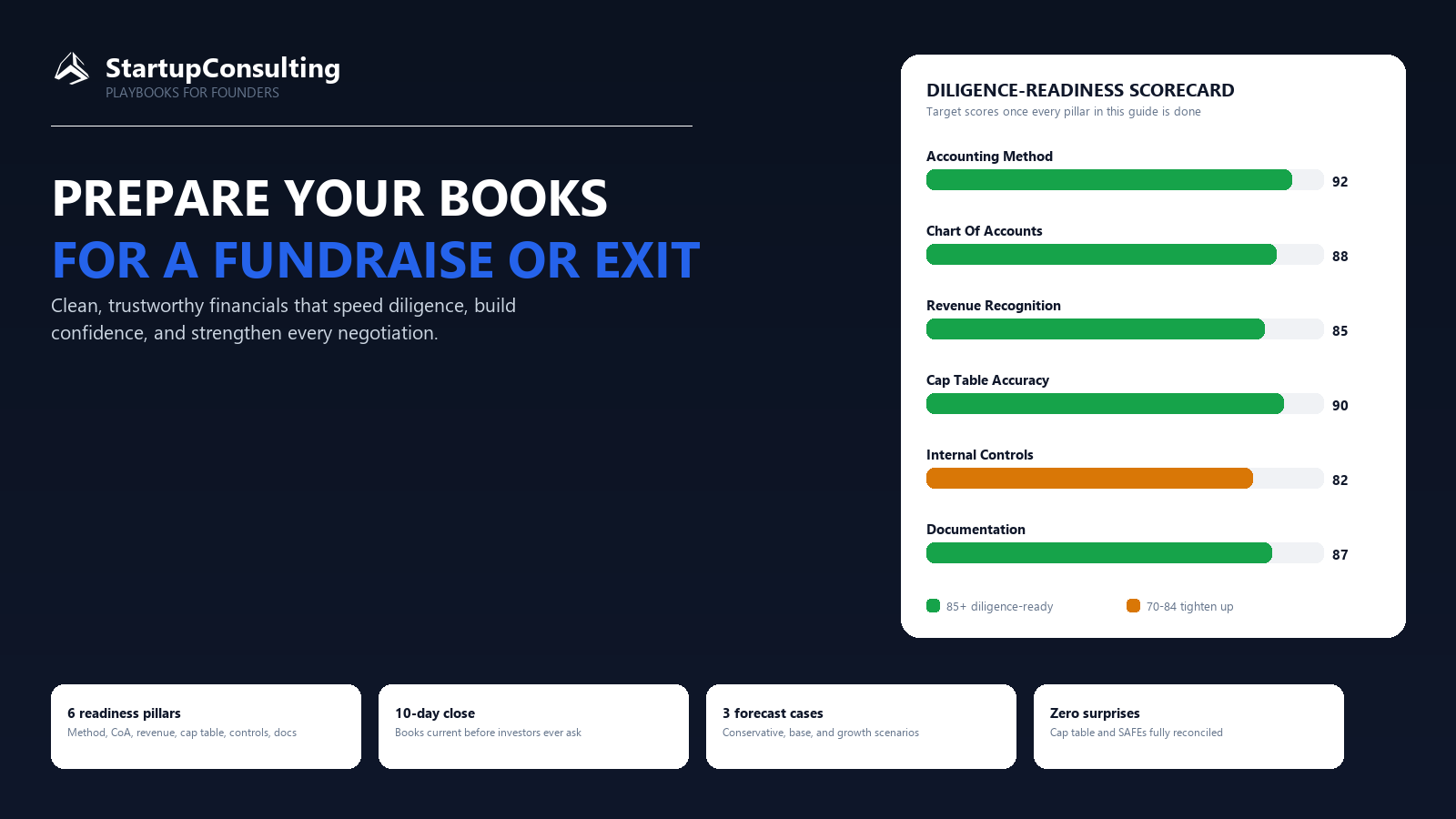
Raising a round or fielding acquisition offers feels exhilarating until someone asks for the last six quarters of bookings, burn rate proof, and a cap table that does not look like confetti. Founders then discover whether their numbers sing in harmony or shriek off key. The tidy science of finance may not thrill visionaries, yet it is the music investors study before committing capital.
Advice from seasoned startup consulting sources boils down to one imperative: get your books due-diligence ready well before the first data-room invite. Treat this guide as your financial due diligence checklist for turning raw ledgers into investor-ready financials. This guide walks through the moves that turn scattered spreadsheets into a polished symphony and keep inquisitive analysts smiling instead of scowling.
Why Your Books Matter Before Money Talks
Clean Numbers Build Trust
Investors and acquirers do not demand perfection, but they insist on consistency. When revenue arrives in one ledger while expenses lurk in another, red flags pop up. A coherent, GAAP-compliant set of records signals operational maturity and instills confidence that your team can scale responsibly. Clear margins also arm you with negotiating leverage. If you know gross profit by product line to the penny, you can defend your valuation with ease.
Transparency Speeds Negotiations
Delays during diligence often stem from missing invoices or ambiguous contract terms. By labeling each journal entry properly and attaching supporting documents, you answer questions before they surface. That translates into shorter exclusivity windows, fewer price chips, and faster wire transfers. In a market where speed makes or breaks deals, especially in competitive M&A processes, transparency is not just polite; it is strategic.
Keeping your financial house pristine is not a vanity exercise. Each tidy reconciliation frees brainpower for product strategy and underscores your commitment to professional discipline, a subtle cue that commands premium valuations.
Build The Foundation: Chart Of Accounts And Accounting Methods
Choose The Right Accounting Method
Cash accounting feels simple, but accrual reveals the true pulse of the business. Switching methods mid-flight complicates comparisons, so decide early. SaaS firms should embrace accrual to match subscription revenue with service delivery, whereas very early marketplaces might start cash due to transaction simplicity. Whichever path you pick, document the rationale so external reviewers understand context. If you are still running on cash and the bank balance is starting to disagree with how the business is actually performing, this guide to timing the shift from cash to accrual accounting walks through the signals worth checking before investors ask why the books do not line up.
Design A Chart Of Accounts That Reflects Reality
A bloated chart bloats headaches. Group accounts by major functions such as product development, customer success, and infrastructure, so you can trace ARR growth back to the teams driving it. Resist the urge to bury every new SaaS tool under “Miscellaneous Software” because that laziness hides trends. Use numbering schemes that allow future growth; leaving gaps between codes prevents renumbering chaos later.
Think of your chart of accounts as the legend on a treasure map. When markers are clear, explorers follow the path without detours, and you avoid frantic Slack threads explaining what “Other Misc” really means two years later.
| Foundation Piece | What It Controls | Best Practice | What Diligence Teams Look For | Example Setup |
|---|---|---|---|---|
|
01
Accounting Method
Cash vs. accrual determines when revenue/expenses “count.”
|
Timing and comparability of revenue, COGS, and operating expenses across months/quarters. |
|
Consistency quarter-to-quarter, clean cutoffs, and a clear explanation for any policy change. |
SaaSAccrual + deferred revenue
Early marketplaceCash (temporary)
PolicyDocumented memo
|
|
02
Chart of Accounts (CoA)
Your ledger’s “map”—how transactions are categorized and reported.
|
Reporting clarity: margins by product line, spend by function, and clean rollups for board/investor packets. |
|
A CoA that explains the business at a glance, with minimal “Other/Misc” and consistent categorization. |
4000sRevenue
5000sCOGS
6000sOperating expenses
Gaps10–20 codes
|
|
03
Functional vs. Vendor Coding
Avoid burying spend under “Misc Software.”
|
Your ability to explain spend drivers and show efficiency improvements over time. |
|
Whether category trends are believable and whether gross margin/opex are distorted by sloppy coding. |
RuleTag vendor in memo
SplitSupport tools → CS
SplitCloud hosting → COGS
|
|
04
Documentation & Consistency
Policies that make your numbers reproducible.
|
How quickly you can answer diligence questions without restating history. |
|
Evidence of a control environment: repeatable close, consistent treatment, and clear rationale. |
DocPolicy memo (1–2 pages)
CadenceMonthly close checklist
OwnerFinance “quarterback”
|
Tame Revenue Recognition And Deferred Income
Match Revenue To Delivery
Revenue that lands in the bank long before obligations are met is a liability, not a victory lap. Allocate subscription fees over service periods and align professional services income with milestone completion. Precision now avoids painful restatements during diligence when auditors scrutinize contract clauses with a magnifying glass.
Track Deferred Revenue The Smart Way
Set up automated schedules that release deferred revenue monthly. Tie each release to customer IDs and contract dates so reviewers can trace the waterfall, the same discipline that keeps ARR and deferred revenue reporting audit-ready. This proactive stance proves control environment strength and shields you from skepticism about revenue quality.
Auditors can smell sloppy revenue schedules like sharks smell blood. Early rigor prevents a feeding frenzy, saving you from value-eroding adjustments at the eleventh hour.
Control Expenses And Capitalization
Separate Operating Costs From Capex
Mixing hosting invoices with laptop purchases muddies gross margin and gives an inflated sense of profitability. Capture capital expenditures on a separate line and create depreciation schedules that match asset lifespans. Doing so assures potential buyers that future earnings will not evaporate under the weight of hidden asset write-downs.
Capture R&D Spend Correctly
Many founders assume all engineering costs are research and must be expensed. In reality, certain software development efforts qualify for capitalization. Consult standards, decide a policy, and apply it consistently. Capitalizing eligible work can lift EBITDA, but only when documentation is airtight.
Expense discipline is also cultural. Teams that see leadership separating capital costs from Friday fun budgets quickly learn to treat company money with respectful frugality, a habit acquirers appreciate.
Nail Down Equity, Debt, And Cap Table Accuracy
Update Equity Grants And Vesting
Nothing derails a raise faster than option grants missing board approvals or vesting schedules spelled out in Slack threads rather than resolutions. Reconcile your cap table against executed agreements, update strike prices to reflect recent valuations, and confirm that terminated employees no longer appear as shareholders.
Document Every Convertible Instrument
SAFE notes, convertible debt, and warrants lurk like hidden vegetables in a toddler’s meal. Spell out conversion caps, discounts, and maturity dates. Maintain a reconciliation sheet that shows fully diluted ownership under different scenarios so suitors can anticipate dilution instead of uncovering surprises mid-negotiation.
A clean cap table with a bulletproof paper trail tells a silent story about governance maturity. It reassures new shareholders that earlier rounds were handled with care and that no phantom shares lurk in the shadows.
Upgrade Systems And Internal Controls
Automate Where It Counts
Manual data entry breeds typos and late nights before board meetings. Modern cloud stacks integrate banking, payroll, and billing to feed real-time dashboards. Automation reduces error rates, strengthens your audit trail, and demonstrates scalability. Show that your finance stack is as modern as your product stack.
Set Approval Policies That Scale
A humorous office meme may celebrate the CEO’s single-sign-off spend policy, but acquirers will not laugh when they see no controls. Establish tiered approval thresholds and document them in an employee handbook. When diligence teams test transactions, they will find evidence of governance rather than a free-for-all.
Prepare Documentation For Due Diligence
Assemble The Financial Data Room
Organize bank statements, tax returns, customer contracts, and vendor agreements in a logical folder tree. Name files with dates and versions so reviewers can locate information without scavenger hunts. A neat financial data room signals operational rigor and can shave weeks off closing timelines, whether you are fundraising, preparing for an exit, or fielding early M&A interest.
- 32% Inconsistent or unrecognized revenue timing (see “Tame Revenue Recognition”)
- 27% Cap table errors, missing approvals, or undocumented SAFEs
- 24% Incomplete or disorganized financial data room documentation
- 17% Unclear expense or capex coding that distorts margins
Craft Cohesive Management Narratives
Numbers alone lack voice. Pair each financial packet with a narrative explaining growth drivers, one-time anomalies, and strategic pivots. When analysts grasp context quickly, they ask smarter questions, which you can answer confidently instead of frantically.
Scenario planning is also a creative exercise. It liberates you to imagine bold moves, safe landings, and worst-case storms, all within the sandbox of a spreadsheet instead of on the battlefield of real cash.
Stress-Test Scenarios And Forecasts
Model Conservative, Base, And Growth Cases
Diligence teams will not take your rosy forecast at face value. Build multiple scenarios that flex churn, pricing, hiring velocity, burn rate, and runway. Showing resilience under pessimistic assumptions illustrates thoughtful stewardship and reduces perceived risk.
Make Assumptions Transparent
List the source behind every driver whether industry report, historical cohort, or vendor quote. Transparency lets reviewers tweak inputs live rather than grill you over email chains. Collaborative modeling shortens the path to consensus.
Finally, rehearsing the process ahead of time melts stage fright. When the actual diligence curtain rises, your team performs with calm precision, turning a stressful rite of passage into a confident stride toward liquidity.
The Final Pre-Flight Checklist
Schedule A Mock Audit
Hire an external CPA to run a light audit before buyer auditors arrive. Discovering issues internally lets you fix them quietly instead of explaining them under fluorescent lights to a room of skeptical financiers.
Lock Timelines And Roles
Assign one person as diligence quarterback. Map out document deadlines and communication channels. When everyone knows the playbook, chaos fades and the closing process feels like a well-rehearsed performance rather than improv theatre.
Maintain Discipline Post-Transaction
Keep Reporting Cadence Consistent
Closing day is a celebration, yet the Tuesday after still needs bank reconciliations and budget variance reviews. Maintain monthly close rituals and continue publishing dashboards, proving that discipline was not a temporary makeover for investors but a permanent lifestyle.
Invest In Future-Proof Processes
Use fresh capital to shore up compliance modules, upgrade analytics, and train staff on new systems. By reinvesting in finance infrastructure, you prevent post-deal complacency and lay rails for the next stage of hypergrowth. Remember, the best time to plant the seeds of fiscal responsibility was yesterday; the second-best time is right now, before the next board packet is due.
Conclusion
Due diligence can feel like a gauntlet, but strong exit readiness and fundraise readiness reward preparation with better terms and smoother closes. When your financial records are crisp, your narratives compelling, and your controls battle-ready, investors stop poking holes and start picturing upside. Make bookkeeping a standing rehearsal, not a last-minute scramble, and your company will stride into every negotiation tuned, tested, and ready for an encore.
Put this into practice with AI
This article is for general information only and is not legal, tax, accounting, HR, or investment advice. Consult a qualified professional for your specific situation.
Related reading
 Fundraising
The Founder’s Guide to Startup Valuations and Cap Tables
Learn startup valuations & cap tables with clarity, understand ownership, dilution, and investor terms to raise smart, fair rounds that fuel long-term growth.
Read article Fundraising
How to Build a Startup Financial Model That Investors Will Love
Investor-ready modeling made simple with clear drivers, smart benchmarks, and storytelling that turns your spreadsheet into a confidence-building funding tool.
Read article Fundraising