
How to Build a Startup Financial Model That Investors Will Love
Building a financial model can feel like teaching a cat to fetch. Success is possible, but only if you understand the creature’s instincts. In your case, the creature is a sharp-eyed investor who wants proof that every dollar you request will morph into several more.
This guide walks you through building a startup financial model that charms that creature, dodges common errors, and might even make you grin along the way. We will pull wisdom from startup consulting exactly once right here, then dive straight into the nuts, bolts, and colorful wires that make your numbers sing.
Know What Investors Hunt For
Risk Versus Reward Thermometer
Investors evaluate each row of your investor-ready financial model like chefs tasting soup. They test heat, salt, and texture, which in finance become timing, magnitude, and certainty. You must show how risk cools while reward warms over time. Plot the capital you need, the milestones it unlocks, and the value created at each stage.
When a reader can trace those links without squinting, confidence spikes. If milestones slip, show how contingency reserves keep the company from going cold. That approach proves you think like a steward rather than a gambler.
The Story Behind Every Cell
A naked number is just scenery. Tell the tale of where it comes from, what influences it, and why it matters. If customer acquisition cost is forty dollars, explain the marketing mix, conversion funnel, and seasonal swings that produce it. Clarity beats cleverness.
Annotate unusual changes with short notes so busy partners do not misinterpret them as errors. A spreadsheet that reads like a novel—well paced, logical, and free of loose ends—keeps its audience turning pages instead of opening competing deals in new tabs.
Map Your Revenue Engine
Segment Drivers
Great revenue models treat revenue as a chorus, not a solo act. Break the top line into distinct segments, each with its own volume, price, and growth curve. Show how enterprise contracts rise slowly but stick around for years, while self-serve accounts spike quickly then churn if neglected.
Label each segment’s customer persona, sales channel, and contract term. Doing so reveals that you view revenue not as a monolith but as a living ecosystem where different species thrive under different conditions.
Price Logic That Holds Water
Pricing should never look like it came from a dartboard. Anchor it to competitor benchmarks, willingness-to-pay interviews, or value delivered per customer. If you plan to raise prices later, spell out the feature upgrades or cost savings that justify the jump.
Include a sanity check column comparing your projected gross margin to industry averages; if yours is ten points higher, explain the technology leap or supply chain edge that supports it. Transparency now prevents awkward committee calls later.
Map Your Revenue Engine
Treat revenue like a chorus, not a solo: split it into segments with clear drivers (volume × price × retention) so investors can stress-test assumptions without guesswork.
| Segment | Core drivers (what moves it) | KPIs investors look for | How to model it cleanly |
|---|---|---|---|
| Self-serve / SMB |
Signups → activation → paid conversion → ARPA → churn. Growth often comes from channel mix + product-led loops. |
Conversion: visit→signup, signup→paid Retention: logo churn, revenue churn Efficiency: CAC, payback |
Use a funnel with stage rates and cohort retention curves. Keep pricing simple: plans × mix × ARPA. |
| Enterprise |
Pipeline → win rate → ACV → implementation lag → renewals + expansions. Slower start, stickier cohorts when delivered well. |
Pipeline: coverage, cycle length Economics: gross margin, services load Durability: NRR, renewal rate |
Model by deals: new logos per month × ACV, with a start-delay. Add expansions as % of installed base (NRR logic). |
| Channel / Partners |
Partner recruitment → enablement → sourced leads → influenced closes. Revenue tied to partner quality and incentives. |
Output: sourced ARR, influenced ARR Health: active partners, attach rate Cost: rev-share % and support burden |
Model active partners × leads/partner × close rate × ACV. Separate direct vs influenced crediting. |
| Usage-based / Consumption |
Active accounts × units consumed × price/unit, plus seasonality and caps. Expansion happens naturally if product becomes habit. |
Usage: units/account, DAU/MAU Revenue quality: volatility, concentration Margins: COGS per unit |
Start with a baseline units/account and add growth ramps. Include guardrails: floors, ceilings, and overage tiers. |
Lay Down Expense Ramps
Variable Costs
Tie variable expenses directly to the metrics that drive them. Payment processing fees should scale with gross merchandise volume, server costs with active users, and support tickets with daily sessions. Build formulas, not hard-coded guesses.
This linkage impresses analysts who model scenario shocks, because raising or lowering one driver naturally adjusts downstream lines. The more your expenses mimic real-world physics, the more resilient your model will appear when someone starts toggling numbers like a curious toddler.
Fixed Overhead Reality Check
Founders often forget that people, software, and office rent rarely stay flat. Lay out headcount month by month, connecting each role to product road map or sales targets. Include realistic salary bands, benefits, and annual raises.
For software and rent, bake in tiered pricing so costs jump when you outgrow starter plans or physical space. Show that you know growth demands larger shoes, then prove you have budgeted for them before blisters appear.
Do not forget to model your own line item. Investors will ask what you pay yourself, and an unrealistic $0 founder salary or an inconsistent draw looks just as sloppy as a missing headcount ramp. Our breakdown of salary versus dividends for founders can help you settle on an assumption that is both defensible to the IRS and consistent in your model.
Assemble the Financial Trinity
Income Statement Clarity
Start your financial projections with revenue, subtract cost of goods, and arrive at gross profit without magician tricks. Slide into operating expenses, depreciation, and interest so that every subtotal reads intuitively. Keep line items consistent across periods to avoid forcing readers to hunt for reclassified expenses.
Group discretionary spend separately from mission-critical spend so management flexibility is obvious. A clean income statement is the backbone of credibility and the easiest place to spot wishful thinking.
If you have not already mapped out how those dollars should be split across product, marketing, and operations, this year-one capital allocation framework is a useful companion to the model, since investors will want to see the same categories reflected in both documents.
Balance Sheet Balance
Your balance sheet must actually balance—assets equal liabilities plus equity—yet many early models fail here. Track deferred revenue, accrued expenses, and prepaid assets so timing differences do not create orphaned cash.
If you carry inventory, model its turnover realistically or risk showing more stock than shelves. Investors love founders who respect accounting physics. Meet that expectation and you will hear fewer probing questions and more curious ones about upside.
Cash Flow Candor
Cash flow reveals whether the business breathes fresh air or recycles fumes. Separate operating, investing, and financing sections for clarity. Highlight working capital swings caused by payment terms or production cycles.
Capital expenditures deserve their own line, not a footnote buried in operating expense. Finally, reconcile net income to change in cash meticulously. When your ending cash climbs exactly as the reconciliation predicts, trust levels climb with it.
Revenue → Gross Profit → Operating Income
A single chart that ties the Income Statement (COGS, Opex, Operating Income) to margin expansion. Stacked bars show where each revenue dollar goes; lines show Gross Margin and Operating Margin.
Stress Test Without Mercy
Sensitivity Swaps
A good financial model sensitivity analysis starts by identifying two or three drivers—churn, price, or hiring speed—that move the model’s bottom line the most. Build a simple menu where adjusting each driver automatically updates revenue, margins, and runway. Label scenarios “Cautious,” “Base,” and “Confident” so readers instantly know what lens they are viewing. When you present the model, lead with the cautious scenario first. Showing you can survive lean times frames everything else as upside rather than wishcast.
Three Scenarios, One Model
Cautious, Base, and Confident are not three different spreadsheets, they are the same driver-linked model with one or two dials turned. Lead with Cautious so everything else reads as upside.
Benchmark Guardrails
Compare your assumptions to public filings, research reports, and trusted databases. If your SaaS gross margin sits at ninety percent while the industry pantheon averages seventy-five, highlight the proprietary architecture or reseller avoidance that explains the gap. If you cannot find support, drop the number. Benchmarking is not an academic exercise; it is a flashlight that finds blind spots before an investor’s diligence team does.
Polish and Package for Storytelling
One Page Highlights
Condense headline metrics into a single tab for your investor pitch deck: annual recurring revenue, blended gross margin, payback period, and months of runway at current burn. Pair each metric with a crisp definition to prevent misinterpretation. Format the tab so it prints on one sheet for old-school reviewers who like paper copies. This page is the trailer that convinces people to watch the full film, so make it punchy and accurate.
Version Discipline
Label files with date, time, and author initials. Lock formula cells, protect sheets, and include a change log noting what shifted and why. Distribute view-only links when possible to prevent accidental edits before partner meetings. Nothing erodes confidence faster than discovering that numbers discussed yesterday now differ. Version hygiene signals operational maturity—and maturity is magnetic in boardrooms.
Common Pitfalls and Sneaky Fixes
Spreadsheet Creep
Founders often bolt new tabs onto a model like spare parts on a race car. Eventually the vehicle rattles. Audit formulas quarterly, retire obsolete sheets, and document cell references so newcomers understand the maze. A streamlined model loads faster, crashes less, and delights reviewers who appreciate efficiency.
Magical Thinking
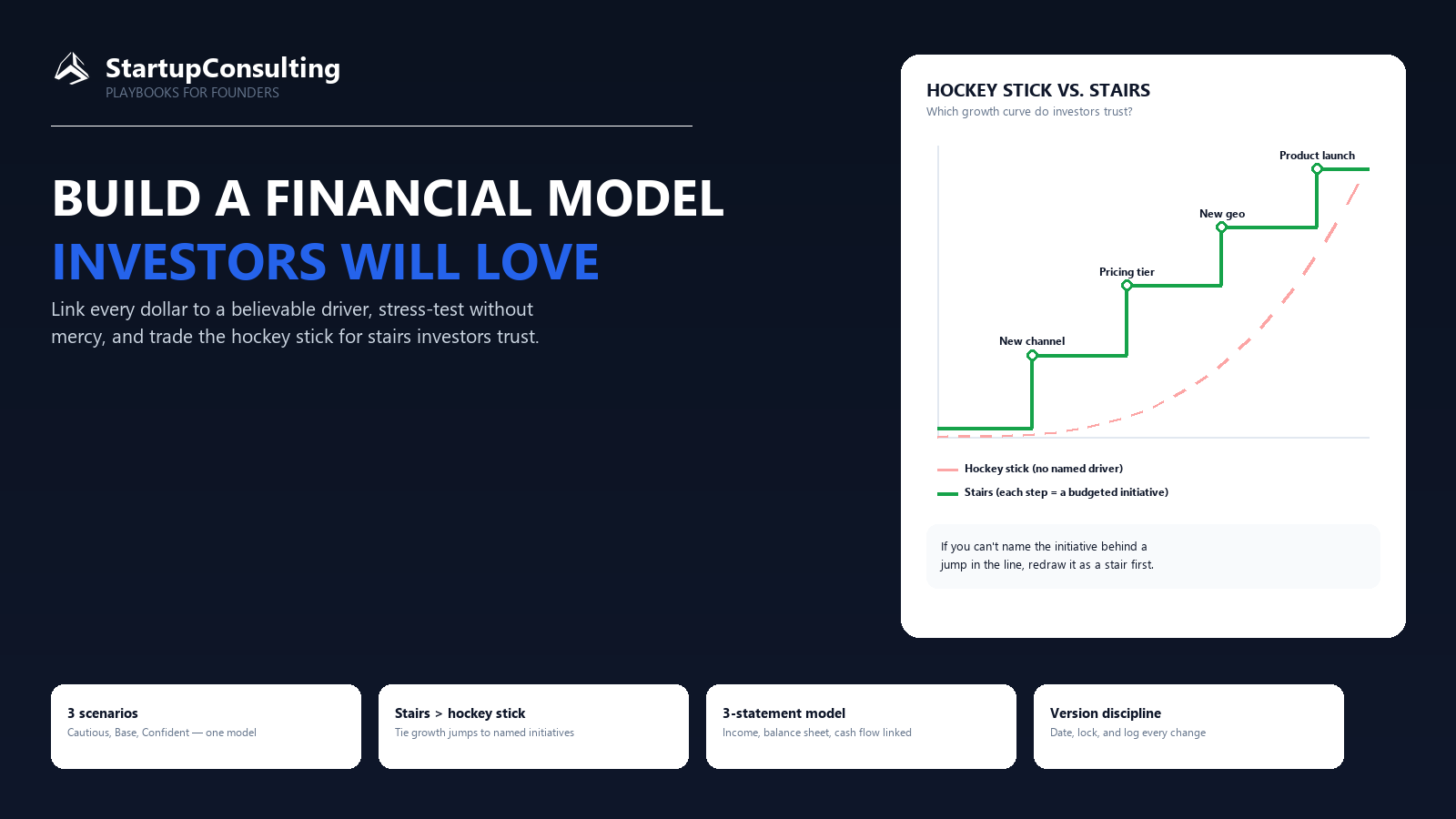
Beware hockey-stick curves that skyrocket without logical drivers. Replace them with stairs that climb after each product release, geographic expansion, or pricing tier. Reality is rarely exponential in the early years, and investors know it. Align growth jumps with documented initiatives and budget their costs upfront. You will appear both ambitious and grounded, a rare and winning combination.
Hockey Stick vs. Stairs: Which Growth Curve Do Investors Trust?
A curve that skyrockets with no logical driver reads as wishcasting. A curve that climbs in steps, each one tied to a dated, budgeted initiative, reads as a plan.
Conclusion
Financial modeling for startups is equal parts art and arithmetic. Treat your spreadsheet as a living narrative, not a static file, and it will carry your company’s story directly into investors’ imaginations. By linking every dollar to a believable driver, translating risk into measurable milestones, and maintaining obsessive version control, you will give potential backers something priceless: confidence. When that happens the conversations shift from “Why should we fund you?” to “How quickly can we sign?”
Put this into practice with AI
This article is for general information only and is not legal, tax, accounting, HR, or investment advice. Consult a qualified professional for your specific situation.
Related reading
 Fundraising
The Founder’s Guide to Startup Valuations and Cap Tables
Learn startup valuations & cap tables with clarity, understand ownership, dilution, and investor terms to raise smart, fair rounds that fuel long-term growth.
Read article Fundraising
How To Prepare Your Startup’s Books For A Fundraise Or Exit
Prepare your startup’s books for fundraising or exit with clear, trustworthy financials that speed diligence, build confidence, and strengthen negotiations.
Read article Fundraising