
When Should Your Startup Hire a CFO (and What Are the Alternatives)?
A growing venture often treats finance like a junk drawer: receipts mixed with investor updates, cap-table scribbles beside lunch invoices, and a half-baked forecast buried under mockups. Eventually the drawer jams. Founders then ask whether to hire a startup CFO or keep improvising.
The answer lives at the crossroads of scale, risk, and the discipline investors expect. In professional startup consulting circles, the debate boils down to math, momentum, and leadership appetite.
The Myth Of The Early CFO
Many founders believe a veteran finance executive will sprinkle credibility on a seed-stage pitch, yet an overqualified CFO can stall more than help. Early teams sprint on uncertainty, iterate pricing, and pivot markets weekly. A finance chief trained in a Fortune-size environment may crave pristine data the company cannot yet produce, slowing decisions.
Until revenue repeats itself and burn patterns appear, the highest-value activity is learning, not controlling. Hiring too soon risks turning agile brainstorms into policy reviews, devouring speed without adding insight. On the flip side, early fractional support can patch gaps without strapping a golden parachute to every cash forecast.
Signs Your Finance Needs Are Outgrowing Founder Math
Complexity Replaces Simplicity
At the pre-seed stage one bank account and a tidy spreadsheet capture reality. By Series A you juggle multiple revenue lines, deferred subscriptions, and maybe a hardware component with inventory turns. When billings follow different cycles from cash receipts, and answering a margin question requires an evening of coffee and circular-reference hunting, complexity has already outrun DIY math.
Money Talks To Regulators
The moment sales-tax nexus appears in three states or international customers ask for VAT numbers, your finance stack moves from internal scoreboard to legal obligation. Misfiled payroll taxes can invite penalties larger than your monthly marketing spend. A professional finance leader, whether in-house or fractional, shifts compliance from reactive scurry to predictable routine, shielding founders from headline-making mishaps.
When signs like these compound, they whisper one message: elevate finance from task list to core function. Our rundown of the most common accounting mistakes founders make is a useful gut check before you decide whether a CFO or fractional hire is overdue.
| Sign | What it looks like day-to-day | Why it’s risky | What to do next |
|---|---|---|---|
|
Complexity replaces simplicity
You’re juggling multiple revenue lines, billing cycles, and cost structures. Operational complexity |
|
|
|
|
Money starts talking to regulators
Finance becomes a legal obligation, not just an internal scoreboard. Compliance pressure |
|
|
|
|
Cash questions take too long to answer
“How much runway?” becomes a debate instead of a quick lookup. Runway visibility |
|
|
|
|
Investor/board scrutiny is rising
The questions shift from “growth story” to “proof and precision.” Governance |
|
|
|
The Core Role Of A Startup CFO
A credible startup CFO is not merely an accountant with a shinier title. They weave product, sales, and hiring plans into one coherent forecast. They present that narrative to investors in language that translates risk into opportunity. They monitor burn rate and runway weekly and flag trouble before burn reaches panic territory.
They structure equity plans, negotiate debt lines, and build dashboards the whole team can trust. Crucially, they install systems able to scale far beyond the next raise, so finance becomes a growth engine, not a bottleneck.
Timing The Hire: Funding Stage And Cash Thresholds
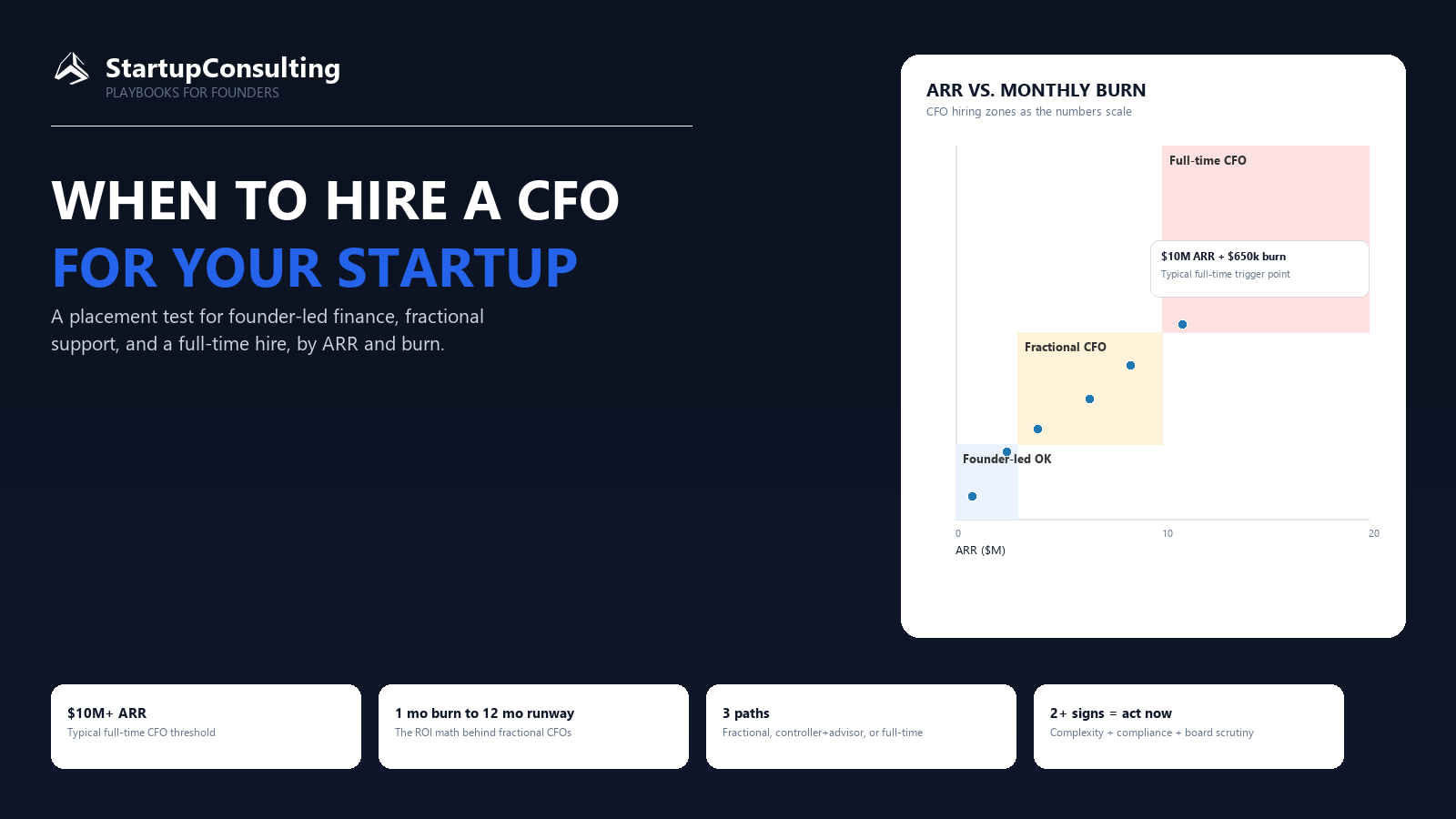
Most ventures land their first full-time CFO between late Series B and mid-Series C, around the stage where annual recurring revenue clears ten million or monthly burn demands eight-figure precision. That window aligns with board pressure to shift from growth at all costs to growth with guardrails.
Companies with slim margins or heavy regulation may accelerate the hire, while high-gross-margin software shops can delay until expansion crosses multiple geographies. Funding milestone alone is not destiny; the real trigger is when financial unknowns could sink strategy faster than product risk.
Alternatives To A Full-Time CFO
Fractional CFOs Deliver Senior Insight
A fractional CFO parachutes in a few days per month, guiding forecasting and fundraising without demanding a six-figure salary. They bring pattern recognition from dozens of ventures and can shepherd audit readiness or term-sheet negotiations.
The trade-off is availability. If your startup pivots twice in a week, waiting three days for feedback leaves leadership guessing. Still, for many Series A companies a fractional leader plus a capable senior accountant keeps finance humming at a fraction of the cost. It is the same tradeoff founders weigh when comparing full-time HR against fractional HR support: senior judgment on demand, at a lower fixed cost, in exchange for less day-to-day availability.
Controller Plus Strategic Advisor Combo
Another route pairs an experienced controller running day-to-day accounting with an outside strategic advisor. The controller shores up processes, closes books quickly, and implements software, while the advisor joins board meetings to narrate growth, freeing founders to champion vision. This arrangement buys time until revenue scale justifies a permanent C-suite seat.
How To Prepare For A CFO Before You Post The Job
A CFO’s first question will be “show me the data.” Begin by moving bookkeeping from spreadsheets to a cloud system that reconciles automatically. Build a chart of accounts aligned with how you manage the business, not how generic templates list expenses. Document revenue-recognition policies even if auditors have not yet come knocking.
Catalog every commercial contract in a shared drive. Create a simple KPI dashboard tracking gross margin, churn, acquisition cost, and payback period. The cleaner your house, the faster a new finance leader can turn insight into action.
Measuring ROI Of Financial Leadership
Startup finance leadership may seem like a cost center, but the right leader pays for themselves. They can shave dilution by negotiating better credit terms, spot revenue leakage in missed renewals, and guide pricing moves that add margin without hurting conversion.
A disciplined finance chief also unlocks partnerships by proving reliability to vendors, easing collateral demands and enabling favorable payment terms that stretch cash further than any fundraiser could achieve alone in the early months. If a fractional CFO adds twelve months of runway while charging the equivalent of one month’s burn, the return is obvious.
Cultural Fit And Leadership Dynamics
Founders sometimes fear a CFO will throttle creative energy. The antidote is hiring for cultural add, not just résumé heft. Seek candidates who speak product as fluently as balance sheets and who translate chaos into calculated bets.
A finance leader comfortable in sneakers and sprint retrospectives can become a strategic copilot rather than a traffic warden. Probe for stories where they empowered experimentation while safeguarding resources. Investors respect prudence; teams cheer support that feels like coaching rather than policing.
Red Flags That Signal Waiting Too Long
If vendor payments slip because approvals lag, if board decks prompt forensic questioning over missing metrics, or if a funding round’s due-diligence request turns into a fire drill, you waited past the ideal window.
Another glaring clue is recurring budget shocks: a surprise tax bill, an unforeseen spike in hosting costs, or an unnoticed drop in gross margin. Each shock erodes trust externally and morale internally. Finance leadership provides early warning lights, not post-mortems.
The Recruitment Process: Crafting A Magnetic Job Description
When the moment arrives, articulate outcomes instead of tasks. Spell out expectations around fundraising readiness, metric architecture, and cross-department collaboration. Be upfront about volatility and rapid decision cycles so candidates self-select for adrenaline tolerance.
Offer competitive equity but balance with vesting schedules that protect the cap table if the match sours. During interviews, assess curiosity: the best CFOs treat unfamiliar models like puzzles, asking incisive questions before proposing fixes.
Onboarding Your New Financial Leader
First weeks set the tone. Introduce the CFO to every function, from engineering to customer success, so they grasp levers behind each number. Allocate time with investors to align on reporting cadence and preferred metrics.
Encourage shadowing of sales calls and product demos. The deeper a finance head understands the customer journey, the richer their forecasting assumptions. Clarify decision rights early, detailing spending levels requiring CFO sign-off and how budget changes flow.
Evolving The Role As The Company Matures
At Series D and beyond, the CFO shifts from tactical modeling to institutional leadership. They negotiate credit facilities, orchestrate secondary share programs for employees, and map exit pathways whether public listing or strategic sale.
Their team balloons to include treasury, tax, and perhaps a mergers-and-acquisitions analyst. Founders should revisit role scope annually, ensuring the mandate grows alongside ambition; stagnation breeds frustration and needless turnover.
Conclusion
Choosing the right moment to hire a CFO for your startup is not a rigid command from a handbook; it is an honest reckoning with complexity, risk, and ambition. Recruit too early and you bog invention under procedure. Wait too long and you invite chaos to play accountant.
Whether you select a full-time executive, a fractional veteran, or a savvy controller-advisor tandem, treat finance leadership as an accelerator of insight, not a hall monitor of spend. When numbers get the respect they deserve, investors relax, teams focus on customers, and the company moves faster, safer, and smarter toward the horizon it set out to conquer.
Put this into practice with AI
This article is for general information only and is not legal, tax, accounting, HR, or investment advice. Consult a qualified professional for your specific situation.
Related reading
 Finance
Should You Pay Yourself a Salary or Dividends as a Founder?
Founder pay explained: compare salary vs dividends, tax impacts, compliance rules, and cash flow tradeoffs to choose the smartest compensation mix.
Read article Finance
5 Common Accounting Mistakes That Sink Startups
Learn five common accounting mistakes sink startups and how to avoid them with simple routines that protect cash, taxes, runway, and investor trust.
Read article Finance
Burn Rate, Runway, and Cash Flow: Financial Metrics Every Founder Should Track
Burn rate, runway, and cash flow shape every startup’s survival plan. Learn how these metrics guide smarter decisions and keep your company moving with confidence.
Read article