
5 Ways to Reduce Your Startup’s Tax Burden Before Year-End
Launching a company in December feels like racing downhill on a skateboard while balancing a tray of espresso shots: thrilling, reckless, and somehow right on schedule. The calendar is shrinking, investors keep refreshing their dashboards, and the tax collector is lacing up running shoes. Happily, a handful of well-timed moves can keep more cash in your war chest and less parked at the treasury. With guidance worthy of top-tier startup consulting, this article unpacks five practical tactics you can still deploy before the clock strikes midnight.
A quick heads-up before we dive in: these strategies work best when your books are current and receipts are not hiding in a shoebox. If your accounting resembles a mystery novel, dedicate a morning to reconciling bank feeds and tagging expenses accurately. Clean data turns the following plays from confident talk into real-world impact. Ready? Caffeinate, crack knuckles, and let the countdown to lower taxes begin.
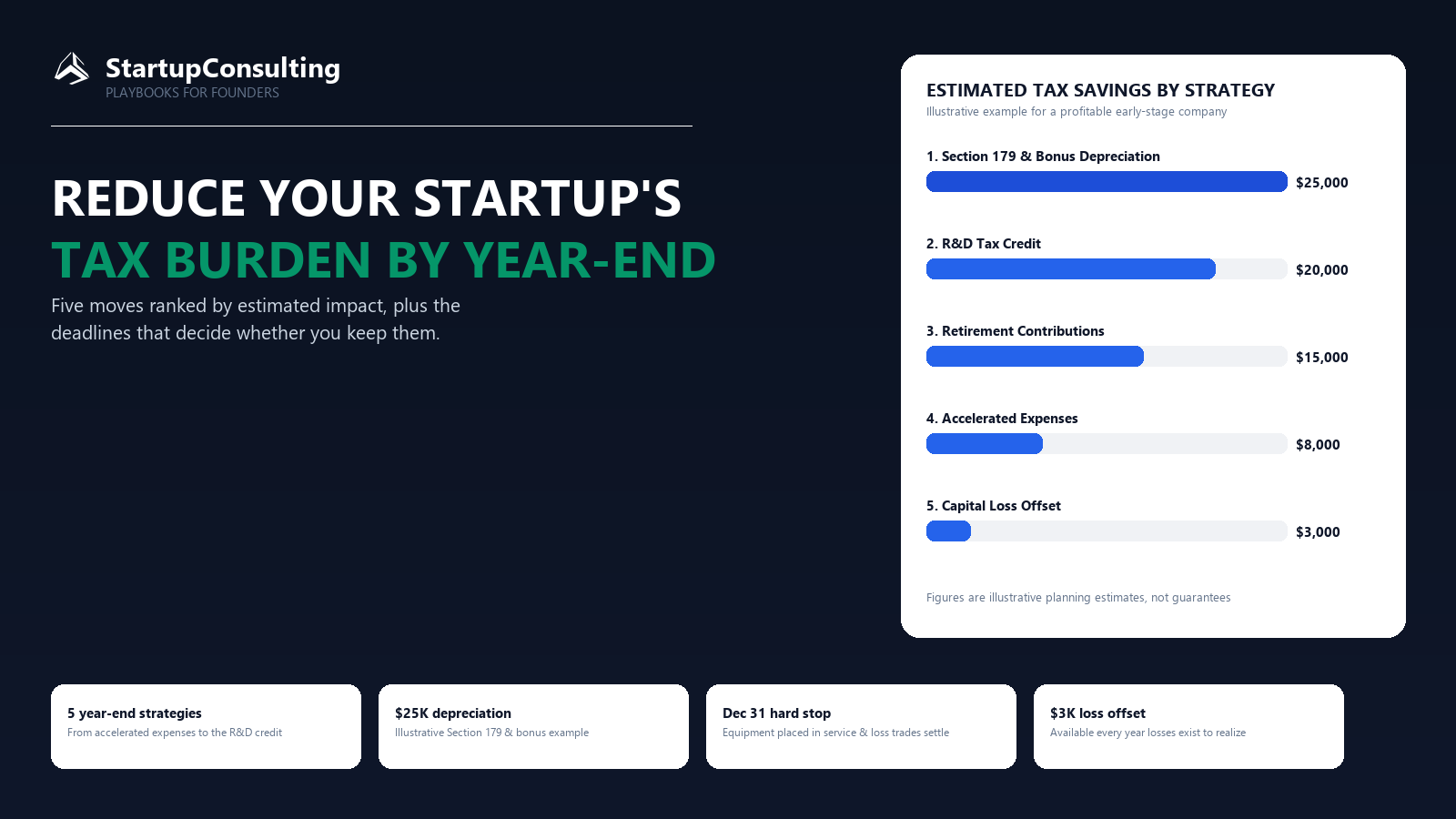
Before diving into each tactic, it helps to see the relative size of the prize. Some founders also practice tax-loss harvesting throughout the year rather than waiting for a December scramble, trimming taxable gains every time a position turns sour. And because the IRS expects a share of profits on a rolling basis, staying current on estimated tax payments keeps you from trading one tax headache, an underpayment penalty, for another. Just remember that trimming income tax exposure is only part of the equation: many states also send a Delaware franchise tax bill early in the new year that is calculated using year-end share and asset figures, so decisions you make before December 31 can move that number too.
Accelerate Eligible Expenses Before The Clock Strikes Twelve
Commit To Planned Purchases Now
Imagine your tax return as a photograph taken at midnight on New Year’s Eve. Whatever spending appears in that frame reduces this year’s taxable income, while expenses postponed until January morph into next year’s burden. If fresh laptops, annual software licenses, or prepaid advertising credits already sit in next quarter’s budget, slide them forward.
The government rewards the proactive shopper who finishes retail therapy before the last calendar page drifts away. Even modest purchases stack up quickly; what seems like pocket change today can shave thousands from taxable profit.
Document Everything Like A Tax Detective
Receipts are the love letters your accountant cherishes. Forward digital invoices to an expenses inbox, snap pictures of paper slips with your phone, and tag each item in your bookkeeping app the moment it lands.
Detailed notes prevent future head-scratching and turn a potential audit into a polite chat. For extra clarity, keep a shared spreadsheet listing every accelerated expense, its vendor, and the date cash left your account. Organization is not glamorous, but neither is overpaying taxes.
Supercharge Retirement Contributions
Treat Your Future Self As A Vendor
When founders picture vendors they must pay, their own retirement rarely tops the list, yet funneling money into a Solo 401(k) or SEP-IRA produces a powerful double win. Every dollar contributed lowers taxable income today and quietly compounds for decades.
Think of it as paying an invoice to an extremely patient supplier who delivers hammock time and beach chairs down the line. Even modest deposits matter; ten thousand dollars invested at a seven-percent annual return can bloom into nearly forty thousand within twenty years.
Mind The Calendar And The Caps
Contribution limits rise almost every year and deadlines vary by plan type. Some require cash in the account before December ends, while others allow funding as late as your filing date. Mark the earliest possible cutoff in bold red font and aim to hit it. Waiting invites last-minute cash-flow drama and the risk of missing the door entirely.
Review both employer and employee limits if you wear both hats, then fund as aggressively as your budget allows. Early reminders prevent December panic and keep compound interest working at full throttle.
Retirement contributions are not the only lever tied to the calendar. Companies offering deferred compensation plans should confirm elections are locked in well before the relevant deadline, since many arrangements require paperwork signed before the compensation is even earned. Boards weighing a year-end bonus accrual face a similar timing puzzle: the expense can often be deducted this year even though the cash goes out early next year, provided it is paid within two and a half months of the close of the tax year. Founders leaning on Section 179 expensing for new equipment should map those purchase dates against retirement funding dates on the same calendar, since both categories compete for the same finite cash before December 31. It is also the moment many founders quietly compare taking a bit more salary versus an extra dividend distribution before the year closes, since that choice interacts directly with payroll tax exposure and retirement contribution room.
Harvest Capital Losses Before They Expire
Turn Red Ink Into Gold
No founder enjoys selling an investment that has plunged underwater, but realizing the loss can offset gains harvested earlier in the year. If gains run thin, up to three thousand dollars of losses can still offset ordinary income, and unused amounts carry forward like vintage wine waiting for a profitable vintage. By transforming a paper disaster into a real deduction, you soften the sting of market turbulence and free capital to chase fresh opportunities.
Avoid The Wash Sale Boomerang
Sell and rebuy the same stock inside thirty days and the tax code waves a stern finger known as the wash-sale rule. It disallows the loss and laughs at your heroic timing. The workaround is straightforward: stay out of that exact security for thirty-one days or purchase a not-too-similar proxy if market exposure matters more than sentimental loyalty. Automated alerts help you remember when re-entry is safe, and your future accountant will applaud the foresight.
Harvesting losses is a strategic maneuver, not an admission of failure. By redeploying capital into better prospects, you transform setbacks into a springboard for next year’s growth.
Deploy Section 179 And Bonus Depreciation
Write Off Big Ticket Gear In One Go
Section 179 lets you deduct the full cost of qualifying equipment placed in service before year-end rather than dribbling depreciation over time. That laser cutter, enterprise-grade server, or ergonomic conference table can slice taxable profit the moment it is assembled and humming.
Remember the phrase “placed in service,” because simply ordering the item is not enough; installation and initial testing must happen while this year’s calendar is still hanging on the wall.
Pair Immediate Deduction With Bonus Power
Even after maxing your Section 179 election, bonus depreciation can scoop up the remaining basis of new or used assets and deduct a hefty percentage right away. Pairing the two is like ordering dessert after devouring the entrée; indulgent, yet entirely within the rules.
Beware of phase-out schedules written into law; generous percentages shrink in coming years unless legislators extend them. Aggressive depreciation lowers taxable income now but reduces future deductions, so project profitability carefully to avoid a barren write-off landscape down the road.
Capture The Often Ignored R And D Credit
Innovation Pays You Twice
Writing original software, developing novel hardware, or running lab experiments all generate qualified research expenses. The R and D credit rewards such daring pursuits by offsetting income tax dollar for dollar. Many founders skip it because the forms look dense, yet the payoff is closer to a video-game power-up once a specialist handles the paperwork. The credit can reach twenty percent of eligible costs, effectively turning every five dollars of research into four after taxes.
Payroll Offsets Keep Cash Inside
For early stage companies running at a loss, the credit can offset payroll taxes up to a generous annual cap, returning real cash every quarter. That refund often fuels the next sprint cycle, transforming the credit into renewable energy for innovation rather than a dusty line item. Keep meticulous time-tracking for engineers and scientists, note experiment objectives, and save invoices for testing materials. Organized documentation is the drawbridge protecting your castle of credits, so lower it early and often.
Before the year closes, schedule a quick meeting with your tax advisor to classify upcoming projects for credit eligibility. Knowing which efforts qualify lets you capture hours accurately from day one rather than reconstructing them in a March memory marathon. Act quickly to maximize every deduction.
| Focus Area | What It Means | How To Apply It | Why It Matters |
|---|---|---|---|
|
Innovation Can Qualify
Product development may create tax value beyond the product itself.
|
Original software development, novel hardware design, and experimental technical work may generate qualified research expenses. | Review current engineering and product initiatives to identify projects involving experimentation, technical uncertainty, or iterative development. | Founders often overlook the chance to turn innovation spending into a direct tax benefit. |
|
Credit Value
The benefit can materially reduce tax owed.
|
The R&D credit can offset income tax dollar for dollar, making it more powerful than a standard deduction in many cases. | Work with a tax advisor or specialist to calculate eligible costs and determine how much of the credit your company may be able to claim. | When captured correctly, the credit can improve runway by reducing the company’s actual tax liability. |
|
Payroll Tax Offset for Early-Stage Startups
Useful even when the company is not yet profitable.
|
Early-stage startups running at a loss may be able to apply the credit against payroll taxes, creating near-term cash flow relief. | Confirm eligibility early and align payroll reporting so the benefit can be captured as part of the filing process. | This can bring real cash back into the business and help fund the next cycle of product development or hiring. |
|
Documentation Discipline
Good records make the credit defensible.
|
Time tracking, experiment objectives, payroll detail, vendor invoices, and project notes all help support the claim. | Keep detailed records for engineers and scientists, save testing-material invoices, and document the purpose and scope of experimentation. | Strong documentation protects the company if the credit is questioned and makes year-end filing far less painful. |
|
Plan Before Year-End
Preparation now prevents reconstruction later.
|
Classifying projects before the year closes makes it easier to capture qualifying hours and costs accurately from the start. | Schedule a year-end review with your tax advisor to flag upcoming projects, define eligibility, and organize the records needed to support the claim. | Acting early helps maximize the credit and avoids a last-minute scramble to rebuild project history from memory. |
Conclusion
Year-end tax planning does not require a crystal ball or a doctorate in accounting. By accelerating expenses, supercharging retirement contributions, harvesting capital losses, unleashing depreciation tools, and claiming the R and D credit, you can slim your tax bill and fatten next year’s runway in one decisive sprint.
None of these moves demand heroic effort—only timely action, tidy records, and the courage to prioritize long-term gain over short-term inertia. Review each tactic with a trusted professional, pull the appropriate levers before the ball drops, and greet April with a grin instead of a grimace. Your future self, basking in stronger cash reserves and a calmer balance sheet, will be glad you did.
Put this into practice with AI
This article is for general information only and is not legal, tax, accounting, HR, or investment advice. Consult a qualified professional for your specific situation.
Related reading
 Tax
TaxHow to Stay Audit-Proof: Startup Tax Compliance Made Simple
Stay audit-proof with simple startup tax habits. Learn to organize records, meet deadlines, and reduce audit risk while keeping founders sane and funded.
Read article Tax
TaxWhat Every Founder Should Know About Delaware Franchise Tax
Delaware franchise tax explained for founders, including calculation methods, deadlines, and smart ways to avoid costly surprises each year.
Read article Tax
TaxHow To Structure Your Startup For Maximum Tax Efficiency
Learn how to structure your startup for maximum tax efficiency, from entity choice to equity planning, so more capital stays focused on growth.
Read article