
Pass-Through vs. Corporate Taxation: How It Affects Startup Founders
Your first brush with tax jargon can feel like deciphering an alien menu, but choosing between pass-through and corporate taxation will shape your cash flow, investor appeal, and even your sleep cycle. As you read, imagine me sliding a mug of strong coffee across the table and, with a wink, promising that we'll keep the math digestible. In the world of startup consulting, entity choice is one of those forks in the road that sneaks up early and refuses to disappear.
The Tax Basics Every Founder Needs To Know
What Is Pass Through Taxation
A pass-through entity, think sole proprietorship, partnership, or the ever-popular LLC, doesn’t pay income tax at the business level. Instead, its profits hitch a ride on the owners’ personal returns. Uncle Sam meets you at your Form 1040, tips his hat, and tallies income, self-employment taxes, and whatever state bite applies. The company itself files an informational return, but the check to the Treasury comes from you.
What Is Corporate Taxation
A C-corporation, by contrast, is a separate wallet. It files its own return and pays the corporate rate on profits left after deductible expenses and salaries. Then, if the board declares dividends or a buyer cashes out your shares, shareholders pay tax again on that distribution. That infamous “double taxation” is less horror movie, more inconvenient sequel, but it still pops popcorn out of your earnings if you’re not careful.
Comparing The Numbers
Federal And State Rates
Pass-through owners pay ordinary income rates, which march through brackets up to thirty-seven percent federally. Corporations face a flat twenty-one percent. On paper, twenty-one beats thirty-seven any day. Yet states add their own twists: some levy franchise taxes on corporations while sparing LLCs; others, like Texas, slap a gross-receipts style margin tax on both. The scoreboard varies wildly once local rules show up.
Self Employment Taxes
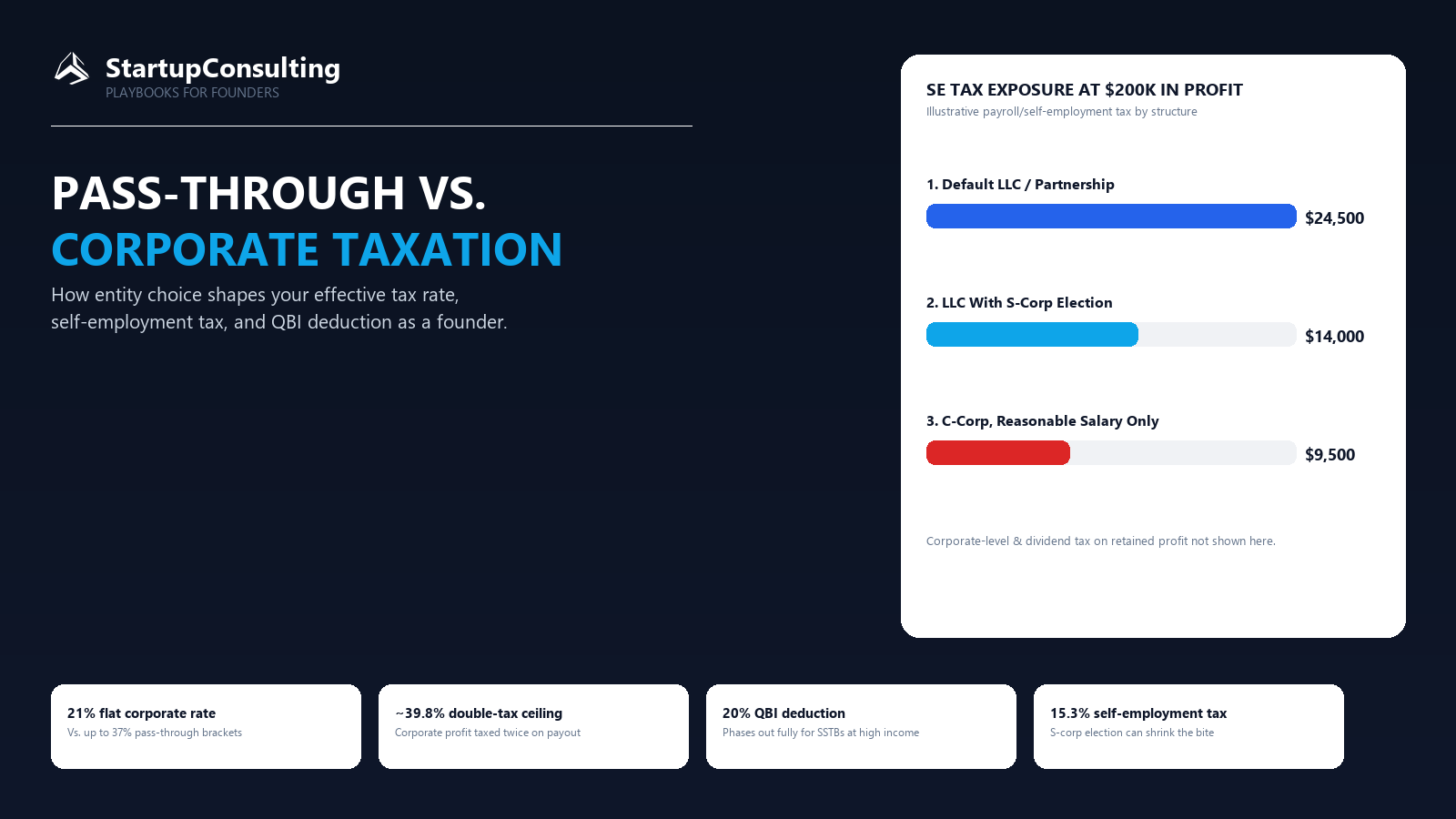
Pass-through income usually attracts self-employment tax, currently fifteen-point-three percent on the first chunk of earnings, covering Social Security and Medicare. Corporations can dodge part of this by paying founders a “reasonable salary” and treating the rest as dividends, which are free of payroll levies. Be warned: set the salary too low and the IRS may treat your “reasonable” as a punchline.
Here’s a hybrid worth knowing about: an LLC can elect S-corp taxation without becoming a C-corp at all. That election still keeps the single layer of pass-through tax, avoiding the double taxation that a C-corp risks on dividends, but it lets the owner split income into a reasonable salary, subject to payroll tax, and a separate distribution that escapes self-employment tax entirely. It’s the same “pay yourself a salary” logic C-corp shareholders use, borrowed by a pass-through entity. The IRS watches the salary-to-distribution ratio closely, so this move tends to pay off only once profits comfortably clear a market-rate salary.
The QBI Deduction Wildcard
One more variable worth tracking is the Section 199A qualified business income (QBI) deduction, which lets many pass-through owners deduct up to twenty percent of qualified business income before tax is calculated, effectively pulling the top federal pass-through rate down from thirty-seven percent toward the high twenties for those who qualify in full. The catch is that the deduction phases out once taxable income crosses statutory thresholds, and specified service trades or businesses (SSTBs), a category that scoops up plenty of consulting and other professional-service startups, lose the deduction entirely once income clears the upper threshold. C-corporations never had access to QBI in the first place; the flat twenty-one percent corporate rate was Congress's trade for leaving it out. That means high-income service-business owners sometimes find the pass-through and corporate paths land closer together than the headline rates suggest.
Double Taxation Concerns
Picture profits as a sandwich. In a pass-through, you take a single bite and move on. In a corporation, the taxman takes a nibble at the entity level, wraps up the remainder, and later asks shareholders for another bite. The total federal-level munch reaches roughly thirty-nine-point-eight percent when dividends are in play, which feels a tad crowded for one sandwich.
Strategic Factors Beyond The Math
Investor Preferences
Venture capital firms love the clean cap table and unlimited share classes of C-corps. Many funds are barred by charter from investing in pass-throughs, so choosing an LLC might slam the door before your pitch deck even loads. Angels are more flexible, yet still appreciate the predictability of corporate stock for SAFE or convertible-note deals.
Equity Compensation
Try gifting options in an LLC and you’ll discover a swamp of “profits interests,” Section 83(b) elections, and eyebrow-raising valuations. A corporation, meanwhile, trots out the tried-and-true ISO and NSO plan. Employees have seen those acronyms before, which helps you recruit talent without first forcing them through a tax seminar.
Exit Scenarios
If your dream ending is an IPO, the C-corp structure is practically required. Public markets demand that tidy corporate shell. For an asset sale or small strategic acquisition, an LLC can be efficient because buyers often prefer to purchase assets for basis step-ups, and members can sometimes secure capital-gains treatment on the gain.
Choosing Your Entity In The Real World
Early Stage Bootstrappers
Running lean on personal savings and sweat equity? The administrative simplicity of a single-member LLC is tough to beat. Pass-through losses can offset other income, softening the blow of ramen-noodle dinners. Just file the short Schedule C, keep receipts, and you’re free to iterate on product-market fit rather than board minutes.
Venture Backed Rockets
Once term sheets whirl through DocuSign, the C-corp becomes king. Preferred shares, liquidation preferences, and Qualified Small Business Stock perks come bundled in the Delaware corporate package. Yes, you’ll file a separate tax return and maintain bylaws, but investors will thank you with larger checks and fewer eyebrows raised.
Lifestyle Businesses
Not every founder wants to blitzscale. If steady cash distributions and personal control top your wish list, an LLC can shine. Distributions can be timed to cover quarterly estimates, members can make targeted basis adjustments, and formalities remain light enough that board meetings never crowd your beach calendar.
| Founder Situation | Typical Priority | Structure That Often Fits Best | Why It Usually Fits |
|---|---|---|---|
| Early-Stage Bootstrappers Lean and Simple | Preserving cash, keeping administration light, and moving quickly while testing product-market fit with minimal overhead. | A single-member LLC or another pass-through structure often fits best at this stage. | Pass-through treatment can keep things simpler, losses may offset other income in some cases, and founders avoid the heavier governance and tax filing burden that comes with a corporation before outside capital is in the picture. |
| Venture-Backed Startups Scale and Fundraising | Attracting institutional investors, issuing equity cleanly, and preparing for preferred stock, SAFEs, option plans, and future financings. | A C-corporation, especially a Delaware C-corp, is usually the strongest fit. | Venture investors generally prefer corporate stock, standard venture documents work more smoothly in a corporate structure, and the company is better positioned for stock options, follow-on rounds, and a potential IPO path. |
| Lifestyle Businesses Cash Flow and Control | Maintaining owner control, distributing earnings efficiently, and avoiding unnecessary complexity when the goal is durable income rather than venture-scale growth. | An LLC or another pass-through structure often makes more practical sense. | Owners can often take distributions more directly, formalities stay lighter, and the structure aligns well with businesses that prioritize steady profitability, flexibility, and personal ownership over venture fundraising mechanics. |
| Founders Expecting to Convert Later Flexibility First | Starting simple now while preserving the option to adopt a more investor-friendly structure when fundraising or scale demands it. | Many founders begin with an LLC, then convert to a corporation once capital needs, hiring complexity, or investor expectations increase. | This approach can reduce early friction, but timing matters. Conversions are possible, yet they should be planned carefully to avoid tax surprises, documentation messes, or rushed legal work right when a financing heats up. |
Keeping Flexibility Alive
Conversions And Timing
The beautiful quirk of U.S. entity law is that conversions often resemble a costume change. An LLC can elect corporate tax treatment with a simple Form 8832, or go full C-corp via statutory merger when funding heats up. Reverse conversions exist as well, though they carry tax baggage. Pick your moment carefully, like a surfer eyeing the perfect wave.
Pass-through versus corporate taxation is only the first fork in the road. Once you know which side you are on, the next questions are how to layer holding companies, time an S-corp election, and handle multistate nexus without creating new headaches. Our guide on structuring your startup for maximum tax efficiency walks through those follow-on decisions in more detail.
Protecting Personal Assets
Regardless of tax flavor, limited liability shields your house from product liability suits or vendor disputes. Pierce that veil with sloppy accounting, however, and creditors may stroll past the fence. Maintain separate bank accounts, sign contracts in the company name, and document major decisions. Bank reconciliation keeps the paper trail crisp and highly credible.
Conclusion
Choosing between pass-through and corporate taxation is like picking the right superhero costume: the best fit depends on the mission. If you crave simplicity, quick distributions, and small-team autonomy, the pass-through cape may flutter nicely in the breeze. If you lust after venture capital, stock options, and a Wall Street finale, a corporate suit of armor offers the protection and polish investors expect.
Either way, stay alert to shifting laws, track your numbers with monk-like discipline, and call in a trusted tax pro before signing paperwork. Your future self, reclining on a beach with proper tax savings, will thank you.
Put this into practice with AI
This article is for general information only and is not legal, tax, accounting, HR, or investment advice. Consult a qualified professional for your specific situation.
Related reading
 Tax
TaxHow to Stay Audit-Proof: Startup Tax Compliance Made Simple
Stay audit-proof with simple startup tax habits. Learn to organize records, meet deadlines, and reduce audit risk while keeping founders sane and funded.
Read article Tax
TaxWhat Every Founder Should Know About Delaware Franchise Tax
Delaware franchise tax explained for founders, including calculation methods, deadlines, and smart ways to avoid costly surprises each year.
Read article Tax
Tax5 Ways to Reduce Your Startup’s Tax Burden Before Year-End
Five practical year-end tax strategies for startups to cut liabilities, improve cash flow, and keep more capital working before December 31.
Read article