
The Founder’s Guide to Startup Valuations and Cap Tables
If you are building a company, the words valuation and cap table can feel like a crossword puzzle with numbers. You know the answers are in there somewhere, yet every letter seems to shift when a new investor appears. This guide makes the puzzle friendlier.
It explains how money meets ownership, why expectations matter as much as math, and how to navigate negotiations with clarity and calm. If you ever hire help for startup consulting, you still want to understand the logic yourself, because nothing beats seeing how the pieces click together.
Why Valuation Matters
Valuation is the price tag on possibility. It determines how much ownership you give up for a given check, it shapes how new teammates think about their equity, and it influences the pressure that shows up later. A round that is priced sky high feels thrilling at the party, then it whispers sternly when growth slows.
A round that is conservative can look dull now, then grant welcome flexibility when you need it most. Understanding valuation will not make you a fortune teller. It will help you avoid promising the moon to get today’s term sheet, only to discover the orbit is crowded.
The Building Blocks of Valuation
Market Size and Timing
Investors want credible proof that the market can carry a big outcome. They ask how many people need your product, how often they buy, and whether the wave you ride is rising or fading. Timing influences valuation because companies that catch a new wave can grow faster before the water gets crowded. Show a realistic path to meaningful revenue. Avoid a glossy island of theoretical demand with palm trees and no boats.
Business Model and Unit Economics
Stories inspire, yet spreadsheets swear the oath. Gross margin, payback period, contribution profit, and repeat purchase rate reveal how each sale behaves. When the unit works, a higher valuation makes sense because more capital likely produces more value. If the unit still wobbles, a lower valuation can be a blessing, since it lowers the performance bar you must clear next.
Traction and Momentum
Numbers do not need to be enormous to persuade. They should simply move in the right direction. Monthly growth, retention cohorts, sales cycle length, and the organic share of acquisition are motion signals. Momentum earns trust. Trust lifts valuation. Glittery adjectives do not.
Team and Execution Risk
Investors back teams that can sprint, rest, and sprint again without breaking. They look for crisp decisions, speed with judgment, and the humility to change course. Lower perceived execution risk means a smaller discount on the price. Tell the truth about what you know and what you are still learning. Candor ages well.
| Building Block | What It Means | Why It Matters to Valuation | What Founders Should Show |
|---|---|---|---|
| Market Size and Timing Opportunity Potential | This reflects how large the addressable market could become and whether the company is entering at the right moment. Investors want to know if demand is real, expanding, and capable of supporting a meaningful outcome. | A larger and better-timed market can justify a higher valuation because it suggests more room for growth, faster scaling, and a better chance of building a venture-scale business. | Present a credible market story backed by realistic customer demand, frequency of purchase, growth trends, and evidence that the market wave is rising rather than fading. |
| Business Model and Unit Economics Financial Quality | This covers how the company makes money and whether each customer or transaction creates durable value. Metrics like gross margin, payback period, contribution profit, and repeat purchase behavior matter here. | Strong unit economics support a higher valuation because they suggest new capital can be deployed efficiently. Weak economics increase risk and may lower the price investors are willing to pay. | Show a business model that scales sensibly, with clean assumptions around revenue, margin, retention, customer acquisition cost, and the path to stronger economics over time. |
| Traction and Momentum Proof of Demand | Traction measures whether the business is gaining real-world pull. This can include revenue growth, retention, user adoption, shorter sales cycles, and increasing organic demand. | Momentum builds investor confidence. Even if the numbers are still early, consistent progress reduces perceived uncertainty and can lift valuation by showing that the business is moving in the right direction. | Bring evidence of month-over-month progress, stronger retention cohorts, expanding pipeline quality, or other signals that customers want the product and the company is learning quickly. |
| Team and Execution Risk Founder Credibility | This factor captures whether the founding team can make smart decisions, execute under pressure, adapt when conditions change, and build a company that can grow responsibly. | Lower execution risk can support a higher valuation because investors believe the team is more likely to convert capital into progress. A strong team can also offset some uncertainty in earlier-stage businesses. | Demonstrate relevant experience, crisp decision-making, honest communication, learning speed, and a clear grasp of both what the team knows well and what it is still figuring out. |
Common Valuation Methods
Comparable Companies
This method looks at similar public companies or recent financings and applies their revenue or user multiples to your metrics. If companies in your space trade at six times revenue, you can argue for a similar multiple, adjusted for growth and risk. Comparables keep you grounded, even if none is a perfect twin.
Precedent Transactions
Here you study prices paid in acquisitions or private rounds for companies like yours. Precedents show what real buyers have actually paid, which can anchor a negotiation. They can also be stale or distorted by special circumstances. Use them as reference points, not prophecy.
Discounted Cash Flow
The classic DCF projects future cash flows and brings them back to today using a discount rate. For early startups this is more art than science, since small assumption changes swing the result. DCF still helps you map what must be true for a price to be reasonable. If the assumptions feel magical, the valuation probably does too.
Venture Capital Method
This approach starts with the investor’s desired return. If a fund wants a ten times outcome and believes your company could be worth a certain amount at exit, they work backward to today’s price, including expected dilution. It is blunt and very common. Learn it so you can speak the same language while still telling your unique story.
The Rule of Thumb Rounds
In many markets investors use familiar ranges for each stage. Pre seed may sit in one bracket, seed in another, with Series A and beyond climbing from there. These ranges shift with the economy. Treat them as guardrails, not handcuffs.
Always compare offers on a fully diluted basis, meaning outstanding options, unexercised warrants, and any unconverted SAFEs are counted as if already turned into shares, since that fully diluted share count, not the raw common stock count, is what determines your real percentage of the company.
The Pre Money and Post Money Puzzle
Simple Example Without Options
Imagine an investor puts two million dollars into your company for twenty percent ownership. If that twenty percent reflects the post money cap table, the post money valuation is ten million and the pre money is eight million. The math is clean, yet terms can twist it. If the option pool must be increased before the investment, that dilution lands on you rather than the investor. A tidy price can mask messy terms, so read carefully.
Getting Dilution Right
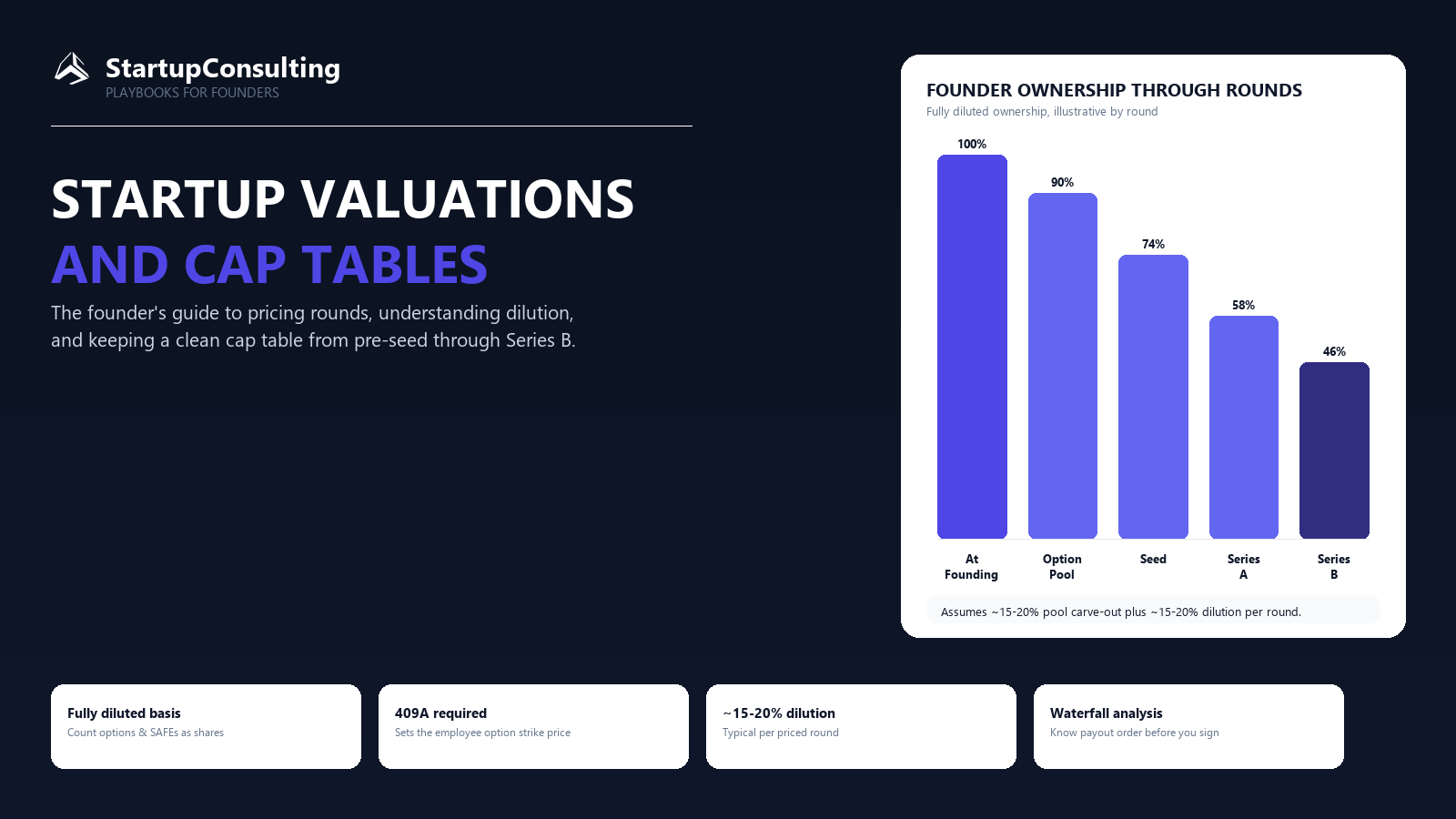
Dilution is not a villain. It is the cost of fuel for the rocket. You care about how many slices you still hold when the pizza becomes enormous. Keep a running model that shows your ownership after each round and after option grants. You will sleep better and negotiate smarter. Focus on percentage after reasonable future rounds, not just the percentage after the next one.
Understanding Cap Tables
A cap table is the map of who owns what. It lists common stock, preferred stock, options, warrants, and any notes or SAFEs that convert. It shows every share class and its rights. A clear cap table reduces friction during diligence, helps you plan hires, and prevents awkward surprises when someone remembers a forgotten grant. For a step-by-step walkthrough of getting every one of these records diligence-ready, see our guide on preparing your startup’s books for a fundraise or exit.
Equity Classes and Instruments
Common stock is what founders and employees usually hold. Preferred stock is what investors buy, often with protective provisions and economic preferences. Options grant the right to purchase shares later, usually vesting over time. SAFEs and convertible notes are promises that become equity at the next priced round, typically with a valuation cap or a discount that rewards early risk. Each instrument arrives with fine print that matters when exits and down rounds enter the chat.
The Option Pool Reality
The option pool funds future hiring. If you run out, you create tension between adding headcount and preserving ownership. Model a pool that covers at least the next eighteen months of hiring, including refresh grants for retention. Expanding the pool increases dilution, so plan it while negotiating price rather than after. If a term sheet says the pool must be topped up pre money, your effective price is lower than it looks.
Separately, an independent 409A valuation sets the strike price for employee options and is not the same number as your funding round valuation. Keep it current after every priced round and every material change in the business, since a stale 409A can create tax headaches for the people you are trying to reward.
Pro Rata Rights and Participation
Some investors ask for the right to maintain their percentage in future rounds. That is pro rata. Others ask to participate above their pro rata share if there is room. These rights can be friendly or frustrating depending on who holds them. Track them carefully so you do not over promise allocations later. Cap table software helps, but discipline helps more.
Modeling a Round
Seed Round Walkthrough
Start with your target pre money valuation and your raise amount. Decide whether the option pool increase happens pre or post. List any notes or SAFEs that will convert, with their caps and discounts. Translate those promises into shares at the new price. The spreadsheet then shows everyone’s final percentage.
Check that your runway, hiring plan, and milestones match the capital raised. If the plan says nine months and your product needs twelve to prove value, the plan needs work, not wishful thinking.
Series a Considerations
At Series A, diligence tightens on cohorts, gross margin structure, and sales efficiency. Investors ask how the model scales without heroics. Your cap table should include a real option pool for the next wave of hiring, not a placeholder bandage. If earlier instruments have unusual terms, clean them up before you sign a term sheet so you are not negotiating while juggling legal fireworks.
Avoiding Pitfalls
Overvaluation Risks
An inflated price can trap you. The next round must either match the hype or risk becoming a down round, which can dampen morale and complicate governance. Reasonable pricing paired with crisp execution beats a high sticker with shaky fundamentals. Aim for a price that makes your next round easier, not harder.
Under Dilution Myths
Founders sometimes chase the myth of raising a large round while giving up almost nothing. That can lead to chronic underinvestment, slow hiring, and missed windows. Ownership is precious, yet momentum is precious too. The goal is not to keep the whole pie. The goal is to grow a pie that feeds everyone and still leaves you full.
Convertible Traps
SAFEs and notes are handy, although they stack up like dishes in a sink. Each one carries a cap or a discount that changes how many shares show up later. If you raise too many small notes with different terms, you create a conversion puzzle at the next round. Simplicity is a feature. Keep terms consistent when you can, and keep a live calculator for how those notes will convert.
Pay attention to whether each instrument is a pre-money or post-money SAFE, since a post-money SAFE fixes the investor’s ownership percentage at conversion and pushes all of the dilution from the pool and other SAFEs onto the founders, which can quietly shrink your stack more than a pre-money structure would.
Tools, Hygiene, and Habits
Documentation Discipline
Keep every grant letter, board consent, and instrument organized. Label files by date and event. Confirm that signatures are complete. When an investor asks for a cap table audit, you will be ready rather than sweaty. Sloppy paperwork quietly increases legal costs and timelines.
Communication and Transparency
Investors do not expect perfection. They expect honesty, speed, and a plan. When something breaks, share the facts and lay out the fix. When something works, explain what you learned so you can do it again. Transparent relationships earn flexibility during tough moments, which is as real as money.
Scenario Planning
Model a few futures. What happens if growth is slower and you raise less at a lower price. What happens if growth is fast and you raise more at a higher price. What if you extend with a small bridge. These scenarios sharpen decisions and calm nerves. Plans feel less scary when you have already seen them on paper.
How to Negotiate Without Burning Bridges
Anchors and Ranges
Anchors frame the conversation. If you give a single number, you paint yourself into a corner. If you offer a thoughtful range and explain the assumptions, you create space for a collaborative landing. Investors respect founders who tie numbers to milestones rather than vibes.
Non Valuation Levers
Price is only one lever. You can negotiate board composition, information rights, liquidation preference structure, option pool size, vesting cliffs, and closing timeline. Sometimes a slightly lower price with founder friendly terms is a better trade than the highest price with handcuffs. The best deal is the one that lets you build at high speed with low drama.
Pay close attention to anti-dilution provisions as well. Full ratchet protection punishes founders far more harshly in a down round than a weighted average formula, and you should also ask whether the new preferred stock sits pari passu with earlier preferred or ahead of it in the stack. Running a simple waterfall analysis, which shows how sale proceeds would actually be distributed across every share class, makes these differences concrete instead of theoretical.
Final Checks Before You Sign
Before pens meet paper, confirm that your model reflects the actual term sheet. Validate that pre and post calculations include the option pool where intended. Reconfirm that every convertible instrument is listed with accurate caps and discounts.
Verify vesting schedules for you and your cofounders, including any acceleration clauses you truly understand. If you promised pro rata to early backers, honor that promise transparently. Then step back, breathe, and ask one last question. Will this round make the next round easier.
Building Toward Long Term Value
Valuation attracts attention, yet value comes from customers who pay gladly and tell their friends. Keep a ruthless focus on product quality, service reliability, and the craft of hiring well. Build a culture where people speak plainly about problems and celebrate wins without spin. The market notices, and so do future investors. Over time, a fair price compounded by excellence produces outcomes that look like luck from the outside and feel like steady work on the inside.
Conclusion
You do not need to love math to master valuations and cap tables. You need a clear model, clean documents, and the courage to ask simple questions until the answers make sense. Set prices that support progress, keep your cap table tidy, and protect the culture that turns capital into value. When the numbers and the narrative agree, fundraising stops feeling like a riddle and starts feeling like a tool.
Put this into practice with AI
This article is for general information only and is not legal, tax, accounting, HR, or investment advice. Consult a qualified professional for your specific situation.
Related reading
 Fundraising
How To Prepare Your Startup’s Books For A Fundraise Or Exit
Prepare your startup’s books for fundraising or exit with clear, trustworthy financials that speed diligence, build confidence, and strengthen negotiations.
Read article Fundraising
How to Build a Startup Financial Model That Investors Will Love
Investor-ready modeling made simple with clear drivers, smart benchmarks, and storytelling that turns your spreadsheet into a confidence-building funding tool.
Read article Fundraising