
Budgeting for Growth: How to Allocate Capital Wisely in Year One
Year one is a rickety bridge between a slide deck and a living company, and your budget is the planks under your feet. Spend too freely and you tumble into the gorge. Pinch every penny and you never reach the far side. The sweet spot lives in disciplined choices that tilt money toward traction without starving essentials. If you want a quick mental model, think of your cash as a team of tiny workers; every dollar should clock in with a job title.
This guide offers practical ways to assign those jobs with the curiosity, candor, and gentle push that startup consulting tries to bring to the table. The tone here is plainspoken on purpose, because money talk gets weird when it hides behind jargon. Expect concrete suggestions, a few laughs, and the occasional nudge to pick courage over comfort. The goal is simple. By the end, you should know how to shape a first-year budget that protects runway, funds learning, and buys you the right kind of momentum.
Set Year One Priorities That Keep You Honest
Your budget should reflect what you want to be true twelve months from now. Do you need a product that strangers use, not just friends who owe you favors. Do you need a revenue line that is more than lunch money. Do you need data that removes wishful thinking. Pick two or three outcomes, then let line items follow.
If a dollar cannot be traced to those outcomes, it is loafing on the job and deserves a performance plan. Clarity turns heated debates into simple checks against mission and stage. It also prevents the slow creep of nice-to-have expenses that nibble away at your options. When every purchase must explain itself to your priorities, meetings get shorter and decisions sting less.
Survival Versus Momentum
Year one invites a tug of war between staying alive and moving quickly. Spend only on survival and you will still be around next year, but with little proof you belong. Spend only on momentum and you will sprint into a brick wall of bills. The trick is sequencing. Buy yourself enough months to learn, and enough movement to learn something worth knowing.
When in doubt, fund customer learning before comfort upgrades, because feedback trims weeks off your roadmap and produces fewer apologetic emails. Think of survival as oxygen and momentum as a compass. You need both. You do not need a leather chair.
The Rule of Sequenced Bets
Big results usually come from a string of modest bets that compound. Set monthly themes that you can actually test. In one month you validate a problem and the minimum features required to solve it. In the next you test messaging that attracts the right people. The following month you pressure test onboarding.
Each bet earns or loses the right to the next check. Your budget becomes a scoreboard that shows which work creates lift and which work only creates colorful dashboards. The scoreboard should be public inside the company. When results are obvious, resource shifts feel like gravity, not politics.
Design a Budget that Survives Contact with Reality
A spreadsheet is a map, not the forest. Your plan should be simple enough to scan and sturdy enough to audit after a long week. Separate money that keeps the lights on from money that makes the lights shine brighter.
You will sleep better when you know which bills can never slip and which experiments can throttle up or down without drama. Treat the plan as a living document that tells you why the month unfolded the way it did. If the plan cannot explain your bank balance, the plan needs work, not the bank.
Fixed Costs That Keep the Lights On
Fixed costs are the stuff that follows you home. Think payroll for core roles, essential software, compliance fees, and the modest office footprint if you truly need one. Err on the side of lean. Pay for data security and legal basics. Pay for the accounting help that stops surprise tax ghosts.
A first-year budget should also flag calendar-driven tax moves, not just recurring bills. Walking through a few ways to trim your tax burden before year-end alongside your Q4 numbers can turn a routine budget review into real cash saved before December 31.
Avoid vanity expenses that exist only to impress a stranger at a coffee shop. The smaller your fixed base, the braver you can be with experiments when a door opens or a customer segment surprises you. A compact fixed cost line is a license to adapt.
Variable Costs that Drive Growth
Variable costs should feel like levers, not luggage. Ad spend can rise when a channel works and fall when it sours. Contractor research can surge during a build and then pause. Usage based infrastructure should match what customers actually do. When you see a cost that does not flex with results, challenge it, then instrument it.
A flexible budget lets you chase green shoots without pledging your future to a single idea or a single tool that promises magic if you just believe. Flexibility, however, is not an excuse to wing it. Tie each variable dollar to a clear test and a time box.
| Budget Principle | What It Means | Why It Matters | Practical Move |
|---|---|---|---|
|
Keep the Plan Simple Make the budget easy to scan and update |
Use a structure the team can understand quickly without digging through dozens of tabs or obscure formulas. | A budget only helps if it can be reviewed during a busy week and still support clear decisions. | Reduce complexity |
|
Separate Essential and Growth Spend Know what keeps the lights on versus what drives momentum |
Split fixed operating costs from experimental or variable growth investments. | This makes it easier to protect core operations while adjusting experiments up or down without panic. | Create two buckets |
|
Auditability Over Elegance The budget should explain reality, not just forecast it |
Build categories and assumptions that can be checked against bank activity and actual monthly spend. | If the plan cannot explain the cash position, the team loses trust in the model and reacts too late. | Match plan to cash |
|
Protect Non-Negotiables Make sure core bills never slip |
Clearly identify payroll, compliance, security, accounting, and other bills that must always be covered. | Startups gain flexibility when they know exactly which obligations are untouchable and which are adjustable. | Flag must-pay items |
|
Throttle Experiments Without Drama Growth spending should flex with results |
Variable spend should be tied to tests, channels, or projects that can be increased, paused, or cut cleanly. | This protects runway when experiments underperform and frees up capital when better opportunities appear. | Time-box each test |
|
Use the Budget as a Monthly Narrative Let the plan tell the story of the month |
Update the budget with actuals and note what changed, what worked, and what created unexpected cost pressure. | A living budget helps the team learn faster and improves future decisions instead of freezing the plan in place. | Review with actuals |
|
Prioritize Decision Usefulness A budget is a tool for choices, not decoration |
Organize spending categories around the real decisions leadership needs to make, such as hiring, product work, and customer acquisition. | A useful budget shortens debates and helps the company respond faster when assumptions break. | Align categories to decisions |
|
Reality-Test the Spreadsheet Treat the model as a map, not the forest |
Expect variances, pressure-test assumptions, and revisit the plan when timing, revenue, or costs shift. | Budgets survive real life when they are built to absorb change instead of pretending uncertainty does not exist. | Reforecast often |
Allocate Capital Across Core Functions with Clear Jobs
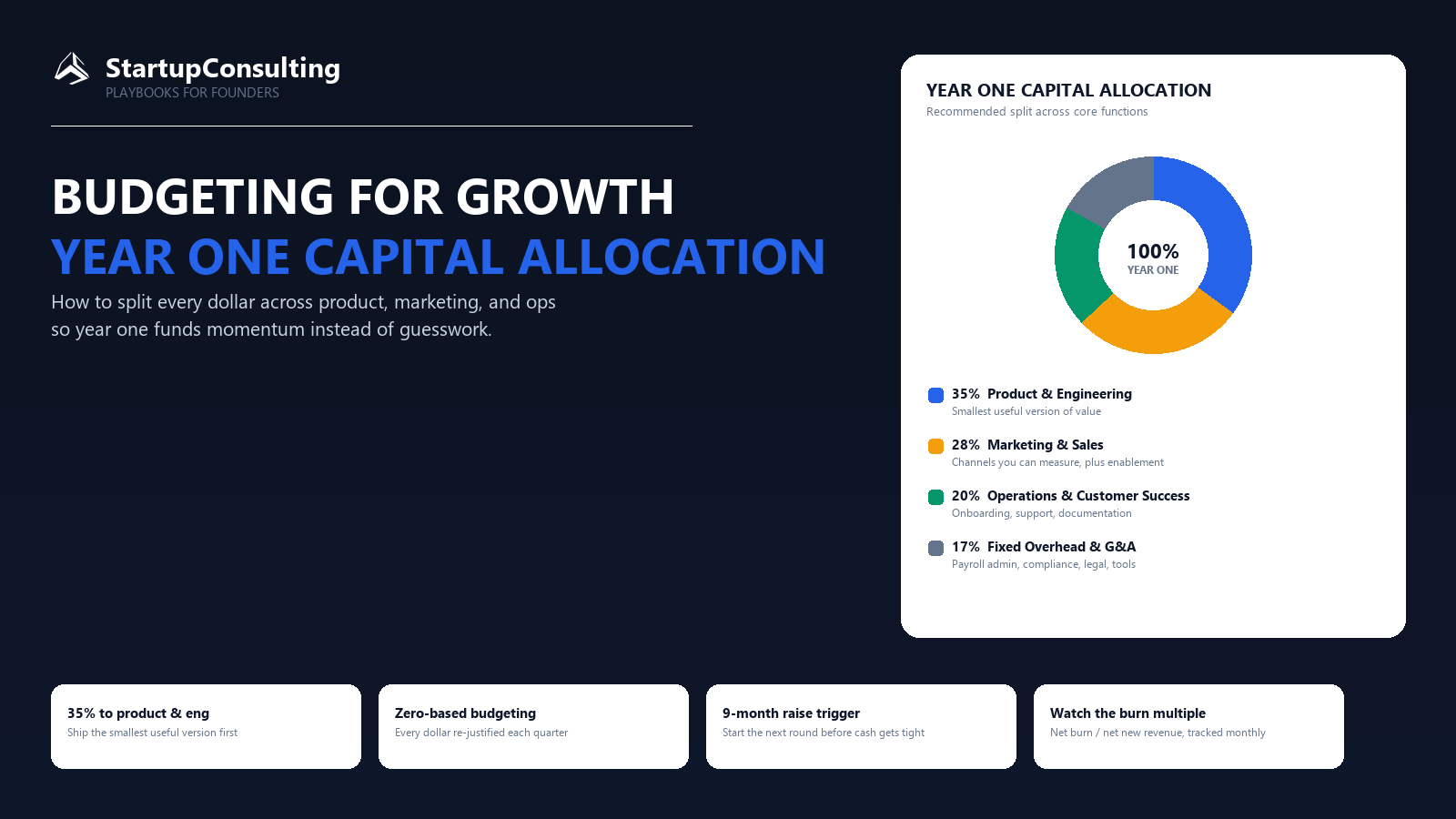
Capital allocation is not a vibe. It is a series of tradeoffs that align with the stage of your product and market. If you are pre launch, you fund discovery, prototyping, and a clean path to a small group of early users. If you are post launch, you fund reliability, retention, and a predictable path to revenue.
Every function gets money because it moves a metric you actually care about this quarter. The phrase to remember is jobs to be done. Your dollars should have job descriptions you can recite without peeking.
A useful discipline here is zero-based budgeting, where every dollar has to justify itself against this quarter’s priorities instead of simply rolling forward last quarter’s line items. It also helps to keep opex and capex mentally separate, even before your accountant formalizes the split, since recurring operating costs behave very differently from one-time capital purchases when you are trying to protect runway.
The split above is a starting point, not a mandate. Pre-launch teams typically tilt further toward product and engineering, while post-launch teams gradually shift dollars toward marketing, sales, and operations as the job to be done moves from building to go-to-market and retention.
Product and Engineering
Early product spend should target the smallest useful version of value. Favor boring, proven tools over clever frameworks that need three plugins just to display a button. Invest in quality where it protects reputation, like uptime, data integrity, and speed. Delay the refactor that nobody asked for.
If you can ship a feature in half the time with a third party service, pay for it and verify that it scales. The goal is to remove friction that blocks adoption, not to win architecture awards from an invisible panel of purists. Reduce heroics by scheduling discipline. Tidy technical debt on a regular cadence so it never grows teeth.
Marketing and Sales
Marketing is not the art of shouting. It is the science of being findable and understandable by people who actually need you. Give money to channels where your buyers already spend time. If you cannot name them, pause the campaign and go talk to customers. Fund a content engine that teaches, not lectures, and pair it with one or two acquisition channels that you can measure.
For sales, put real dollars into enablement like demos that do not crash, pricing that is clear, and a process that turns yes into signatures without drama. Resist the urge to chase every platform. Depth beats breadth when you are buying proof, not fame.
Operations and Customer Success
The unglamorous line items are the ones that rescue your reputation. Budget for onboarding that does not leave new users stranded. Budget for support that responds before a tweet does. Budget for documentation that uses real sentences and current screenshots.
When people can adopt your product without a scavenger hunt, you unlock organic growth that no ad can buy and you reduce the temptation to mask friction with discounts. Reliability is a quiet marketing channel that never sleeps.
Manage Cash Flow and Protect Runway
Investors look at your runway the way pilots look at fuel gauges. You should look even harder. Cash flow is not only about what leaves the account. It is about when it leaves and why. If you can shape the timing of cash, you shape your options when something brilliant or scary happens. Healthy timing buys you the calm required to make better calls. Panic is expensive. Calm is a bargain.
Forecasts You Can Live With
Create a monthly model that you can update in an hour. Include starting cash, expected receipts, fixed costs, variable experiment pools, and a buffer for the thing that always shows up late. Do not build a model that requires a magic growth surge to survive.
Build a model that reveals your breathing room if a plan runs long by three weeks. You will not win points for perfect predictions. You will win time to fix mistakes without panic or late night calls to an investor who is on vacation. Your forecast is a flashlight, not a crystal ball.
Runway and Milestone Math
Translate runway into milestones that change your risk. The first milestone might be a stable product with ten paying customers from outside your friends. The next might be a repeatable channel with a cap on acquisition cost. Tie spend to these stepping stones. When a milestone is hit, graduate the budget.
When it is missed, freeze noncritical experiments until you understand the miss. This rhythm prevents a slow slide into worry and keeps courage intact when the plan takes a hit. Momentum should be earned, not assumed.
Keep an eye on your burn multiple, net burn divided by net new revenue, since a rising ratio is often the earliest sign that spending has outpaced the traction it is meant to buy. If the multiple climbs for two months running, treat it as a cue to have a real runway extension conversation rather than an excuse to spend faster, and make sure a slice of every raise sits untouched as a cash reserve instead of being deployed on day one.
Use Tactics that Stretch Dollars Without Stretching the Truth
Frugality is a virtue when it protects learning and quality. It becomes a vice when it hides problems. The goal is to stretch dollars in ways that increase knowledge and reduce waste, not to substitute unpaid labor for skill or to bury decisions under free trials and wishful thinking. Honest thrift keeps your future self from writing apology emails.
Hire Versus Contract
In the first year, permanent hires should cover the work that never ends. Contract for spikes of specialized work and for projects with clean edges. If your roadmap needs a specialist for two months, do not add a permanent salary.
If your product depends on a craft every week, own it in house. Treat contractors as partners who deliver outcomes, not hours, and give them clear definitions of done. Your budget will thank you for honest scoping and your calendar will thank you for fewer status meetings. Clarity beats haggling.
Notice how the mix shifts across the four quarters. Non-headcount spend, contractors, tooling, and paid experiments, front-loads the early months while you are still discovering what works, and permanent headcount grows only once a role’s workload proves durable. That sequencing keeps fixed costs lean and leaves room in the budget for the quarter when a channel finally clicks and deserves real investment.
Tools, Vendors, and Trials
Tools are fun to buy and dull to cancel. Set a calendar reminder to review every subscription before renewal. Prefer vendors who publish clear pricing and fair exit terms. Use trials to prove value with a test plan, not to postpone a decision. A tiny purchase that unlocks speed is a bargain. A cheap tool that creates confusion is the most expensive thing in the stack. The best stack is the one your team actually uses without grumbling. Keep it that way.
Conclusion
Your first budget is not a monument. It is a living system that funds learning, preserves optionality, and rewards the work that moves the needle. Give dollars clear jobs, aim them at milestones that truly change your risk, and keep the model simple enough to update when the week gets messy. Spend to create proof, not theater. Be brave where it counts and boring where it helps you sleep. Do that, and year two will not feel like a rickety bridge at all. It will feel like a road you paved on purpose.
Put this into practice with AI
This article is for general information only and is not legal, tax, accounting, HR, or investment advice. Consult a qualified professional for your specific situation.
Related reading
 Marketing
The Startup Founder’s Guide to Fractional CMO Services
Fractional CMO services give startups senior marketing strategy without full-time cost. Learn pricing, scope, KPIs, and how to hire and manage one.
Read article Marketing
How to Leverage Thought Leadership to Attract Investors
Build investor trust with thought leadership: share original insights, prove claims with data, publish consistently, and turn visibility into funding talks.
Read article Marketing
SEO for Startups: How to Rank Before You Even Launch
SEO for startups made simple: set up fast tech, publish prelaunch content, earn early backlinks, and launch already ranking before Product Hunt.
Read article