
How to Stay Audit-Proof: Startup Tax Compliance Made Simple
Few things shrink a founder's mood faster than the phrase "tax audit." The mental image is usually a stern agent rifling through shoeboxes of receipts while you watch your runway evaporate one penalty at a time. Happily, that nightmare is optional. With the right habits, your fledgling company can glide through filing season, then sleep soundly knowing an examiner would find nothing but pristine ledgers and gleaming digital breadcrumbs.
In this guide on Startup Consulting, we untangle dense regulations, translate them into friendly habits, and throw in enough wit to keep your eyelids from locking. By the final paragraph, you will own a step-by-step playbook that pushes audits from the realm of terror into the category of mild inconveniences best handled with a fresh cup of coffee. Armed with that confidence, you can get back to shipping code, wooing investors, and debating your company karaoke playlist instead of dreading brown envelopes from the IRS.
Understanding the Audit Monster
The Taxman's Favorite Tripwires
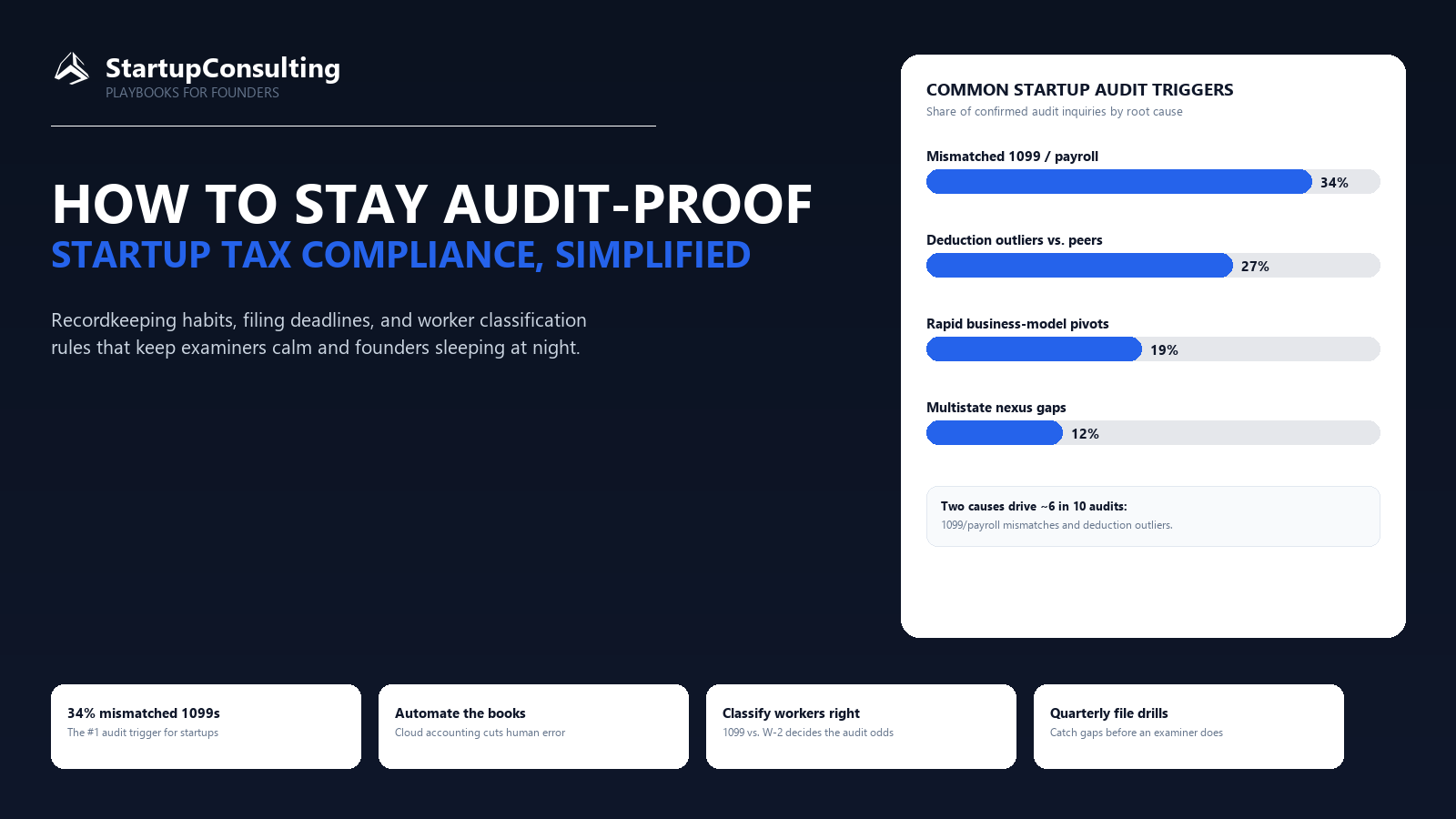
Auditors do not parachute into random offices without signals — most IRS audit triggers follow a handful of predictable patterns. They look for mismatched income reports, payroll filings that play hide-and-seek, and deduction patterns that glow like neon signs. If your 1099 totals disagree with what vendors reported, the automated matching system flags the discrepancy and the audit wheel starts turning.
Staying on top of 1099 compliance and everyday recordkeeping requirements keeps every reported figure consistent across forms, so you will already be less appetizing prey. They also run algorithms scoring industry peers, so if your margins seem magical compared with similar startups, expect a knock. Think of it as spam filtering for taxes—the stranger your data looks, the harder the spam filter grabs you.
Why Startups Get Targeted
Early-stage companies pivot often, hop revenue models, and occasionally forget that every pivot has its own tax treatment. Those rapid changes create paper trails with sharp edges. Combine that with young finance teams learning on the fly, and you have a buffet for curious agents.
Each new product line can introduce fresh nexus, fresh credits, and fresh filing obligations, and the system assumes you know them all. The cure is documenting every business model change and mapping it to specific tax rules before the ink dries, not during a frantic all-hands after the notice arrives.
The Stakes of Ignorance
Fines are only part of the pain. An audit devours leadership time, scares investors, and can freeze a funding round if due diligence uncovers uncertain liabilities. Even rumors of an examination can chill that friendly convertible-note conversation. The same financial statement accuracy that keeps examiners calm is exactly what investors probe at the negotiating table, so founders who treat drafting an investor-ready term sheet and staying audit-proof as the same discipline avoid scrambling twice over the same numbers. Preventing that turmoil is far cheaper than curing it, so treat compliance as an investment in fundraising velocity and founder sanity, not a bureaucratic chore you can shrug off until Series B. That same overlap extends to legal diligence too: the recordkeeping habits that keep an IRS examiner satisfied are exactly what let you sail through startup legal readiness for VC due diligence instead of reconstructing history investors expect to find already organized.
Build a Bulletproof Records System
Choose the Right Accounting Method
Cash accounting feels simple until deferred revenue pops up and turns last month's sales into this year's nightmare. Accrual accounting demands more upfront discipline but mirrors how investors read your books. Pick one method early, document the rationale, and resist the temptation to switch whenever numbers look prettier on the other side.
Switching methods without IRS approval can backfire, leading to messy adjustments and suspicious eyes. Plant your stake in the ground, then automate rules that lock that choice so a well-meaning intern cannot flip a setting in April. Not sure which side of that stake to plant on in the first place? This walkthrough of when it makes sense to switch from cash to accrual accounting covers the thresholds and operational signals worth weighing first.
Automate Your Books Early
Manual spreadsheets may suffice for weekend garage projects, but not for a venture-backed startup handling dozens of subscriptions, ad networks, and international customers. Cloud accounting tools sync bank feeds, flag uncategorized expenses, and spit out ready-to-file forms.
Feed them accurate chart-of-accounts templates, and they become relentless robot assistants who never spill coffee on the keyboard. Automation cuts human error and leaves a clear log for auditors, which means fewer awkward explanations later—and fewer sweat spots on your conference room chair.
Keep Receipts Like a Dragon Hoards Gold
Digital images of every receipt, contract, and invoice should live in organized folders with consistent naming conventions. A good rule: imagine an auditor holding up any expense and asking two questions - what is it, and why is it deductible? Your folder structure should answer both before the agent finishes the sentence.
Store data redundantly in the cloud and an encrypted offsite backup. Receipts fade, servers crash, and laptops sometimes perform gravity tests on themselves, so build resilience before entropy stages a coup.
| Practice | What to Do | Why It Matters |
|---|---|---|
|
Choose the Right Accounting Method
Set the foundation early
|
Select either cash or accrual accounting at the beginning, document the rationale, and keep the method consistent unless a formal change is required and properly approved. | A stable accounting method creates cleaner books, avoids confusing adjustments, and helps founders, investors, and auditors interpret financial results the same way over time. |
|
Automate Your Books Early
Reduce manual errors
|
Use accounting software to sync bank feeds, categorize transactions, maintain a chart of accounts, and generate reports instead of relying on disconnected spreadsheets. | Automation creates a clearer audit trail, lowers the risk of inconsistent entries, and makes it easier to produce accurate records quickly when questions come up. |
|
Keep Receipts Like a Dragon Hoards Gold
Document every expense
|
Store digital copies of receipts, invoices, contracts, and supporting records in organized folders with consistent naming conventions and reliable backup processes. | Good receipt hygiene makes deductions easier to support, speeds up reviews, and ensures that each expense can be tied back to a clear business purpose without guesswork. |
Master the Calendar of Compliance
Federal Deadlines You Cannot Ghost
The IRS is punctual even if your code deployment is not. Mark quarterly estimated tax payments, annual corporate returns, information returns such as 1099-NEC, and payroll deposits on a shared calendar that pings you well before the due date. Payroll tax compliance deserves its own line item too, since the deposit schedule is directly tied to the employment law basics every growing team needs to master, from worker classification through withholding. Late filings attract penalties that grow faster than compound interest on your seed round.
Better yet, assign a single owner for each deadline; nobody invites chaos faster than a team where everyone assumes someone else pressed the submit button. Treat each due date like a product launch: checklist, dry run, confirmation, celebratory snack.
State and Local Dates That Sneak Up
Every state thinks its forms are the most important in the universe. Some want franchise taxes, others crave sales tax reconciliations, and a few demand privilege licenses. Build a cheat sheet of every jurisdiction in which you have nexus, then project manage those dates like product launch milestones.
Remember that nexus is not just physical presence; remote employees, inventory in fulfillment centers, or even affiliate links can trigger it. Keeping an internal tracker avoids the painful discovery that your brand-new Delaware entity still owes fees to Nebraska.
Quarterly Rituals to Keep Your CPA Sane
Once a quarter, reconcile bank accounts, sanity-check your chart of accounts, and close the books even if no external party requires it. These mini closing ceremonies expose problems while they are still small enough to fix, leaving your annual audit-proof status intact.
They also create a rhythm that forces discipline: print financials, explain variances, and document board approvals in line with the governance terms your operating agreement already spells out. When an auditor later asks how you validated revenue, you will have dated memos and clean books and records ready instead of nervous improvisation.
Classify Everything Like a Librarian on Espresso
Worker Versus Contractor: The Eternal Cage Match
Misclassifying a contractor who should be an employee is the tax compliance equivalent of leaving cheese out for a mousetrap - sooner or later the agency snaps. Apply the common law tests: control, financial risk, and permanency.
If you pull the strings on schedules and equipment, issue a W-2 not a 1099, and sleep easier — the same classification call sits at the center of any solid HR compliance checklist. Classifying correctly also protects morale; telling a valued teammate they are a vendor only until payroll stresses ease up is a recipe for slack messages filled with sad emojis.
Deductible Versus Capital Expense
Buying a laptop? Deduct it. Building a custom server farm? Probably capitalize it and depreciate. When in doubt, ask whether the item provides benefit beyond one year. Capitalizing stretches deductions over future periods but avoids raising eyebrows when the depreciation schedule arrives well documented. Create capitalization thresholds, publish them internally, and stick to them so no one sneaks a fancy ergonomic mouse into fixed assets territory.
Revenue Recognition Without Tears
SaaS subscriptions, prepaid services, and bundled contracts all require allocating revenue across performance obligations. Follow ASC 606 guidance step by step and document your judgments. Auditors love clear memos that walk through the five-step model; they dislike hand-waving justifications scribbled after year-end. Build templates for allocation calculations and attach them to each deal so the logic never hides in someone’s brain. These allocation slip-ups are exactly the kind of accounting mistakes that sink startups when they go unchecked for a few quarters.
Credits and Deductions Without Red Flags
R&D Credit Done Right
The research and development credit can slash your tax bill, but only if you map every qualified activity to time sheets, payroll costs, and project documentation. Keep meeting notes that describe technical uncertainty overcome by your engineers. Store source code revisions that prove experimentation rather than cosmetic tweaks. When the IRS asks for substantiation, you want to hand them a tidy packet, not a treasure hunt through GitHub comments written in pirate slang.
Meals and Entertainment Sans Drama
Yes, founders talk strategy over coffee, but not every latte is deductible. Record the business purpose and attendees for each meal as part of routine expense substantiation. Skip the five-course chef’s table unless it directly relates to a revenue-generating opportunity. Moderation tells auditors you are serious, not sloppy. Pro tip: the “ordinary and necessary” standard is easier to meet when your receipt does not list glitter cocktails or inflatable flamingo rentals.
Home Office Tricks That Will Not Backfire
You can deduct a portion of rent or mortgage interest if a room is used exclusively and regularly for business. Take a photograph on January 1 showing the space devoid of gym equipment, drum sets, or toddler toys. That image shuts down skepticism faster than any spreadsheet can. Measure square footage accurately and redo the math if you knock down a wall; auditors carry tape measures - sometimes literally.
Prepare for Audit Before It Happens
Internal File Drill
Once a year, pretend you are the auditor. Pull random transactions, trace them from receipt to bank statement to ledger entry, and ensure every link holds. If you cannot reconstruct the trail in five minutes, strengthen the weak point and update your checklist. Gamify the drill by timing different departments and awarding the fastest one a ridiculous trophy. Competition makes compliance less of a slog.
Communication Etiquette With Examiners
If the dreaded letter arrives, breathe first. Respond within the listed time frame, stick to facts, and never volunteer extra documents beyond the scope. Cordial professionalism shortens audits, while defensive rambling invites deeper probing. Think of your correspondence as a minimalist haiku, not a novel, and save colorful adjectives for product marketing copy.
Remember, auditors are trained to note tone as well as content. A defensive email full of exclamation marks and bold text says more about your readiness than a thousand spreadsheets. Keep replies calm, concise, and spelled correctly, and you will earn invisible brownie points for professionalism.
When to Lawyer Up
Complex issues like transfer pricing, stock option valuation, or international withholding call for specialized counsel. Retain a tax attorney before the first meeting so strategy shapes the narrative from day one, building your tax audit defense before the clock starts rather than after. Legal fees are cheaper than a prolonged dispute. Plus, having counsel present signals respect for the process and convinces auditors you take compliance seriously rather than treating it like surprise homework. If you are unsure whether a question is complex enough to warrant that call, our breakdown of when to hire a startup attorney versus relying on legal templates walks through exactly that judgment call.
Scaling Tax Hygiene as You Grow
Multistate Nexus Basics
Winning customers outside your home state is cause for champagne, but each new zip code can also bring sales tax, franchise fees, or gross receipts taxes. Track where you store inventory, hold events, or employ remote staff, because those activities create nexus faster than recruiters create Slack channels. Implement software that maps ship-to addresses against tax jurisdictions so you know when to register long before the love letter from state revenue arrives.
International Sales and VAT Surprises
Cross-border e-commerce platforms make global expansion feel as easy as toggling a currency selector, yet overseas tax authorities are just as curious as the IRS. Value-added taxes, digital services taxes, and import duties each come with their own acronyms and portal passwords.
Set up a routine to collect the correct documentary evidence for zero-rating exports, and never assume "software" means "exempt." A bit of planning today avoids panicked midnight Googling when a Belgian customs form lands in your inbox.
Choosing the Next-Level ERP System
Spreadsheet wizards eventually hit their ceiling. When your chart of accounts reads like a Dickens novel, migrate to an ERP that integrates inventory, payroll, and tax modules. Pick a system your auditors already know; forcing them to learn a quirky niche tool invites billable hours that feel like a dental procedure.
Document your migration path carefully so journal entries line up across both systems, leaving no dark corners where duplicate revenue could lurk. When implementing, assign a change-management captain, conduct parallel runs for two cycles, and archive screenshots of every reconciliation step so you can prove data integrity without a detective badge.
Conclusion
Tax compliance is not the glamorous part of founder life, yet it is the quiet engine that keeps your company from stalling on the runway. Build systems early, document choices, and treat every receipt like a tiny insurance policy. When the audit monster prowls, you will greet it with an organized grin and a well brewed coffee instead of panic.
That confidence lets you pour your energy into customers, code, and culture, safe in the knowledge that the taxman is merely another stakeholder and not a lurking saboteur. So sharpen your pencils, automate your ledgers, and enjoy the liberating relief of being truly audit-proof.
Put this into practice with AI
This article is for general information only and is not legal, tax, accounting, HR, or investment advice. Consult a qualified professional for your specific situation.
Related reading
 Tax
TaxWhat Every Founder Should Know About Delaware Franchise Tax
Delaware franchise tax explained for founders, including calculation methods, deadlines, and smart ways to avoid costly surprises each year.
Read article Tax
Tax5 Ways to Reduce Your Startup’s Tax Burden Before Year-End
Five practical year-end tax strategies for startups to cut liabilities, improve cash flow, and keep more capital working before December 31.
Read article Tax
TaxHow To Structure Your Startup For Maximum Tax Efficiency
Learn how to structure your startup for maximum tax efficiency, from entity choice to equity planning, so more capital stays focused on growth.
Read article