
When to Hire Full-Time vs. Fractional HR Support for Your Startup
You are juggling product deadlines, investor updates, and coffee that tastes like ambition. HR keeps getting pushed down the list until something urgent pops up. That is exactly when a thoughtful plan saves the day. In this guide, we will map out when a full-time HR hire makes sense and when fractional support is the smarter bridge. We will keep it practical, a little witty, and grounded in what fast-moving teams actually face in startup consulting, covering the full-time HR versus fractional HR decision from cost, timing, and culture angles.
How to Think About HR Capacity
Assess the Stage, Not the Hype
Early teams move quickly, but the real indicator for HR timing is the complexity of people decisions. Headcount size matters, yet the bigger trigger is how often you are making choices about hiring, compensation, performance, and compliance. When those decisions start stacking up weekly, a dedicated capacity plan becomes essential, truly. This is the core of HR capacity planning: matching people operations effort to decision volume, not headcount alone — the same logic that decides whether outsourcing HR entirely makes more sense than any hire at all.
Separate Strategic from Transactional Work
Every startup has a pile of tasks that range from onboarding to coaching managers. Some are repeatable and predictable. Others are thorny, like reorganizing a team after a pivot. If the bulk of your needs are process heavy, a repeatable playbook with fractional coverage will hold up well. If your pain is leadership development, culture repair, or a compensation reset, you may need deeper in-house ownership. These are the moments where a full-time people leader earns their seat, rather than a rotating cast of fractional help.
Signals You May Need Full-Time HR
Growing Headcount and Manager Layers
Once you pass a dozen employees and create a second layer of managers, guidance cannot be ad hoc anymore. Leaders need consistent frameworks for hiring, one-on-ones, and feedback. A full-time HR lead can set the rhythm and provide continuity that templates and occasional help cannot deliver. This is manager enablement in practice: consistent coaching that a fractional HR consultant visiting a few days a month cannot fully replicate.
Sensitive Risk and Compliance Exposure
Equity offers, location-based pay, time off policies, and early employee separations introduce legal risk and emotional weight. A full-time partner who knows your team context can spot patterns and intervene early. This is especially important if you operate in multiple states or countries where rules differ in subtle but costly ways. Left unmanaged, this kind of HR compliance risk compounds quietly until it becomes an expensive surprise.
When Fractional Support is the Smart Play
Flexibility During Volatile Phases
If your next six months include uncertain fundraising, market testing, or a temporary hiring freeze, keep things flexible. Fractional HR gives you senior expertise without locking in headcount. It is a staffing model built for optionality, not permanence. You can scale hours up during a hiring sprint and then pull back without drama.
Outcome-Focused Projects
Sometimes the need is sharply defined, like building a performance review cycle or redesigning benefits. A fractional leader can design, implement, and hand off an operating system that your team can run. This style of engagement suits teams that prefer clear deliverables and predictable costs.
Full-Time HR vs. Fractional HR
| Situation / signal | What it looks like in real life | Why it matters | Best fit | Smart next step |
|---|---|---|---|---|
| Growing headcount + new manager layer | You’ve passed ~12 people, managers are managing, and “how do we do this?” pops up daily. | Consistency becomes a system, not a suggestion. Managers need a steady cadence. | Full-time HR | Establish hiring & feedback frameworks, manager coaching rhythm, and onboarding standards. |
| Sensitive risk + compliance exposure | Multi-state hiring, equity offers, tricky terminations, or policies that can create legal/regret risk. | High-stakes decisions benefit from deep context and fast intervention. | Full-time HR | Own compliance calendar, policy hygiene, and separation playbooks with consistency. |
| HR interrupts are constant and founder-owned | Founders are the default HR inbox; context switching is hurting product focus and morale. | People issues are emotionally charged and time-sensitive; delays compound. | Full-time HR | Move “default HR contact” off founders; build predictable channels and office hours. |
| Volatile next 6 months | Fundraising uncertainty, market testing, hiring freeze risk, or pivot probability is high. | Flexibility beats fixed overhead; scale hours up/down without whiplash. | Fractional HR | Use a senior fractional lead for weekly coverage + a lightweight “HR backlog” plan. |
| Outcome-focused, defined projects | You need a performance cycle, leveling, benefits redesign, or offer templates built and shipped. | Best handled as a deliverable with a handoff—fast and predictable. | Fractional HR | Set scope, milestones, and ownership for maintenance after launch. |
| Hiring sprints (but not constant recruiting) | You need 5–10 hires quickly, then slower periods; recruiting isn’t your year-round core advantage. | Peak-demand help wins; building full-time capacity may be overkill. | Fractional HR | Bring in fractional talent support + a simple pipeline and interview loop. |
| Bridge model: fractional lead + internal coordinator | You need senior judgment, but day-to-day tasks are piling up (docs, onboarding, scheduling, tooling). | Splits strategy from admin so you get leverage without full-time cost. | Fractional HR | Assign an internal ops owner for execution; fractional lead focuses on decisions and systems. |
Cost, Time, and Opportunity Tradeoffs
Total Cost of Ownership
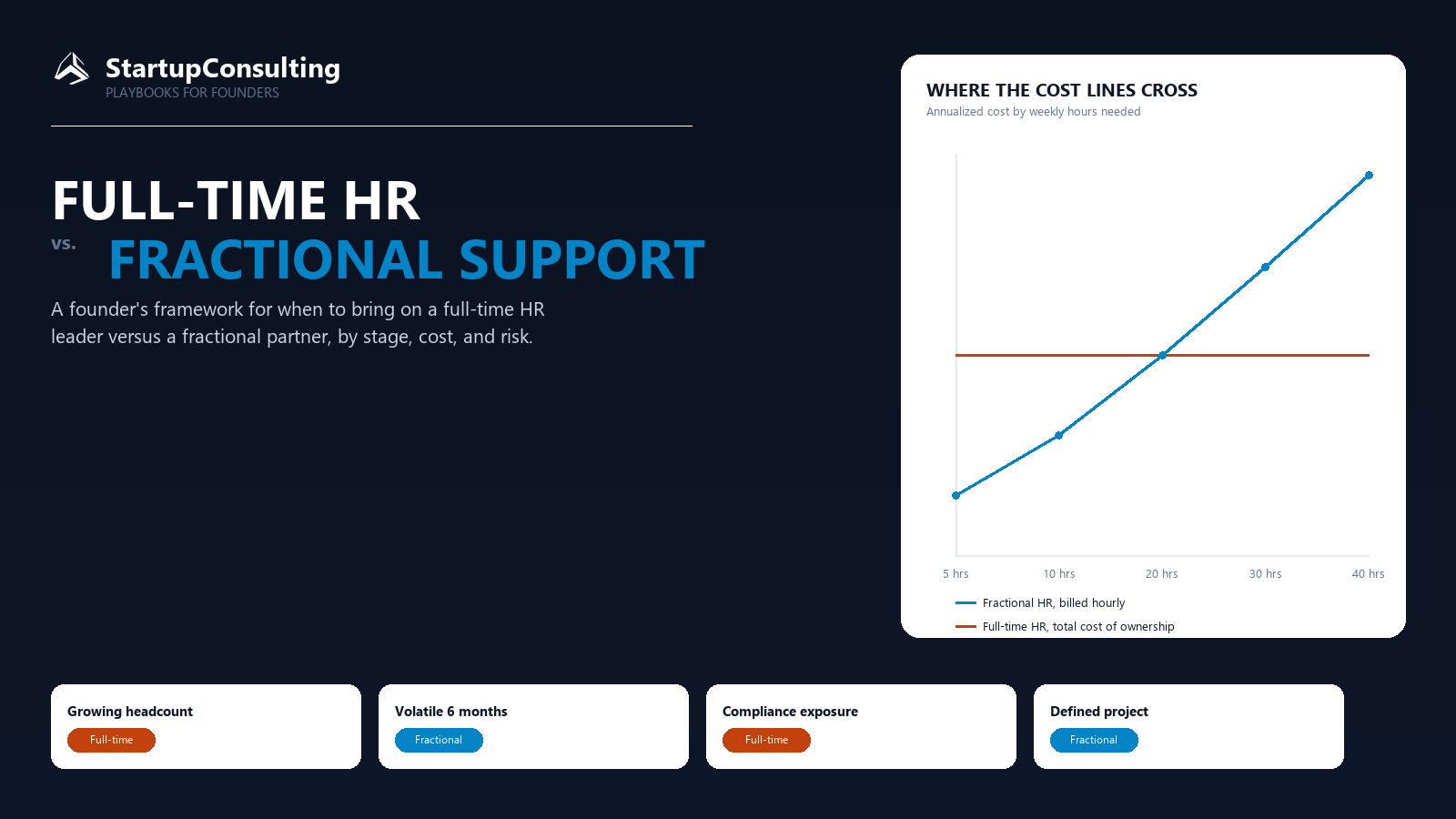
A full-time HR leader costs more than salary. Add benefits, tools, subscriptions, and the time you spend hiring the wrong person. Fractional support looks pricier by the hour but can be cheaper overall if you need only a few high leverage initiatives done right the first time. Run the total cost of ownership math before deciding, not just the sticker price.
Where the Cost Lines Cross
The Speed of Iteration
Fractional leaders often arrive with road-tested templates and can move quickly. Full-time leaders ramp, then go deeper, tailoring systems to your culture. Choose based on the pace of change you need this quarter versus the level of bespoke fit you expect over the next year.
Team Health and Culture Needs
Coaching and Manager Enablement
New managers tend to mimic whatever they have seen before, which may not be ideal. Full-time HR can invest in coaching, shadow key meetings, and nudge habits weekly. Fractional partners can equip managers with toolkits and office hours that keep momentum without requiring permanent oversight.
Recruiting Experience for Critical Roles
If your next ten hires define the company’s trajectory, experienced help matters. Fractional talent partners can fill hard seats fast while building a simple pipeline process. If recruiting is constant and central to your advantage, an in-house leader who owns the brand and candidate experience may be better.
The Product and Go-to-Market Lens
This decision hinges on how you win revenue. At the center of things, remember that customer acquisition shapes hiring pace and skill mix. Long, consultative cycles call for sales enablement, crisp onboarding, and incentive design, while product led growth leans on engineering pipelines, referrals, and simple, fast feedback loops.
Practical Capacity Planning By Milestone
Seed to Early Post-Seed
Keep it lean, aim for senior fractional support a few hours a week, and keep a tight focus on hiring, basic compliance, and onboarding. Document lightly but clearly. Invest in a simple manager cadence and a clean offer template. Do not overbuild processes you will outgrow in a quarter.
Series A to B
Complexity rises fast. You add managers, expand locations, and need consistent leveling and pay bands. This is where many teams convert from fractional to full-time because policy clarity, feedback systems, and career frameworks must be coherent and maintained daily. If budget is tight, a fractional lead with an internal coordinator can bridge well.
Practical Capacity Planning By Milestone
The Geography and Hybrid Question
Distributed Teams and Time Zones
Slack threads can carry a lot of nuance, but people still need human contact. If your team spans time zones, a full-time HR leader ensures no group feels second class. A fractional partner can still work if you schedule regular virtual office hours and publish clear playbooks.
Onsite Rituals and Connection
When people gather, small rituals matter. Welcome breakfasts, new hire intros, and calendar clarity reduce social friction. An internal owner with a feel for your quirks will keep these alive. A fractional pro can design the rituals and train champions who run them locally.
Metrics and Early Warning Signals
What to Watch Weekly
Monitor offer acceptance, time to fill roles, voluntary departures, and manager one-on-one completion. Spikes or dips tell you where to intervene. If these metrics wobble in the same month, an on-site full-time leader can triage faster. If they swing occasionally, fractional oversight is fine.
The Four Numbers Worth Checking Every Week
What to Review Quarterly
Look for pay equity outliers, promotion velocity, and engagement survey themes. Patterns show whether your systems are fair and effective. A fractional expert can synthesize results and recommend fixes. A full-time leader can execute those fixes while shaping the story of change inside the company.
Founder Energy and Focus
Cognitive Load and Context Switching
HR interrupts are unpredictable and emotionally charged. If founders are the default HR contact, context switching will eventually tax product quality and morale. Bringing in full-time help can absorb that load. If interruptions are rare, fractional support preserves founder focus while keeping a safety net in place.
Values, Voice, and Trust
People listen for consistency. A full-time HR leader becomes a recognizable voice, which builds trust. Fractional leaders can still be trusted if they show up reliably, communicate plainly, and publish decisions where everyone can find them.
Making the Call With Clarity
You do not have to guess. Map the next two quarters of hiring, list the most sensitive people challenges you expect, and assign owners. If your list is long and volatile, favor a full-time leader. If your list is sharp and finite, choose fractional. Revisit the call every quarter as reality evolves and the company grows up.
Where You Land on the Decision Map
Conclusion
In short, decide based on the shape of your work, the speed of change, and the level of trust your team needs from a steady people leader. Use fractional help to move fast on clear problems and protect flexibility. Either path is a legitimate HR staffing model when it matches the shape of your work, not just your budget. Shift to full time when complexity, risk, and culture call for a dedicated owner who can live inside your context every day. Either way, clarity beats guesswork, and your future self will thank you for choosing deliberately.
Put this into practice with AI
This article is for general information only and is not legal, tax, accounting, HR, or investment advice. Consult a qualified professional for your specific situation.
Related reading
 HR
HRThe Complete HR Compliance Checklist for New Companies
A complete HR compliance checklist for startups, covering hiring, payroll, policies, and legal essentials to keep your new company compliant.
Read article HR
HROutsourcing HR for Startups: What It Costs and When It Makes Sense
Learn when HR outsourcing makes sense for startups, what it costs, and how the right partner streamlines hiring, compliance, and daily operations.
Read article HR
HRBuilding Your First HR Department: A Step-by-Step Guide for Startups
A practical, founder-friendly guide to building your first HR department, clear steps, smart systems, and culture that scales with your startup.
Read article