
Should You Pay Yourself a Salary or Dividends as a Founder?
Balancing your own paycheck while steering a young company is like trying to refuel the airplane you are piloting without landing. Choose poorly and you run out of fuel mid-flight; choose wisely and you reach cruising altitude with cash to spare.
The classic debate pits salary against dividends, each delivering a mix of tax twists, paperwork acrobatics, and boardroom optics. You could spend hours in paid startup consulting sessions or simply read on for a clear, slightly cheeky roadmap that keeps both the tax collector and your investors smiling.
Understanding Your Compensation Options
The Salary Perspective
Drawing a wage transforms you from heroic founder into ordinary employee, at least in the eyes of payroll software. Regular paychecks create financial predictability, helping with mortgage approvals and late-night snack budgets. Taxes are withheld automatically, which means no nasty surprises in April. From an accounting standpoint, salaries are deductible business expenses that trim corporate taxable income.
The catch is payroll taxes: Social Security, Medicare, and assorted local levies nibble at each payday. Add in the need to file employment returns and you are suddenly juggling extra deadlines. Still, many boards like the discipline a modest wage signals. It says you respect GAAP, care about optics, and are not treating the company bank account like a personal piggy bank.
The Dividend Perspective
Dividends feel like a celebratory slice of pie after a profitable quarter. They bypass payroll taxes and arrive as a single, tidy distribution. In corporations, shareholders report them as investment income, often taxed at favorable long-term rates when qualified. That sounds dreamy until you remember dividends are paid from after-tax profits, meaning the company already faced corporate income tax before cash reaches your pocket.
Pass-through entities avoid double taxation, yet distributions are not deductible to the business, so taxable profit may climb. Timing matters too; taking dividends in a loss year offers zero benefit if there are no distributable earnings. Lastly, skipping salary entirely can trigger regulator suspicion, because the IRS expects founders who actively work to receive “reasonable compensation.”
Navigating The Tax Mechanics
Payroll and Withholding Nuances
When you run payroll, federal and state taxes are withheld automatically. The company shoulders employer payroll taxes while you fund the employee portion. That upfront bite feels painful, yet the withholding system acts like forced savings, sparing you from a giant April tax bill. Salaries also unlock retirement plan contributions, health benefits, and unemployment insurance coverage, perks unavailable to pure dividend recipients.
On the downside, once wages exceed the Social Security cap, the Medicare levy still lingers, eroding the marginal benefit of bigger paychecks. Crafting a Goldilocks salary—not too high, not too low—requires periodic review of market data and company cash flow.
Dividend Taxation Basics
Dividends create no payroll filings and sidestep self-employment tax, immediately boosting take-home pay. For C-corp owners, qualified dividends enjoy preferential federal rates, currently topping out below ordinary income brackets. S-corp or LLC distributions flow through to personal returns and may qualify for the twenty percent Qualified Business Income deduction, but they still attract income tax at your marginal rate.
Recordkeeping remains crucial: the board should formally declare dividends, document the amount, and track each shareholder’s basis to avoid double-counting future gains. Forget that paper trail and you risk tangled books when the auditor comes knocking.
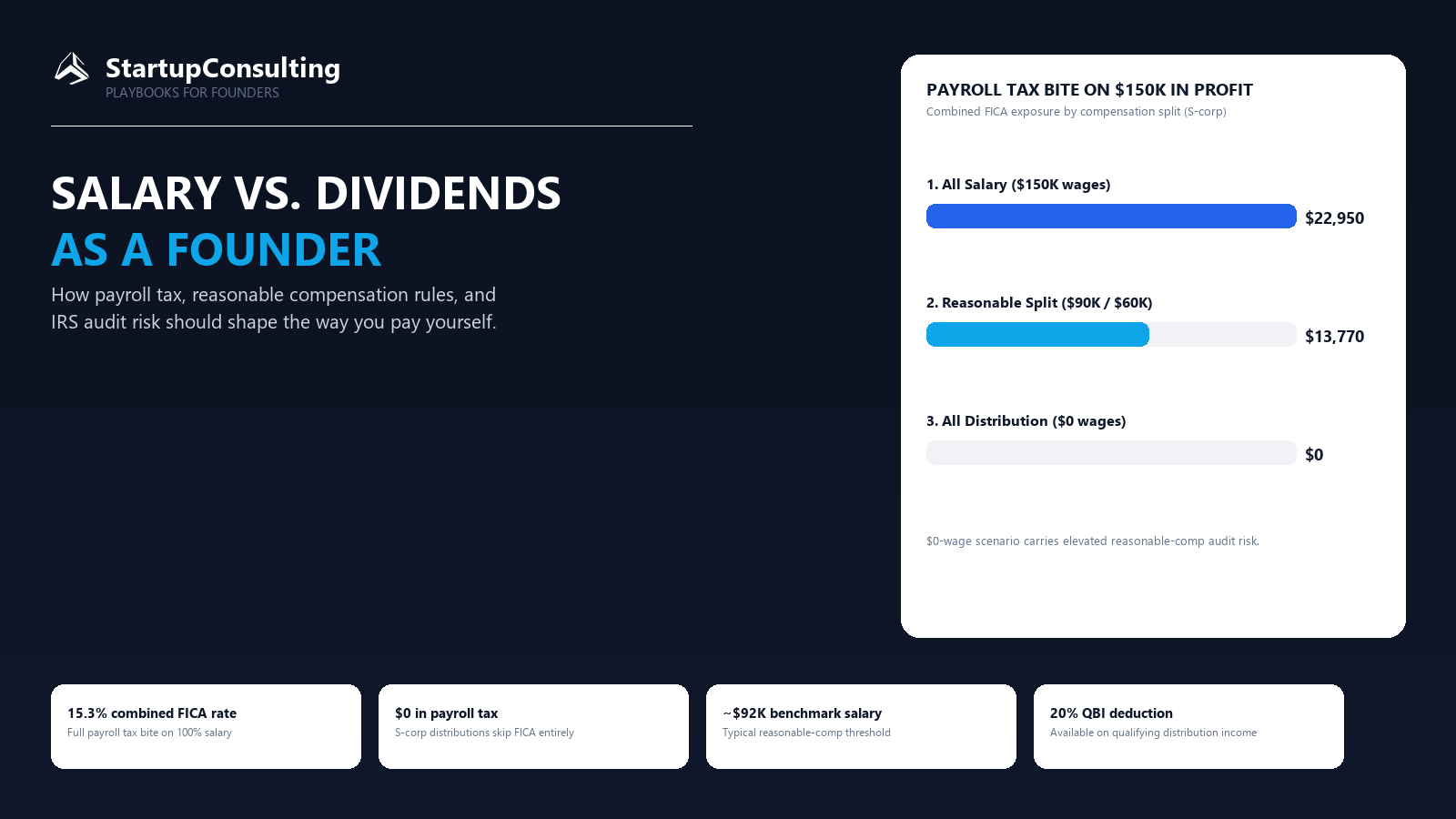
To make this concrete, picture a founder running an S-corp with $150,000 in profit. Whether that money lands as W-2 wages, as an S-corp distribution, or split between the two changes the payroll tax bill dramatically, and it is a big part of why so many advisors push founders toward a deliberate salary-and-distribution mix instead of an all-or-nothing approach.
Staying Compliant While Minimizing Risk
Reasonable Compensation Rules
Regulators assume active founders perform significant duties. If you skip salary entirely yet pull hefty dividends, the IRS may reclassify part of those distributions as wages, layering back payroll taxes plus penalties. The concept of “reasonable” is fuzzy but typically aligns with what an outside professional would earn for similar work.
Industry surveys, job postings, or pay-scale databases provide evidence. Keep a file of these benchmarks and update it annually. When cash is tight, you can defer a portion of salary but still accrue it on the books, signaling intent to pay and satisfying the reasonable standard.
Because “reasonable” is not a fixed dollar figure, it helps to see roughly where examiners tend to draw the line. A salary near zero paired with large distributions looks the most aggressive, while a salary benchmarked against comparable-pay data for similar roles is far easier to defend if questions ever arise.
~$92,000 salary
Common Audit Triggers To Avoid
Large, erratic dividends paired with zero wages raise flags. Another trigger is claiming the owners work full-time but listing minimal officer compensation on corporate tax returns. Failing to issue W-2s while distributing K-1 income without backup schedules can also invite scrutiny.
Mitigation is simple: pay a modest wage, document board approval, file payroll returns on time, and maintain minutes whenever distributions occur. Compliance may feel dull, yet it is cheaper than defending an audit with a lawyer who bills by the six-minute increment.
Weighing Cash Flow and Investor Optics
How Compensation Signals Discipline
Investors read financial statements like tea leaves. A sensible salary communicates frugality and respect for burn rate. Lavish dividends during growth phases can signal misaligned incentives or an exit mindset too early for comfort. Many term sheets cap founder compensation until revenue targets emerge, so align pay structure with milestones. Transparency keeps boards supportive and reduces friction when fundraising again.
Protecting the Cash Runway
Salaries hit cash consistently, shrinking runway month by month. Dividends, however, can be deferred until liquidity events or profitable quarters, preserving working capital when needed most. The flip side: dividends lack the predictability your household budget craves.
New founders often start with a lean salary to cover essentials, sprinkle in occasional distributions when profits materialize, and escalate wages once monthly recurring revenue stabilizes. That hybrid model balances discipline with flexibility.
Personal Finance and Hybrid Strategies
Balancing Stability and Flexibility
Your personal expenses do not vanish because equity might be worth millions someday. A base salary covering rent, groceries, and insurance lowers stress, letting you focus on growth instead of juggling personal credit cards. Dividends then act as bonuses, funding vacations, down payments, or emergency reserves without inflating payroll taxes unnecessarily.
Separate personal and business accounts rigorously, auto-transfer salary on a consistent schedule, and treat dividends as windfalls only when cash reserves exceed a prudent buffer.
Crafting a Founder-Friendly Blueprint
Begin each fiscal year by forecasting company cash flow under conservative revenue assumptions. Set a baseline salary at or slightly below market rates for your role. Review benchmarks semi-annually and adjust as metrics improve. Schedule board meetings near quarter-end to evaluate potential dividends if net income tops targets.
Document decisions, update payroll systems promptly, and revisit health benefits or retirement plan contributions as part of overall compensation. This repeatable framework keeps politics out of pay and aligns incentives nicely.
Conclusion
Choosing between salary and dividends is less a binary choice and more an ongoing calibration. Pay yourself enough wage to satisfy regulators, calm investors, and keep personal stress at bay, then sprinkle in dividends when profits allow.
Document every step, revisit market data each year, and lean on trusted professionals for complex scenarios. By balancing predictability with tax efficiency, you will fuel both company growth and personal wellbeing without tempting the IRS to crash your victory party.
Put this into practice with AI
This article is for general information only and is not legal, tax, accounting, HR, or investment advice. Consult a qualified professional for your specific situation.
Related reading
 Finance
5 Common Accounting Mistakes That Sink Startups
Learn five common accounting mistakes sink startups and how to avoid them with simple routines that protect cash, taxes, runway, and investor trust.
Read article Finance
Burn Rate, Runway, and Cash Flow: Financial Metrics Every Founder Should Track
Burn rate, runway, and cash flow shape every startup’s survival plan. Learn how these metrics guide smarter decisions and keep your company moving with confidence.
Read article Finance
When to Switch from Cash to Accrual Accounting (and Why It Matters)
Learn when and why to switch from cash to accrual accounting, how it transforms your reports, and the key signals that show your business is ready to upgrade.
Read article