
When to Hire a Startup Attorney vs. Use Online Legal Templates
Launching a startup feels like juggling flaming chainsaws on a moving skateboard. Paperwork, cap tables, and intellectual property traps show up faster than new features. Somewhere between your first coffee shop pitch and closing a seed round, you will open a browser tab and confront the timeless question: should you hire a breathing lawyer or download a five-dollar template that promises instant legal bliss? If you already spar daily with a Startup Consulting mentor, you have probably heard the warning: the answer is rarely a simple yes or no.
It is a sliding scale of risk, budget, and ambition. In the pages that follow we weigh professional counsel against do-it-yourself documents, flagging the exact moments when a brief conversation with a specialist pays for itself many times over. For builders who treat legal hygiene as part of product-market fit, the following framework turns anxiety into informed action and keeps courtroom drama off the roadmap. Along the way, expect a few laughs because fear burns fewer calories.
The Early Paper Trail: Foundational Documents
Incorporation Basics
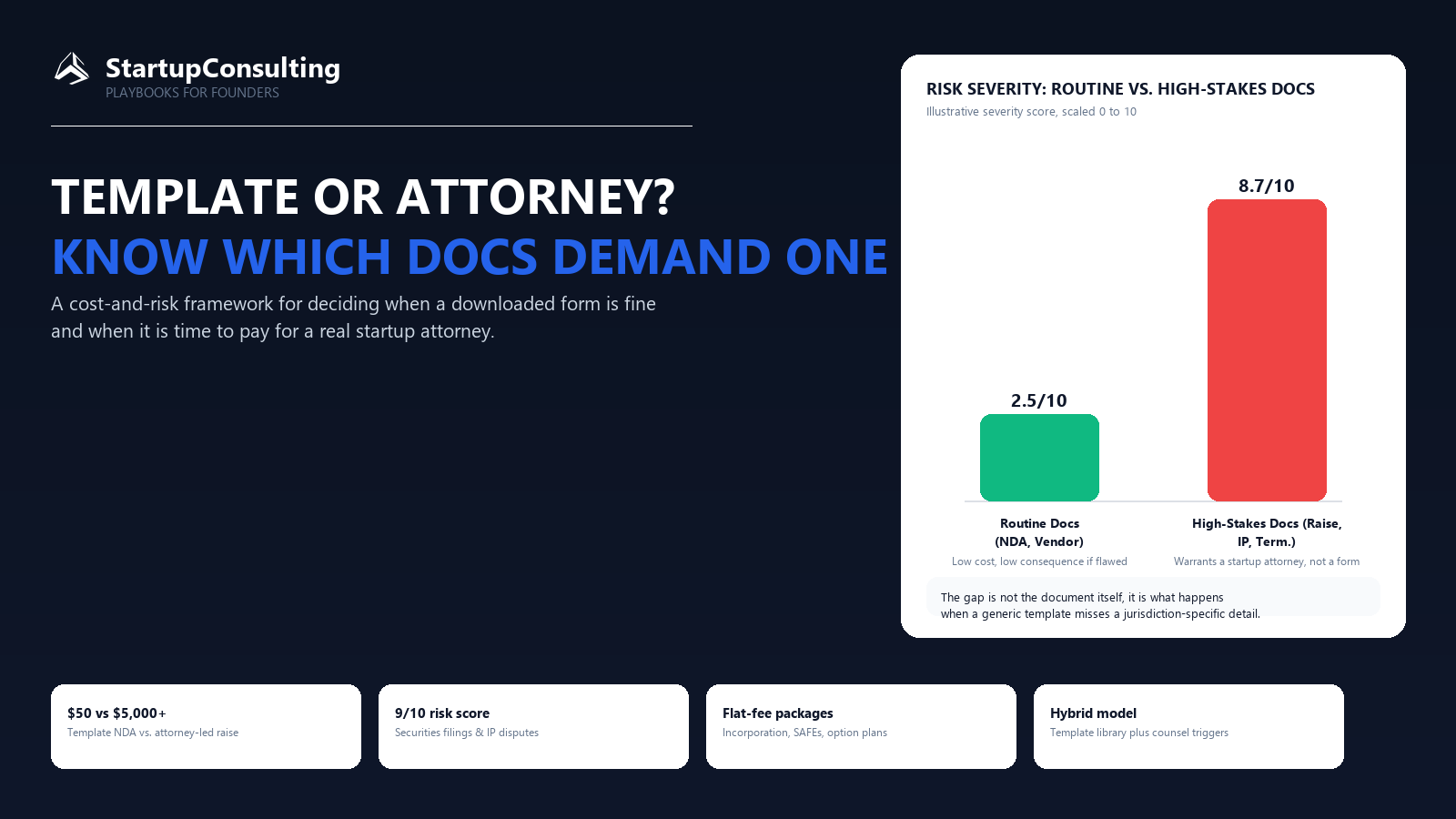
Incorporation is the legal birth certificate of your venture, and it sets the tone for every contract that follows. A template certificate of incorporation might look harmless, yet state-specific quirks can sneak in late fees, naming conflicts, or restrictions that chase away investors. An attorney spots these landmines early and shapes articles so they align with long-term cap-table strategy rather than short-term convenience. He or she will also advise on the difference between a C corporation, an LLC, and that trendy public benefit corporation your co-founder read about on social media. Because state filing requirements are not uniform, an attorney also verifies jurisdiction-specific compliance details, such as franchise-tax elections and registered-agent rules, that a generic template will never flag.
Templates talk in generic terms, but a lawyer translates those terms into your revenue model, tax posture, and hiring roadmap. If your company expects equity financing, those subtleties influence preferred-stock rights before the first term sheet arrives. Treat incorporation as the foundation of a skyscraper: pour it carefully, because cracks cost more than concrete.
Equity Splits and Vesting
Nothing torpedoes a friendship faster than an uneven slice of the equity pie, especially when sweat and caffeine keep the lights on. Online templates hand you a boilerplate founders agreement, yet they do not ask whose code built the prototype or who will still be around in eighteen months. A seasoned attorney interviews the team, maps contributions to ownership percentages, and designs vesting schedules that encourage commitment while protecting the company.
Four-year vesting with a one-year cliff sounds standard, but nuances like double-trigger acceleration or reverse-vesting clauses require tailored language. Ignoring these details can leave a dormant co-founder holding voting power that strangles future funding rounds. Lawyer-drafted documents also weave in repurchase rights that let you reclaim shares if someone ghosts after the launch party. Templates skip that conversation, which means you could be pitching investors with a ghost on the cap table.
Intellectual Property Assignment
Your startup's value often lives inside source code, product designs, and brand names rather than tangible machines. A downloadable IP-assignment template will tell employees to hand over work product, but it may ignore contractors, interns, and that freelance designer you paid through crypto. An attorney makes the language broad enough to capture every future deliverable while specific enough to satisfy investors performing diligence.
They check state laws on work-for-hire, confirm moral-rights waivers for creative works, and add invention-assignment clauses that survive termination. When patents enter the picture, a lawyer also synchronizes assignment records with the USPTO to avoid ownership clouds. Failing to button up IP from day one can delay acquisitions or IPO aspirations because nobody wants to buy a lawsuit. Think of an assignment agreement as a giant intellectual vacuum cleaner that sucks every new idea back into the company.
Getting the assignment paperwork right is only half the job. Founders also need a plan for spotting patentable inventions, registering trademarks, and guarding trade secrets before a careless disclosure or a slow-moving competitor beats them to it. For a step-by-step framework, see this guide on protecting your startup’s intellectual property from day one.
| Document Area | What It Covers | Why It Matters | When to Use an Attorney |
|---|---|---|---|
| Incorporation Documents | Entity type, state formation, articles or certificate of incorporation, and initial governance structure. | The wrong setup can create tax issues, investor friction, or structural problems before fundraising begins. | Use counsel if you expect equity financing, multiple founders, preferred stock, or complex tax considerations. |
| Founders Agreement | Founder roles, ownership splits, decision rights, responsibilities, and dispute handling. | Clear agreements prevent future conflict when workload, priorities, or relationships change. | Use counsel whenever equity, control, or founder departures could affect the cap table. |
| Equity and Vesting Terms | Vesting schedules, cliffs, repurchase rights, acceleration, and treatment of unvested shares. | Proper vesting protects the company if a founder leaves early or stops contributing. | Use counsel for reverse vesting, acceleration rights, investor expectations, or founder equity negotiations. |
| IP Assignment Agreements | Ownership of code, designs, inventions, brand assets, patents, and contractor deliverables. | Investors and acquirers need confidence that the company owns the work that creates its value. | Use counsel when contractors, freelancers, prior inventions, patents, or open-source software are involved. |
| Confidentiality Documents | NDAs, confidentiality duties, trade secret protection, and limits on information sharing. | Protects sensitive product, customer, and business information during early conversations. | Templates may work for simple demos, but use counsel for strategic partnerships, investors, or sensitive IP. |
Template Toolbox: When DIY Makes Sense
Speed Over Complexity
Speed is the currency of early-stage survival, and a template can be downloaded, edited, and sent for signature before pizza arrives. When the document in question is a simple nondisclosure agreement for a one-off demo, the risk profile is low and the upside of velocity is high. Investors rarely negotiate NDAs anyway, so spending billable hours polishing it is like waxing a rental car.
Templates shine for quick wins because they allow founders to preserve cash for engineering sprints and marketing experiments. The key is discipline: track which template you used, store signed copies, and revisit the language once funding allows. Treat these early forms as scaffolding rather than finished architecture so you feel no guilt replacing them later. Speed matters, but never at the expense of forgetting where the legal bodies are buried.
Budget Constraints and Bootstrapping
Cash burn keeps founders awake at night, and legal invoices can feel like setting money on fire in the parking lot. Templates supply a predictable, near-zero-cost option when your runway is measured in ramen dinners. They are especially handy for routine vendor agreements where the risk is capped at a few thousand dollars and the relationship is optional. An attorney may still add value, but you can often renegotiate terms or walk away if things sour, making full-service representation less urgent.
Just remember that bad contracts do not only cost legal fees; they can lock you into auto-renewals or unfair indemnity traps. Set a policy: anything customer-facing or equity-related goes to counsel, while low-impact operational docs can sit in the template drawer. With discipline, you can stretch a tiny budget without leaving future investors shaking their heads.
Standardized Agreements That Rarely Change
Some documents are so standard that even lawyers admit their work is more copy-paste than craftsmanship. Terms of service for a straightforward SaaS, basic privacy policies that follow state or EU checklists, and simple internship agreements often fall in this category. Online generators stay updated with new regulations and spit out compliant language faster than you can locate the coffee filters. If your operations are low risk and your user-data footprint is modest, these tools may cover you for the first version.
Still, you must read every sentence because one wrong data-processing clause can pull you into an overseas jurisdiction you never planned to visit. Think of templates like frozen pizza: perfectly fine on a busy night, but you still need to check the expiration date. Schedule periodic reviews so that as the company evolves, the fine print evolves too. Recognizing template limitations early, before a generic clause causes a real dispute, is part of managing DIY legal risk responsibly; when a document needs legal document customization for your specific business model, that is the cue to loop in counsel rather than force-fitting a stock clause.
Red Flag Moments: Lawyer Required
Fundraising and Securities Compliance
Accepting outside money is like inviting a detective to inspect your dirty laundry with a magnifying glass. Securities regulations punish ignorance, and the wrong filing can result in fines that dwarf the amount raised. Templates cannot tell you whether Rule 506 b or 506 c fits your round, nor will they advise you to file a Form D within fifteen days. An attorney structures the offering, drafts subscription agreements, and ensures investor questionnaires capture accreditation status.
Proper counsel will also coordinate blue-sky filings in each state where investors reside, a tedious ritual that keeps regulators happy. They also issue opinion letters that institutional backers demand before wiring funds. Cutting corners here is penny-wise and lawsuit-foolish; missteps follow founders long after the champagne corks pop. When strangers wire cash, hire a lawyer before you gift the SEC an early holiday present. This is exactly the territory where startup legal readiness for VC due diligence becomes non-negotiable, since institutional investors will comb through every subscription agreement and cap-table document in a way a template alone rarely survives.
Employee Issues and Termination
Firing your first employee feels like ripping off a bandage made of social contracts and dashed hopes. A template termination letter rarely tracks state labor laws, final-paycheck timing, or accrued-vacation rules. A lawyer audits the personnel file, confirms non-compete enforceability, and drafts a release that survives diligence.
They also coach tough conversations so emotions do not spill into Slack and later into discovery. Even routine hiring warrants review when stock options, overtime, or cross-border remote work turn simple offers into regulatory soup. Templates overlook wage-theft penalties that can triple liability once the labor board knocks. Spend a few hundred dollars on counsel today to avoid reading lawsuits at two in the morning.
High-Stake IP Disputes
When a cease-and-desist letter lands in your inbox alleging trademark infringement, the template era officially ends. IP fights move quickly, and filing the wrong response can waive defenses or trigger statutory damages. A specialized attorney dissects claim charts, compares goods classifications, and negotiates coexistence agreements that keep courts out of it. They also know when to fight, when to rebrand, and how to signal confidence without lighting cash on fire.
Templates cannot weigh the marketing cost of changing a logo against the legal risk of continuing. Lawyers handle discovery requests, preserve evidence, and manage privileged communications so internal chats do not become exhibits. They may also secure temporary restraining orders that stop knockoff sellers before your SEO rankings melt. Every minute lost can shift leverage, so hesitation is the most expensive line item you will never see on an invoice.
Crunching the Costs: Budget vs Value
Negotiating Flat Fees
Sticker shock is real, yet many startup-friendly firms now publish menu pricing for common projects. Incorporation packages, option-plan setups, and SAFE-note financings often come in tidy flat-fee bundles. Knowing the final cost upfront removes the fear of one more endless email chain swelling the invoice. Founders can then compare that number to the opportunity cost of handling the task alone.
If the quote is fifteen hundred dollars and your time is worth one hundred per hour, do you want to spend two evenings teaching yourself Delaware bylaws? Flat fees also align incentives; the firm works efficiently because overages hit their margin, not yours. For ongoing needs beyond one-off projects, some founders instead negotiate monthly attorney retainer costs, trading a predictable subscription fee for on-demand contract review and advice. Treat these arrangements as subscriptions to peace of mind, renewed whenever the stakes escalate.
Calculating Return on Legal Spend
Investors obsess over metrics, so approach legal bills with the same analytical zeal. Estimate the probability and cost of contract breach, IP theft, and employment claims over a twelve-month horizon. Multiply probability by cost to find expected loss, then compare that figure with the quoted fee for prevention. If counsel charges three thousand dollars to draft a data-processing addendum and the expected loss of a privacy suit is one hundred thousand dollars, the math writes the check for you.
Founders fluent in this equation communicate confidence to boards because every dollar spent traces back to quantified upside. More importantly, it reframes legal as an investment line, not an expense column. Spreadsheets may be unromantic, but they beat anecdotes when cash is scarce.
Making the Call: A Practical Decision Framework
Risk Matrix for Founders
Picture a whiteboard with two axes: cost and consequence. Low-cost, low-consequence documents live in the template quadrant; high-consequence matters climb straight into lawyer territory. The gray zone occupies most of the board, and founders must grade their own risk tolerance honestly. Ask yourself: if this contract explodes, how many users churn and how much equity dilution follows? If the answer keeps you awake, write the attorney's retainer check the next morning.
Updating this matrix quarterly ensures decisions evolve with the business, not with mood swings. A systematic approach beats gut feel when the stakes are existential. Document the results in a shared drive so co-founders can challenge assumptions and keep each other honest. This transparency also reassures investors who want to see that governance habits grow alongside revenue. Procedures trump bravado when cap tables are fragile. Keep legal debt off your backlog.
Building a Hybrid Approach
The smartest founders do not choose sides; they mix tools like a chef seasoning soup. Templates handle repetitive, low-risk paperwork while attorneys tackle bespoke missions. Create a template library vetted once by counsel, then empower your operations team to use it within clear boundaries. As the company matures, many founders eventually add outside general counsel on retainer, someone who already knows the cap table and can triage new documents fast instead of starting from zero each time. When a document crosses a threshold, such as equity, data privacy, or international expansion, route it through counsel automatically.
Calendars and task-management software help track renewal dates and remind you to refresh forms with changing laws. This hybrid model keeps velocity high without gambling the company. It also builds a legal audit trail that impresses acquirers hunting for red flags. Periodic lunch-and-learn sessions with your lawyer reinforce best practices and surface questions before they escalate. Think of counsel as a strategic partner, not an emergency room; proactive checkups cost less than surgery.
Conclusion
Choosing between a full-service startup attorney and an online template is not a philosophical debate; it is a situational equation. By mapping cost, consequence, and velocity, you can decide which path protects the dream you are building. Templates propel you forward when money is tight and stakes are modest, while lawyers become indispensable partners the instant outsiders’ cash, employees, or intellectual property raise the ceiling of risk.
Keep your legal strategy iterative, document every choice, and upgrade protections as quickly as you upgrade code. The result is a company that scales on solid footing, impresses investors, and lets you sleep at night knowing that your biggest surprises will come from users, not lawsuits.
Put this into practice with AI
This article is for general information only and is not legal, tax, accounting, HR, or investment advice. Consult a qualified professional for your specific situation.
Related reading
 Legal
LegalHow to Ensure Your Startup Is Legally Ready for VC Due Diligence
A practical, witty checklist to get your startup legally ready for VC due diligence, from cap tables and IP to compliance and data rooms investors trust.
Read article Legal
LegalAvoiding Founder Disputes: Legal Best Practices for Early Teams
Learn legal best practices to prevent founder disputes, align roles, equity, and decisions, protect IP, and keep early teams focused and drama free.
Read article Legal
LegalEmployment Law Basics Every Startup Must Understand
Employment law basics every startup must know, from hiring and pay rules to compliance, IP protection, and avoiding costly legal mistakes.
Read article