
When to Switch from Cash to Accrual Accounting (and Why It Matters)
If you have ever tried to wrangle receipts with one hand while refreshing your bank app with the other, you already know accounting is where ambition meets arithmetic. In the early days, it is tempting to keep things simple and tally only the dollars that move right now. That is the cash method, and it feels comforting because it mirrors your bank balance. But as your company grows, simplicity can turn slippery.
Vendors want terms, customers want invoices, investors want clarity, and your decisions need timing and context. If you are browsing articles on startup consulting, consider this your cheat sheet for timing the switch with confidence. We will keep the jargon to a minimum, the practical steps front and center, and a bit of humor nearby to keep the coffee jitters in check. By the end, you will know what to watch, when to move, and why it pays today.
Cash Versus Accrual: The Cleanest Explanation You Will Read Today
The cash method records income when it arrives and expenses when it leaves. It is the accounting equivalent of a pocket notebook. If a customer pays you on Tuesday, you have revenue on Tuesday. If you swipe the company card on Friday, you have an expense on Friday. It keeps your mental math sane on chaotic weeks with uneven payments coming in.
Accrual accounting treats earnings and obligations as real when you deliver or incur them. You recognize revenue when the invoice goes out and costs when the bill arrives, even if cash has not moved. It is a wider lens that tends to produce steadier numbers across weeks and months because it reflects performance rather than bank timing. This approach, often just called the accrual basis, is also the method required under GAAP (Generally Accepted Accounting Principles) whenever a company needs audited, investor-ready financial statements.
The Signals That Say It Is Time to Switch
The clearest signal is when your cash reports stop matching business reality. That happens when you deliver work long before the payment shows up. On paper you look flat in January, then weirdly heroic in March, even though your team has been sprinting the whole time. Accrual smooths that timing and stops the roller coaster.
Another signal is when your customers and vendors insist on terms. If you are issuing invoices with thirty days to pay, or accepting supplies with a bill due next month, you are living in an accrual world whether you record it or not. The books should catch up to your operations.
What Changes When You Switch
Moving to accrual is not mystical, but it does require new habits. You will create accounts receivable for money owed to you and accounts payable for money you owe. You will track deferred revenue when you are paid for work you have not delivered yet, and you will accrue expenses you have incurred but have not been billed for. These accounts explain timing differences and turn your reports from snapshots into a film. This is the matching principle at work, the core accrual-basis rule that revenue and the expenses used to generate it belong in the same reporting period.
Your income statement will show revenue matched with the expenses that earned it. If you sign an annual contract and deliver a portion each month, you will recognize one month of revenue at a time. If you prepay insurance for a year, you will spread the cost across those months instead of taking a single hit on day one.
Your balance sheet will finally carry its weight. Under cash, it might have been a sleepy list of the bank balance plus some equipment. Under accrual, it becomes a dashboard. Receivables show how much customers owe. Payables reveal upcoming cash needs. Deferred revenue signals obligations that will cost time and resources. Accrual brings the balance sheet to life and helps you manage the future rather than the past.
| What changes | Cash method behavior | Accrual method behavior | Why it matters |
|---|---|---|---|
| Accounts Receivable (AR) | Revenue shows up only when the customer pays. | Revenue is recognized when you invoice / deliver; AR tracks what customers still owe you. | You can see whether growth is real or just “paid late.” AR aging also tells you who needs a friendly nudge. |
| Accounts Payable (AP) | Expenses appear only when you pay the bill. | Expenses are recorded when the bill is incurred / received; AP tracks what you owe. | You get early warning on upcoming cash needs instead of being surprised at payment time. |
| Deferred Revenue | If you get paid upfront, it can look like “all revenue now.” | Upfront payments become a liability until you deliver; revenue is recognized over time. | Stops “hero months” from prepayments and makes subscription performance easier to interpret. |
| Accrued Expenses | Costs can “disappear” until an invoice arrives or a card is charged. | You record costs when they happen, even if the bill arrives later. | Your profit reflects the real period of work, not the vendor’s billing calendar. |
| Income Statement quality | Profit can swing wildly based on collection timing and payment timing. | Revenue and expenses are matched to the period they belong to. | You can judge product/customer profitability with fewer timing illusions. |
| Balance Sheet becomes “alive” | Often mostly cash + equipment, with little forward-looking signal. | AR, AP, deferred revenue, and accruals turn it into a planning dashboard. | You can manage collections, vendor timing, and delivery obligations proactively. |
| How you handle “annual” items | Big prepaids can hit all at once (insurance, annual software, etc.). | Prepaids are spread over the months you benefit from them. | Makes margins and operating expense trends easier to compare month to month. |
| Month-end close habits | Close can be “reconcile bank + categorize,” then you’re done. | Close adds light review of open invoices/bills, accruals, and deferred revenue. | You trade a bit more routine for reports you can trust in meetings. |
The Real Benefits You Will Feel
The biggest benefit is better decisions. When revenue is recognized with the work, you can see which products and customers truly perform. You can price smarter, hire with confidence, and plan inventory without guessing.
Another benefit is cleaner forecasting. Cash flow still matters, but now you can project it from earned revenue and committed expenses. Collections and vendor payments become levers, not mysteries.
You also gain operational visibility. Receivables aging shows who needs a friendly nudge. Payables schedules show which bills deserve early payment. Deferred revenue tells you how much work you owe customers before the next renewal conversation.
Common Objections, Answered
People worry that accrual is complicated. It adds steps, but modern software handles most of the mechanics. You still reconcile your bank and send invoices and pay bills. The difference is that your system recognizes timing. Think of it as moving from a bicycle to a motorcycle. It goes faster, but the controls are familiar.
Some say accrual hides cash problems. That only happens if you stop looking at cash. The cure is simple. Maintain both an accrual income statement and a direct cash flow report. The first shows performance, the second shows liquidity.
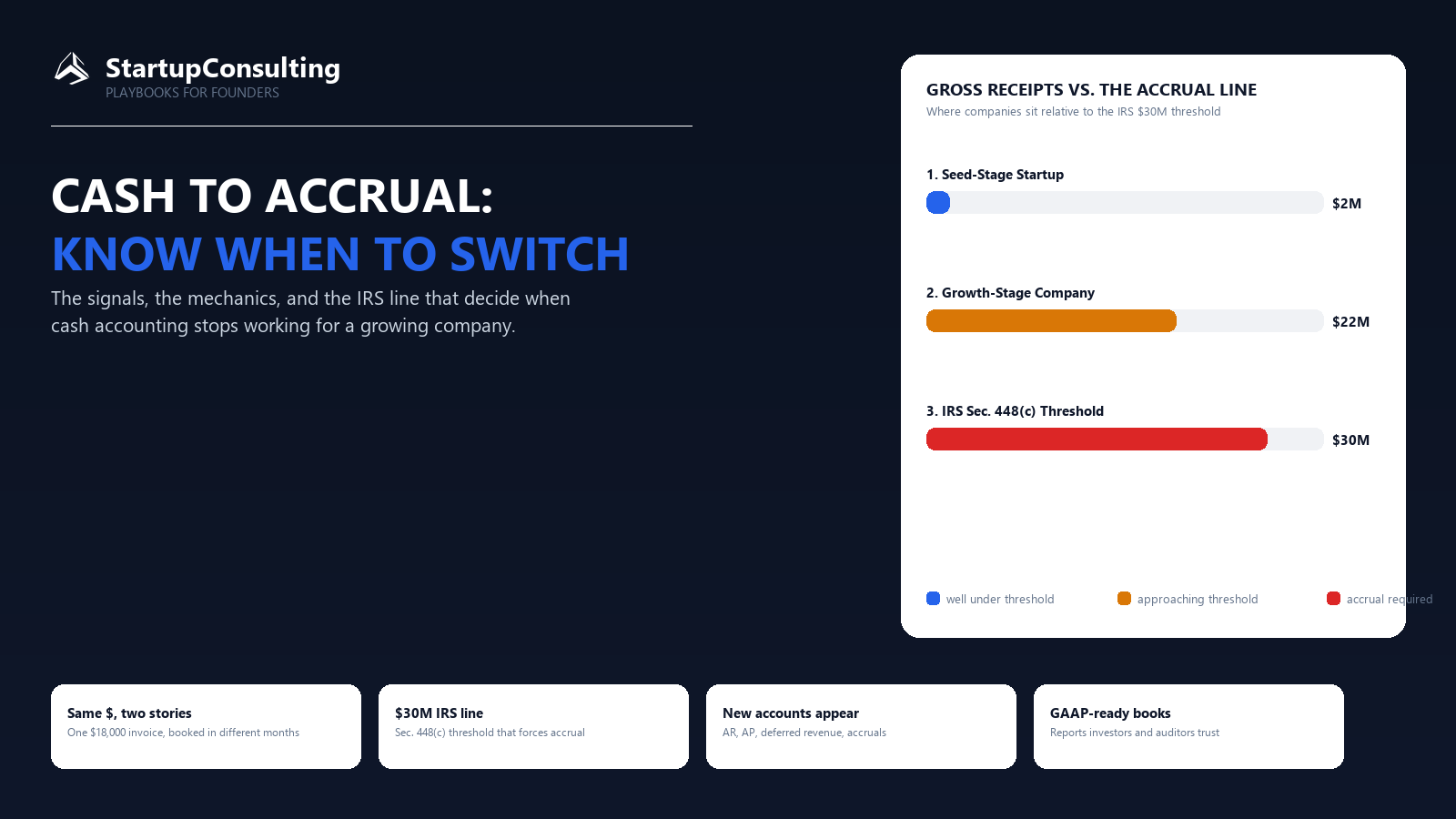
Others ask whether the tax bill will spike. Taxes depend on your jurisdiction and elections. In many places, small businesses can choose their tax method. Some choose cash for taxes and accrual for management. Talk with a qualified tax professional before you switch, because rules vary and there can be thresholds for mandatory accrual. In the United States, the clearest example is the IRS gross receipts threshold under Section 448(c): once a C corporation’s average revenue crosses roughly $30 million, accrual generally stops being optional.
How to Switch Without Losing Your Mind
Pick a transition date. The first day of a new fiscal year is the cleanest choice, but any month end can work. Gather your open invoices and unpaid bills as of that date. Those will become receivables and payables on day one.
Inventory anything you have been paid for but have not delivered yet. That is deferred revenue. Also list expenses you have incurred but have not yet been billed for. Those are accruals. Capture them so your opening balance sheet reflects reality.
Configure your accounting system to handle accrual entries. Most mainstream platforms let you turn on accrual features with a few settings. Create aging schedules for receivables and payables. Establish a simple month end close that reviews open jobs, recognizes revenue, adjusts accruals, and reconciles key accounts.
Finally, communicate the change to your team and stakeholders. Explain that profit timing will change and that you will rely more on the balance sheet. Share a side by side view of cash and accrual for the first couple of months so no one panics when patterns shift. Once the ledger itself is clean, run through our checklist for preparing your books for a fundraise or exit so the rest of your diligence package is just as tight.
The Reports You Will Rely On
Income Statement
The income statement remains the star, but under accrual it becomes trustworthy. Gross margin reflects the true cost to deliver. Operating expenses align with the period you used them. When you ask whether a campaign worked or a product line earns its keep, you get a straight answer.
Balance Sheet
The balance sheet steps forward as a planning tool. Watch receivables growth relative to revenue. If it rises too fast, collections need attention. Watch payables relative to purchases. Stretching suppliers too far can strain relationships. Track deferred revenue relative to capacity.
Cash Flow Statement
The cash flow statement ties performance to bank account. It starts with accrual profit, then adjusts for working capital movements like receivables and payables. Over time, you will anticipate the dips and crests and plan accordingly.
Accrual and Your Sales Cycle
Accrual shines when your sales cycle is longer than a handshake. If you quote, deliver, invoice, and collect over weeks or months, cash accounting makes results look like a carnival ride. Accrual lets you see momentum building and spot slowdowns early.
Payment terms complicate cash but clarify strategy under accrual. Offering thirty or sixty days might help you win deals, yet it also slows cash. With accrual in place, you can weigh the impact of early payment discounts or deposits with clear eyes. You can model how a change in terms affects both revenue recognition and the bank balance.
Inventory, Subscriptions, and Projects
If you hold inventory, accrual is close to nonnegotiable. You must recognize the cost of goods sold when you recognize the sale, or margins will swing. Accrual handles this by tracking inventory as an asset, then moving the cost to the income statement when items ship.
If you sell subscriptions, accrual is your best friend. Annual prepayments feel great in cash, but they can hide churn and delivery costs if you record them all at once. Deferring that revenue and recognizing it monthly keeps performance transparent. That is revenue recognition doing its job: matching what you report to the service you have actually delivered so far, rather than the size of the check that cleared.
If you run long projects, accrual lets you use percentage of completion or milestones to recognize revenue. You match labor and materials to progress, which prevents the end of a big project from distorting your year.
When Staying on Cash Still Makes Sense
There are times when cash accounting is enough. If you run a tiny operation with same day payments and few bills, cash is pragmatic. If you are evaluating an idea with minimal transactions, cash keeps overhead low. Some jurisdictions even require or encourage cash for very small entities. Others land in between on a modified cash basis, a hybrid that accrues just a few accounts, inventory is the classic example, while keeping everything else on plain cash accounting as a stepping stone toward full accrual.
The key is honesty. If your operations have outgrown the cash method, holding on can blur the dashboard. It is fine to start simple. It is not fine to stay simple past the point of clarity.
Conclusion
Switching from cash to accrual is a milestone, not a monument. Choose a clean date, capture the timing differences, and let your systems do the heavy lifting. Keep one eye on performance and the other on cash. If you adopt accrual when the signals appear, your numbers will read like the story you are actually living, and the business decisions that follow will feel less like a roll of the dice and more like the next confident step.
Put this into practice with AI
This article is for general information only and is not legal, tax, accounting, HR, or investment advice. Consult a qualified professional for your specific situation.
Related reading
 Finance
Should You Pay Yourself a Salary or Dividends as a Founder?
Founder pay explained: compare salary vs dividends, tax impacts, compliance rules, and cash flow tradeoffs to choose the smartest compensation mix.
Read article Finance
5 Common Accounting Mistakes That Sink Startups
Learn five common accounting mistakes sink startups and how to avoid them with simple routines that protect cash, taxes, runway, and investor trust.
Read article Finance
Burn Rate, Runway, and Cash Flow: Financial Metrics Every Founder Should Track
Burn rate, runway, and cash flow shape every startup’s survival plan. Learn how these metrics guide smarter decisions and keep your company moving with confidence.
Read article