
SEO for Startups: How to Rank Before You Even Launch
Launching a startup feels like planning a moon landing with pocket change. You need every maneuver to count, and organic search traffic is the gravity slingshot that can fling you farther for free. Whether you are bootstrapping solo or leaning on a tight-knit Startup Consulting squad, planting search seeds before the official reveal can land you on page one the same day you hit Product Hunt.
The roadmap below mixes technical prep, content magic, and human outreach so your fledgling brand arrives with a healthy halo of visibility.
Keep in mind that SEO rarely wins alone. It performs best as one pillar of a broader growth marketing strategy that also leans on paid experiments, partnerships, and community building to keep the pipeline flowing while organic rankings mature.
Lay the Technical Groundwork Early
Secure a Clean, Memorable Domain
Choosing a domain is more than grabbing something that looks available after midnight brainstorming. Search engines favor clarity, and visitors favor spelling they can manage after one espresso. Stick with a short brand term plus a dot-com if possible, avoid tricky hyphens, and register misspellings that could siphon traffic.
While you are at it, set every variant to redirect to the canonical address so bots do not wander into duplicate-content alleys. Future you will thank present you for this tidy foundation.
Pick a Lightning Fast Hosting Plan
Google has a stopwatch, and it hands gold stars to sites that load faster than users can blink. Skip bargain hosting that shares resources with noisy neighbors selling knockoff sunglasses. Choose a provider with solid-state drives, global CDN integration, and automatic SSL so your coming soon page feels snappy from Manila to Milan.
Speed audits, the backbone of any technical SEO audit, should confirm healthy Core Web Vitals, including largest contentful paint below two seconds. If numbers creep upward, resize images, defer non-critical scripts, and toss any plugin that hogs memory like a buffet-loving wrestler.
Map a Scalable Site Architecture
Think of your future site like a city grid you have yet to build, complete with traffic lights and street names. Plan top-level pages around clear search intent clusters so each section earns authority without cannibalizing siblings.
A flat structure keeps crawlers happy, limiting clicks from home to key content to three or fewer. Draft URL slugs that spell out the topic in plain English, and reserve folder paths for upcoming feature launches. Solid architecture now prevents frustrating alleyway remodels later.
Craft Prelaunch Content That Hooks Searchers
Start With Intent Driven Keyword Research
Keyword tools are crystal balls that reveal what your audience whispers to search bars at 3 a.m. Begin with seed phrases that describe your core promise, then dig into questions, comparisons, and problems people tag alongside them. Prioritize long-tail terms with decent volume and friendly competition ratings.
These phrases act as low-hanging fruit that can rank quickly and funnel curious users toward sign-up forms. Keep a spreadsheet of chosen targets so every draft you write serves a specific query instead of shooting generic confetti into the void.
Broad seed phrases pulled from keyword tools that describe the core promise.
Questions, comparisons, and problems people tag alongside each seed term.
Long-tail terms filtered down to genuine search intent with friendly competition.
The final spreadsheet of chosen targets, one per landing page section or blog post.
Build a Lean Yet Rich Landing Page
Your prelaunch landing page is a teaser trailer, not the full movie. It should answer what you are building, why it matters, and how visitors join the waitlist, all within a scroll and a half. Layer primary keyword variants into the headline, meta description, and alt text without stuffing them like a Thanksgiving turkey.
Include a concise value proposition, a benefits list disguised as lively prose, and a single call-to-action button. Less clutter equals clearer focus for bots and humans alike.
Launch a Sneak Peek Blog Series
Blog posts written before launch do two jobs: they seed authority and build a backstage narrative fans love. Outline a three-part series on the problem landscape, current solutions, and your fresh angle, then slot it into a simple content calendar so publishing weekly never depends on last-minute inspiration. Publish weekly to teach search algorithms that new content appears regularly.
Sprinkle secondary keywords naturally in subheads, link back to the landing page, and invite readers to comment with pain points you might solve. Authentic storytelling beats sterile press-release language and keeps bounce rates pleasantly low.
Done well, this sneak-peek series becomes early thought leadership that attracts investors, who are often quietly reading your blog long before they ever open a pitch deck.
Earn Authority Signals Before Day One
Collect Strategic Backlinks Quietly
Backlinks are votes of confidence, but early stage startups cannot buy fancy endorsements. Start by offering thoughtful comments on industry blogs, contributing quotable insights to journalist source boards, and publishing data-backed infographics that bloggers crave.
Each earned link should point to a relevant resource, not just your homepage, and use anchor text that mirrors target keywords organically. Aim for quality over quantity; a single link from a respected niche forum beats a dozen from directories nobody has visited since dial-up days. Every earned link compounds toward the domain authority that will carry your site through future algorithm updates.
Leverage Social Proof and Mentions
Google does not count retweets as backlinks, yet brand mentions across social channels still feed its entity graph. Claim handles early and share bite-sized research findings, founder musings, and product mock-ups that invite conversation. When followers quote or tag you, reply with gratitude and humor.
Those interactions generate unlinked citations that hint at growing buzz, nudging search engines to view your domain as a rising topic entity worth crawling more frequently. Pair this activity with relevant hashtags to surface in discovery feeds without paying for promoted slots.
Guest Post to Borrow Credibility
Pitch guest posts to complementary SaaS blogs, accelerator newsletters, and micro-influencer sites that serve the audience you crave. Offer a fresh perspective, whip up practical takeaways, and include one contextual link to your landing page in the author bio.
Guest posting swaps effort for exposure, placing your voice in front of pre-built communities. Keep a tracker of outreach status, acceptance rates, and traffic lifts so you can double down on partners delivering real results and gracefully thank those who do not.
Measure, Iterate, and Stay Human
Track Core Metrics in Context
Install analytics the moment your placeholder page goes live. Watch impressions, clicks, and sign-up conversions, but also overlay qualitative notes such as marketing pushes and public holidays. Context prevents false panic when traffic dips on a sleepy weekend.
Set modest benchmarks and update them monthly as the brand awareness curve bends upward. Reporting should fit on one slide so the team spends more time improving than formatting. Celebrate even small upticks to keep energy high during the long prelaunch countdown.
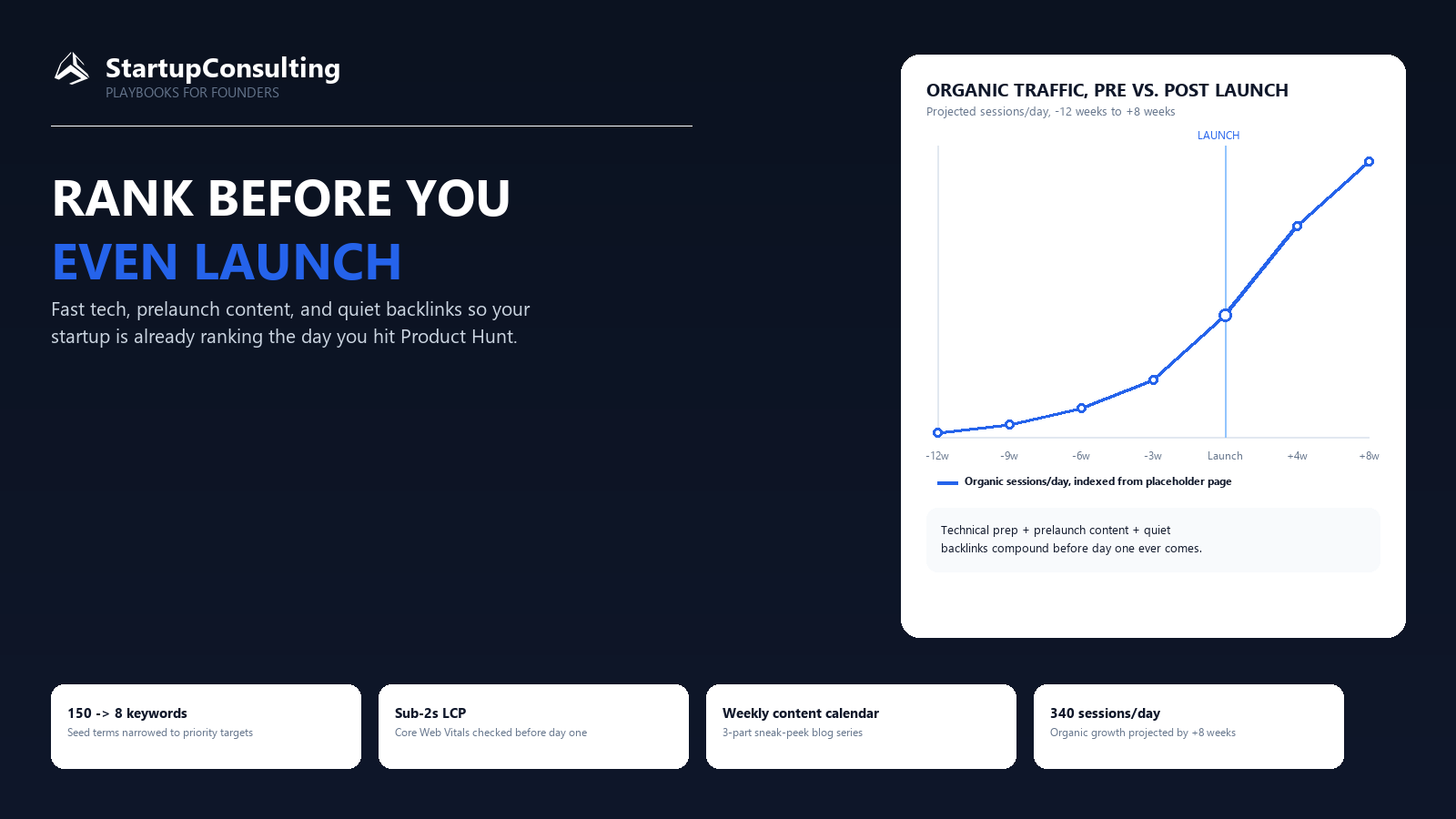
Sessions per day, indexed against a placeholder page launched twelve weeks out. The steepest jump lands on launch day itself, when prelaunch content, backlinks, and a Product Hunt push all land in the same week.
Refine On Page Elements Continuously
Crawlers revisit clever pages, so give them something new every pass. Tweak headline wording, replace generic hero images with smiling beta testers, and adjust internal links to push authority toward posts that perform well.
Each update prompts a fresh index request and offers another chance to improve click through rates. Keep change logs so you can tie ranking jumps to specific edits and stop guessing which tweak worked. Iteration is a polite conversation with algorithms, answered slowly but surely.
Blend SEO With Brand Voice
Stuffing keywords until prose groans is a rookie mistake that turns potential fans into eye-rolling skeptics. Maintain your distinct sense of humor, sprinkle synonyms, and speak like a helpful friend instead of a jargon generator. When in doubt, read the copy aloud; if it sounds like a tongue twister built by a spreadsheet you have gone too far.
Search algorithms now parse context and sentiment, so authenticity helps ranking and rapport in equal measure. Finally, leave room for playful Easter eggs, like a cheeky alt tag or a hidden Thank You page joke, because delighting readers signals confidence and invites shares that algorithms happily notice. Those tiny surprises forge bonds that analytics miss.
Conclusion
Prelaunch SEO is less about secret hacks and more about deliberate habits done early and often. Secure tidy infrastructure, craft intent-driven content, earn authentic signals of trust, and keep refining the experience with data and empathy. Follow this game plan, and your startup will greet launch day already orbiting the search results instead of scrambling for liftoff fuel. Happy ranking!
Put this into practice with AI
This article is for general information only and is not legal, tax, accounting, HR, or investment advice. Consult a qualified professional for your specific situation.
Related reading
 Marketing
The Startup Founder’s Guide to Fractional CMO Services
Fractional CMO services give startups senior marketing strategy without full-time cost. Learn pricing, scope, KPIs, and how to hire and manage one.
Read article Marketing
How to Leverage Thought Leadership to Attract Investors
Build investor trust with thought leadership: share original insights, prove claims with data, publish consistently, and turn visibility into funding talks.
Read article Marketing
Growth Marketing 101: How Startups Scale Without Big Budgets
Scale your startup without big budgets using scrappy growth marketing: smart metrics, rapid experiments, reusable content, partnerships, and automation that pays off.
Read article