
The Startup Founder’s Guide to Fractional CMO Services
Startups sprint, stumble, and sprint again, often without the marketing horsepower a full-time senior marketer can provide. Outsourcing tasks to freelancers keeps the lights on but rarely unifies the brand chorus. That is where fractional chief marketing officer services step in, giving founders an outsourced CMO with executive-level guidance on a timetable the burn rate can support.
In this guide for founders steeped in Startup Consulting wisdom, we unpack everything from cost math to culture fit, served with a wink rather than a bland brochure. By the end, you will know how to recruit, brief, and measure a part-time marketing brain so sharp it can slice through crowded markets without puncturing your runway. Grab your favorite beverage and let us chart the marketing adventure.
Understanding the Fractional CMO Model
What Is a Fractional CMO
A fractional chief marketing officer, sometimes called an interim CMO or part-time marketing executive, is a senior strategist you rent rather than buy. Instead of joining payroll with a corner office and full equity package, they appear a few days each week, pour decades of experience into your road map, and then vanish back into the cloud to help someone else. Think of them as a Swiss Army knife of brand positioning, growth loops, and board-meeting swagger who charges by the slice.
Because they are not fighting office politics or annual reviews, their focus stays glued to outcomes. You pay for momentum, not headcount, which keeps the finance team reasonably calm. The arrangement is flexible, fast, and surprisingly personal — a form of fractional marketing leadership built for founders who need senior judgment before they need a full org chart.
Why Startups Choose Fractional Marketing Leadership
Early-stage companies operate like improv troupes; the script changes nightly. Committing to a full-time CMO before product-market fit feels like buying a tuxedo for a toddler. Fractional engagements square that circle. Founders plug critical skill gaps without surrendering precious equity or locking in six-figure salaries that balloon expenses, which is the core appeal of CMO as a service compared with a full-time executive hire.
Better still, fractional leaders arrive with a toolkit of benchmarks from dozens of other startups, so decisions benefit from pattern recognition rather than late-night guesswork. Their outside perspective also helps burst the echo chamber that forms when engineers and investors talk only to themselves. In short, you gain senior clout minus the payroll migraine and still make payroll without selling cherished hoodies. The same logic drives the debate over full-time versus fractional HR once people operations, not just marketing, start needing senior judgment.
When to Bring One On
Timing is everything. If your daily stand-up includes the phrase “who owns marketing again,” you are probably overdue. Typical trigger points include a funnel leaking like a colander, a product launch planned for next quarter, or a board member glaring at stagnant lead velocity graphs. You might also feel the pinch when sales asks for messaging that does not change every fortnight, or when agency invoices pile higher than MRR.
The sweet spot is after seed funding, when you have cash for strategy but not enough for vanity hiring. Install a fractional marketing executive before growth chaos crystallizes into bad habits impossible to unwind later. Think preventive medicine, not emergency surgery.
Calculating the Real Costs
Fractional CMO Cost vs Full-Time Salary
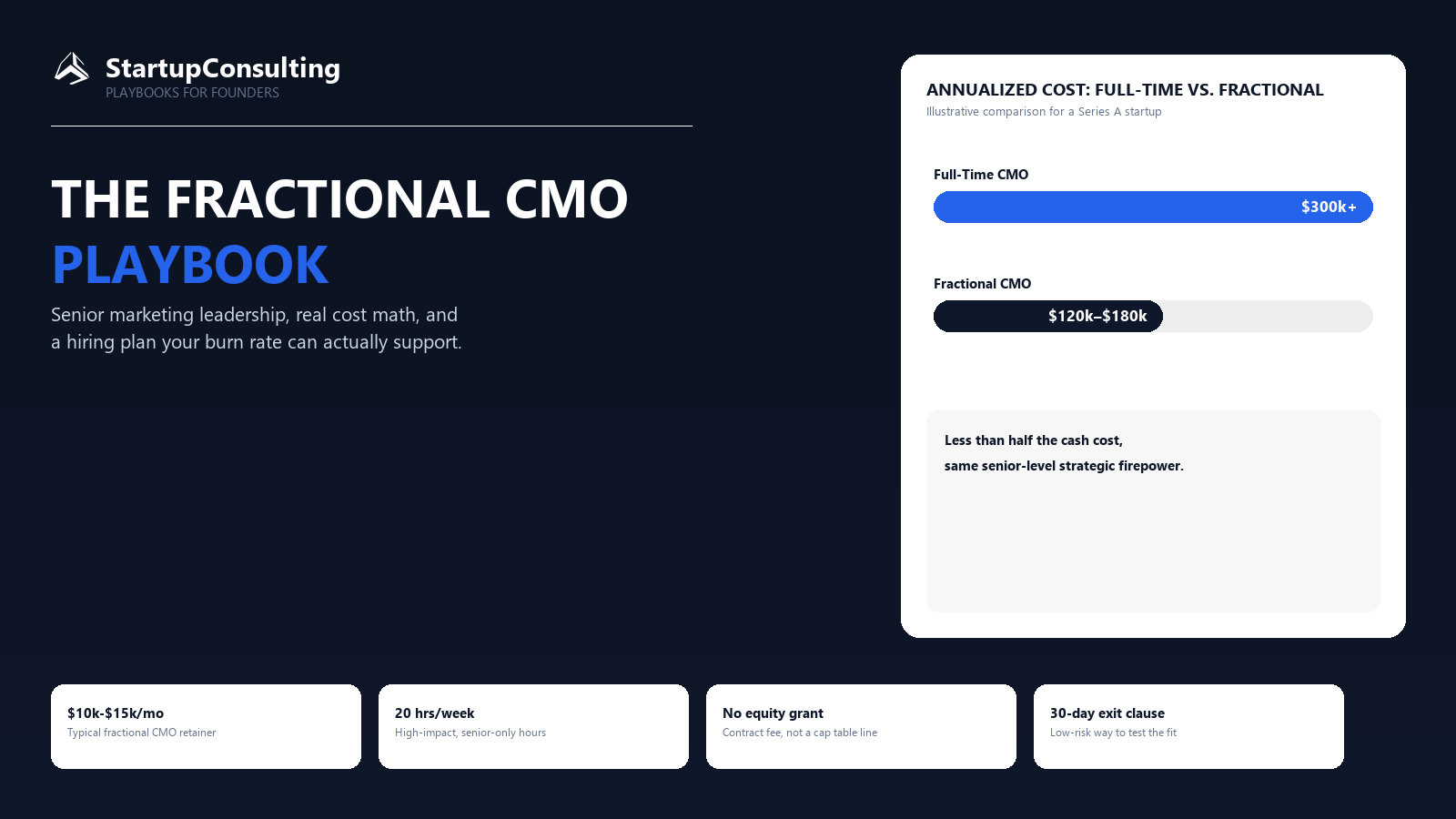
Let us talk numbers, because spreadsheets never lie although founders sometimes do. A senior full-time CMO in a major tech hub can command a total compensation package north of three hundred thousand dollars once benefits and stock options are tallied. Contrast that with a fractional CMO who might bill ten to fifteen thousand a month for twenty hours of high-impact work — a fractional CMO pricing range that repeats across most early-stage engagements.
Even at the top of that range, you are spending less than half the cash while still tapping top-shelf expertise. Factor in recruiting fees, onboarding costs, and the emotional torque of drawing up option grants, and the contract model wins on pure arithmetic by several power-of-ten margins almost effortlessly.
Hidden Savings in Flexibility
Money saved on salary is only the headline. The fine print of flexibility contains quieter wins. Fractional CMOs scale their hours alongside campaign intensity, so you avoid paying peak rates during product slumps. Because they are contractors, you skip health insurance, 401(k) matches, desk space, and the stealth tax of corporate swag.
Travel costs drop too; many fractional leaders work remotely and charge per trip rather than per diem. Finally, let us price the luxury of firing fast. If culture fit fizzles, you end the agreement with minimal severance, shake hands politely, and move on without HR drama. These quiet discounts accumulate quicker than your Slack channels on demo day.
Budget Forecasting Tips
Forecasting for a fractional engagement looks different from locking annual salaries. Begin with your growth schedule: product releases, fundraising rounds, major conferences, and seasonal demand spikes. Allocate heavier CMO hours around those moments, lighter touch during maintenance months. Multiply the estimated hour blocks by the agreed rate, then pad ten percent for unexpected rabbit holes such as brand crises or algorithm updates.
Track spend in the same dashboard that monitors paid-ad outlays, so you can see marketing labor against media cost. If the total creeps above fifteen percent of projected revenue, pause and reassess scope before the finance gremlins riot. Remember, budgets are maps not handcuffs, adjust without guilt later.
Defining Strategic Scope
Brand Positioning Blueprint
Before your fractional CMO drafts catchy taglines, they need a positioning blueprint correct enough to tattoo on a T-shirt. That means agreeing on the target persona, competitive moat, and emotional promise the brand will deliver at every touchpoint. Avoid the trap of endless whiteboard sessions. Provide a concise brief, then let them pressure-test it against market interviews and keyword data.
Expect pushback; seasoned CMOs dislike mushy statements like “we empower synergy.” When they challenge vague claims, celebrate, because sharp edges cut through cluttered feeds. Sign off only when the statement answers why you exist and why anyone should care within fifteen words. Your elevator pitch should fit on a coaster.
Growth Channel Selection
Not every shiny platform deserves your budget. A fractional CMO will map channels based on audience hangouts, purchase intent, and cost per acquisition ratios, not FOMO. They weigh organic search against paid social, partnerships against community flywheels, then sequence experiments so wins compound rather than collide. The plan should name no more than three priority channels for the next quarter, or focus will fracture.
Each channel gets a hypothesis, success metric, and kill switch. When stakeholders demand TikTok just because cousins love it, the CMO points to the plan, saves the team from chasing squirrels, and peace returns to Slack. Discipline converts random tests into a predictable growth data ladder.
Data-Driven Decision Rhythm
Great CMOs keep a metronome for metrics. They establish weekly dashboards that track leading indicators like qualified demo requests, not just lagging revenue. Data reviews happen on the same weekday, at the same hour, to bake accountability into company muscle memory. Vanity metrics get exiled; only numbers connected to strategic goals survive. When trends wobble, the CMO assigns an owner, a hypothesis, and a next action before the Zoom window closes.
This rhythm prevents surprise plateaus and teaches the team to treat analytics as conversation starters instead of courtroom verdicts. It also turns reporting sessions from blame festivals into collaborative troubleshooting, which keeps morale high and attrition comfortably low overall.
| Scope Area | What It Includes | Why It Matters | Founder Action Step |
|---|---|---|---|
| Brand Positioning Blueprint | Defines the target persona, competitive moat, emotional promise, category language, market problem, and the core reason customers should care. | Without clear positioning, every campaign sounds different and the startup wastes budget explaining itself from scratch. | Give the fractional CMO a concise brief, then let them pressure-test it against customer interviews, competitor messaging, and keyword data. |
| Message Sharpness | Turns vague claims into specific language that explains what the company does, who it serves, and why the offer is meaningfully different. | Seasoned CMOs should challenge mushy statements and force sharper language that can survive landing pages, sales calls, and investor updates. | Approve the positioning only when it can explain the company’s value in plain language within a short elevator pitch. |
| Growth Channel Selection | Prioritizes the best channels for the next quarter, such as organic search, paid social, partnerships, outbound, community, lifecycle email, or events. | Startups lose momentum when they chase every shiny platform. A tight channel plan helps experiments compound instead of collide. | Limit the quarter to no more than three priority channels, each with a hypothesis, success metric, budget range, and kill switch. |
| Experiment Sequencing | Organizes campaigns into a logical testing order so learnings from one experiment improve the next instead of creating random activity. | A fractional CMO should convert scattered marketing ideas into a growth data ladder that shows what to test, keep, pause, or scale. | Ask for a 90-day experiment roadmap with owners, timelines, assumptions, and decision points. |
| Data-Driven Decision Rhythm | Establishes dashboards, weekly metric reviews, leading indicators, accountability habits, and a repeatable process for interpreting results. | Regular data reviews prevent surprise plateaus and keep the team focused on metrics tied to real strategy instead of vanity numbers. | Set a fixed weekly review time and require every wobbling metric to leave the meeting with an owner, hypothesis, and next action. |
| Strategic Boundaries | Clarifies whether the fractional CMO owns strategy only, vendor selection, creative review, campaign execution, reporting, team coaching, or board-level updates. | Scope clarity prevents the engagement from drifting into either too much tactical busywork or too little operational accountability. | Put responsibilities in writing before kickoff so the founder, team, and fractional CMO understand exactly where decision rights begin and end. The best scope is narrow enough to create focus, but flexible enough to adjust as the startup learns. |
Setting Up the Engagement
Crafting a Fractional CMO Statement of Work
A vague handshake breeds disappointment faster than a delayed funding round. Create a statement of work that lists deliverables, timelines, and acceptance criteria in plain English. Swap legalese for bullet points your intern can understand. Specify whether the CMO is responsible for vendor selection, copy review, or simply steering strategy. Include response time expectations: for example, feedback on creative within forty-eight hours.
Finally, embed a thirty-day exit clause to soothe nervous board members and signal confidence in your own decision. Clarity up front prevents passive-aggressive Slack threads later. Treat the document like a prenup for marketing; everyone hopes never to invoke it, yet everyone sleeps better knowing it exists tonight.
Communication Cadence
Nothing kills momentum like guessing games about availability. Decide on standing meetings, preferred channels, and emergency contact methods before kickoff. Most fractional CMOs thrive with a weekly strategy call plus a quick midweek check-in. Use project-management tools for task tracking, not for philosophical debates; reserve deep discussions for video calls where tone survives.
Document decisions in a shared workspace so future hires can trace why choices were made. Include a silent-hours policy to protect focus time; even superheroes need sleep. When rhythm is steady, deliverables hit inboxes without frantic chasing. Consistent cadence also stops priority creep, that sneaky phenomenon where every shiny idea claims to be mission critical by Friday.
Goal and KPI Alignment
Before any campaign launches, tie goals to metrics the executive team actually reads. Revenue is obvious, but pipeline quality, churn, and payback period deserve equal spotlight. Your fractional CMO will translate lofty objectives into trackable indicators like demo-to-close ratio or newsletter upgrade percentage. Set baseline numbers, then agree on realistic uplift targets for ninety days.
Resist the temptation to inflate goals just to impress investors; nothing erodes trust faster than graphs heading south of projections. Review progress monthly, celebrate milestones loudly, and recalibrate when market turbulence muddies the original assumptions. Remember, success is a moving dot on the horizon, not a finish line painted once during the seed round ceremony.
Integrating With Existing Teams
Balancing Authority and Culture
A fractional CMO must wield influence without a CEO title on their email signature. Introduce them as a strategic partner, not a temporary babysitter. Clarify decision rights: can they override design choices, or must they lobby product first? Share company values so their guidance aligns with the cultural DNA you cherish.
Encourage them to join casual Slack banter and Friday demo rituals; rapport accelerates adoption of new ideas. When staff see leadership trusting the CMO’s calls, they follow suit, and the transition feels less like an audit and more like a power-up. Respect works both ways, so invite feedback on their style and adjust before small annoyances metastasize into resistance.
Onboarding in Sprints
Treat onboarding like a series of design sprints: tight, focused, and outcome oriented. Week one covers product deep-dive, user personas, and analytics walkthrough. Week two introduces key vendors and existing content calendars. By week three, the CMO should present a ninety-day roadmap; iteration begins immediately. Short cycles prevent analysis paralysis and let everyone gauge fit before critical milestones.
Document each sprint’s output in a shared wiki so future hires can catch up without rerunning the whole orientation circus. Schedule debrief sessions after every sprint to capture lessons learned, celebrate quick wins, and refine priorities. This cadence keeps energy high and signals that learning, not perfection, is the real operational currency.
Product deep-dive, user personas, and a full analytics walkthrough before any campaign work starts.
Introductions to key vendors and a review of existing content calendars and past campaign performance.
The fractional CMO presents a ninety-day roadmap and iteration begins immediately, no long ramp-up required.
Tools and Process Harmonization
Tool sprawl can turn collaboration into archaeology. Let your CMO audit the current stack - CRM, analytics, automation, project boards - and retire redundant gadgets. Standardize naming conventions so campaigns do not vanish in a maze of cryptic tags. Grant admin rights early; nothing stalls momentum like waiting two days for a forgotten password reset.
Align workflows: if engineering uses two-week sprints, marketing should mirror those cycles, not invent thirty-five-day moons. When processes click, dashboards light up with real-time data instead of ghost numbers, and your investors see a company that looks larger than its headcount suggests. As a bonus, fewer tools mean leaner invoices and less context switching, which your burnout meter appreciates.
Measuring Impact and Knowing When to Exit
Early Indicators of Traction
You do not need to wait until the next funding round to judge results. Watch for leading indicators like rising share of voice in niche forums, upticks in organic search impressions, and faster demo scheduling velocity — the early proof points that a fractional marketing strategy is compounding. If those needles move within the first eight weeks, campaigns are likely resonating. Qualitative wins count too: journalists requesting quotes, partners reaching out, or talent applying because they admire the brand story.
Collect these anecdotes, tag them by date, and flash them in board updates; momentum loves an audience. Conversely, if crickets remain the soundtrack, investigate messaging, creative fatigue, or channel misalignment before assuming the fractional model itself is broken while torching precious calories.
Midstream Adjustment Techniques
Even the smartest playbooks need tweaking. Schedule a mid-quarter retro where the CMO walks through what is working, what is wobbling, and what deserves the trash icon. Use a simple stop-start-continue framework to keep emotions neutral and focus on evidence. Swap campaigns that underperform for fresh experiments, but only after diagnosing root causes—not all flops are channel based; sometimes messaging misses mood.
Document each pivot so future hires learn from scars, not just highlight reels. Midstream adjustments showcase agility, reassuring investors that the company iterates on data rather than doubling down on sunk costs. Think of it as a pit stop, not a detour, keeping the growth engine humming smoothly.
Planning a Graceful Handoff
Fractional does not mean forever. As the company exits adolescence, you may decide to hire a permanent CMO. Prepare for that day early. Have your fractional leader build process docs, vendor lists, and a ten-slide strategy deck that any successor can digest over a weekend. Schedule overlap weeks where both leaders attend key meetings; knowledge transfer is a contact sport. Celebrate the transition publicly to signal stability rather than upheaval.
A graceful handoff turns a temporary hire into a long-term ally who might join advisory boards, invest personally, or simply cheer from LinkedIn sidelines. Leaving doors open is the ultimate networking hack, and karma always circles back with opportunities later.
Conclusion
A fractional CMO is more than a contractor; they are a catalyst designed to compress learning curves and stretch budgets without diluting vision. By scoping clearly, communicating often, and measuring what actually moves the meter, founders can tap senior marketing firepower at a price point their treasurer can applaud.
When the time comes to hire in-house, the processes, insights, and momentum forged during the fractional phase will pave a far smoother runway. In the meantime, enjoy the thrill of expert guidance on demand and keep your brand voice ringing in the ears of every prospect, partner, and investor within reach.
Put this into practice with AI
This article is for general information only and is not legal, tax, accounting, HR, or investment advice. Consult a qualified professional for your specific situation.
Related reading
 Marketing
How to Leverage Thought Leadership to Attract Investors
Build investor trust with thought leadership: share original insights, prove claims with data, publish consistently, and turn visibility into funding talks.
Read article Marketing
SEO for Startups: How to Rank Before You Even Launch
SEO for startups made simple: set up fast tech, publish prelaunch content, earn early backlinks, and launch already ranking before Product Hunt.
Read article Marketing
Growth Marketing 101: How Startups Scale Without Big Budgets
Scale your startup without big budgets using scrappy growth marketing: smart metrics, rapid experiments, reusable content, partnerships, and automation that pays off.
Read article